Clinical hours for every ETSU nursing program
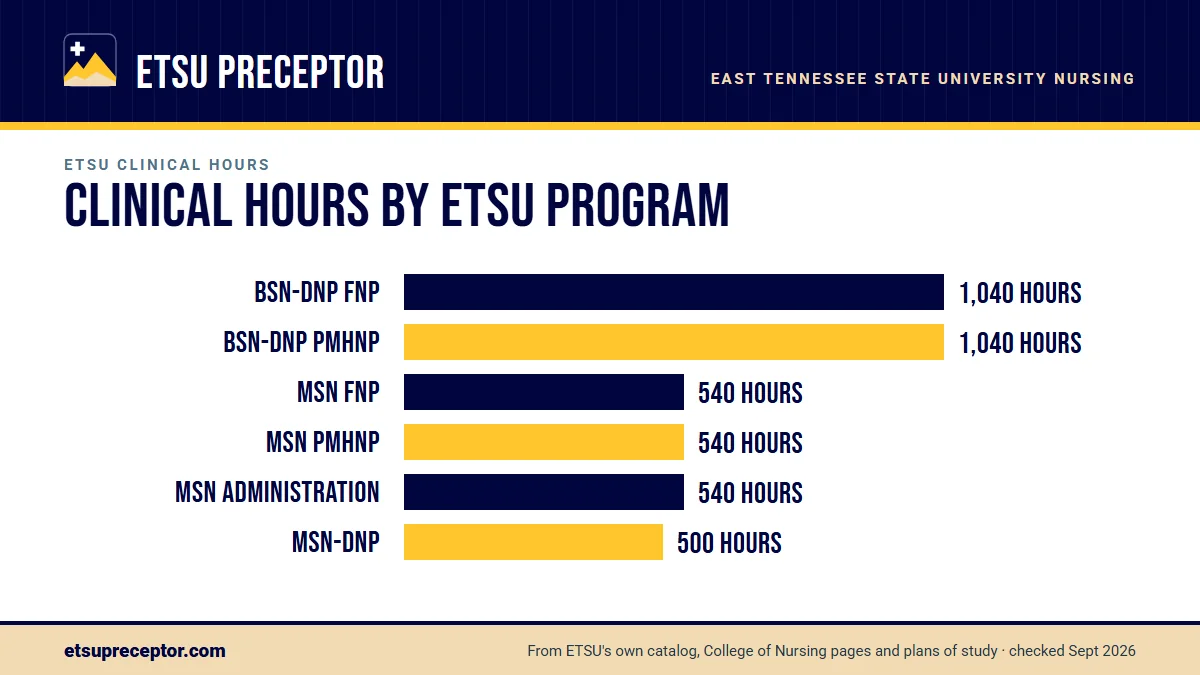
The plans of study at East Tennessee State University (ETSU) put the MSN FNP, PMHNP and Nursing Administration concentrations at 540 clinical hours each, the BSN-to-DNP at 1,040 and the MSN-to-DNP at 500. A few ETSU sources give other totals, so the planner below shows each course path and the sections after it set every figure, and every conflict, side by side.
Plan your ETSU hours with a preceptor
Tell us your program and start term. We match a preceptor who can carry your whole hour total.
Pick your ETSU program
Your practicum courses and hours, who can precept you, where, and when to start looking. From ETSU's own catalog, College of Nursing pages and plans of study.
- Who precepts
- An FNP, adult or family NP, or physician whose patients match each course: young and middle adults, women, older adults, then children and adolescents
- Where
- Primary care in rural, urban and underserved communities, in Tennessee or, with case-by-case approval, the state where you live
- Start looking
- NRSE 5010 runs in your first semester; full-time students start the 120-hour practicums in their first summer
- Who precepts
- A psychiatric mental health NP or psychiatrist who sees patients across the lifespan, for individual, group and family care
- Where
- Outpatient psychiatry, community mental health, integrated primary care and inpatient units
- Start looking
- Full time, the first psychiatric practicum (NRSE 5405) comes in your second semester, a spring
- Who precepts
- A nurse administrator, at a location near you
- Where
- Hospitals and large health care organizations, from unit leadership to the executive suite
- Start looking
- Practicum I (NRSE 5502) comes in your first summer, semester 3, full or part time
- Who precepts
- A clinical expert in your specialty for NRSE 5115, then experienced academic nurse educators for the two education practicums
- Where
- Your clinical specialty (adult, mental health, women's health and perinatal, or pediatric), then a school of nursing or clinical education setting
- Start looking
- NRSE 5115 comes in semester 3, then the two 180-hour practicums in semesters 4 and 5
- Who precepts
- NP or physician preceptors for the specialty practicums, then a practice site and partners for your DNP project residencies
- Where
- Primary care or psychiatric care in your home community when approved, with a focus on rural and underserved care
- Start looking
- Specialty practicums in semesters 1 to 5 full time, then Residency I in the summer of semester 6
- Who precepts
- A practice site that agrees to host your DNP project, and a site-based project team member; a supervising preceptor if you are changing specialty
- Where
- The organization where your DNP project will run, often in your own community
- Start looking
- Residency I (NRSE 6801) in your first summer full time, or your second summer part time
- Who precepts
- A nurse at your own workplace if you work full time in direct patient care; otherwise the College sets up the clinical with you
- Where
- Your current employer, or a Tennessee institution or agency if your state's rules require it
- Start looking
- The R.N. Practicum comes in the final semester of the three-semester track
Every ETSU program's hours, with the date of the plan behind them
The table gives the total each ETSU source states for every program with clinical work, the credits, and the date printed on the plan of study behind the figure. The MSN plans are dated 2023 and the DNP plans 2020, and the 2026-2027 catalog is the official record for your year. Treat each number as ETSU's published plan, then hold it up against the catalog year you entered under and the plan your advisor gave you.
| Program | Credits | Clinical hours | Precepted practicums | Plan dated |
|---|---|---|---|---|
| MSN Family Nurse Practitioner | 51 | 540 | Five: one of 60 hours, four of 120 | 2023 |
| MSN Psychiatric Mental Health NP | 48 | 540 | Five: one of 60 hours, four of 120 | 2023 |
| MSN Nursing Administration | 45 | 540 | Three of 180 hours | 2023 |
| MSN Nursing Education | 42 | 429 stated; courses add to 420 | One of 60 hours, two of 180 | 2023 |
| BSN-to-DNP FNP | 83 | 1,040 | The five FNP practicums, then four 125-hour residencies | 2020 |
| BSN-to-DNP PMHNP | 80 | 1,040 | The five PMHNP practicums, then four residencies | 2020 |
| BSN-to-DNP Executive Leadership | 77 | 1,040 stated; full-time plan adds to 980 | Three administration practicums, then four residencies | 2020 |
| MSN-to-DNP | 32 | 500 | Four 125-hour residencies | 2020 |
| DNP AGPCNP | Not posted | Not posted | Termination pending | None |
| ETSU-TTU joint DNP | 77 to 92; 32 to 35 | Not on ETSU's web pages | Catalog only | None |
| Post-graduate certificates | 24 to 32 | Not on ETSU's web pages | Catalog only | None |
| RN to BSN | Varies | Not published | NRSE 4026, final semester | Current page |
| Accelerated BSN | 75 nursing | Not published | Eight, worth 28 credits | Current page |
| LPN to BSN | 52 nursing | Not published | Three intensives, 13 credits | 2024 |
Credits and hours follow no single ratio across course types; the hours-per-credit guide explains the 60, 120, 180 and 125 patterns and what each means for your weeks.
Where ETSU's own hour figures disagree
Three ETSU totals fail to match either the courses listed under them or another ETSU page. None of them is yours to settle alone: the figure that counts is the one your course faculty and plan of study confirm for your catalog year.
- Nursing Education, 429 or 420. The plan states 429 clinical hours, yet
NRSE 5115(60),NRSE 5046(180) andNRSE 5045(180) come to 420, and the plan never explains the nine-hour gap. The Nursing Education program page covers the concentration. - ETSU DNP, 1,040 or 1,000. The BSN-to-DNP plans reach 1,040 by adding four 125-hour residencies to 540 practicum hours. The graduate catalog lists 1,000, and the College DNP page splits the requirement into project hours and specialty hours, at least 500 of each. The DNP hours page sets the three out in full.
- Executive Leadership, 1,040 or 980. The full-time BSN-to-DNP plan shows
NRSE 5504at 120 hours but still totals 1,040, so its own courses sum to 980. The part-time plan showsNRSE 5504at 180, which does reach 1,040.
One smaller mismatch touches timing rather than totals: NRSE 5009 and NRSE 5010 appear in the 2026-2027 catalog as fall courses, yet the FNP spring-start plans schedule both in spring.
Before you promise a preceptor a number of hours, ask course faculty or the graduate clinical coordinator which ETSU figure applies to you, and ask by @etsu.edu email so the answer stays on record.
Which hours you arrange and which ETSU arranges
Each graduate practicum hour in the table needs a preceptor and a site. For the MSN, the ETSU DNP and the certificates, ETSU's FAQs place that search in the student's hands, backed by the graduate clinical coordinator's contacts and past-preceptor lists; the joint DNP describes a shared effort. Finding your own preceptor quotes each program's wording. Several blocks of hours follow their own rules:
- DNP residencies. Hours in
NRSE 6801toNRSE 6804belong to your DNP project, and a 2020 ETSU project guide requires the practice site's agreement before faculty sign off on a project based there. - Interprofessional hours. Every ETSU DNP concentration builds in an interprofessional experience of 40 hours or more, counted inside the total, in a formal clinic or one you design with faculty and the partner organization.
- Residency I supervision.
NRSE 6801carries 125 hours, and students entering from the BSN, like MSN graduates switching specialty, need 40 of them under a supervising preceptor. - RN to BSN. RNs in full-time direct patient care can take
NRSE 4026where they already work, and the College sets up a clinical for everyone else.
When each plan's first precepted hours arrive
The planner above follows the full-time path. Every FNP and PMHNP plan opens with NRSE 5010, the 60-hour health assessment practicum in semester 1, which pairs lab practice with clinical placements. The table shows the first precepted practicum after it, because part-time students meet that course later.
| Program | Full time | Part time |
|---|---|---|
| MSN FNP | NRSE 5012 and NRSE 5022, first summer | NRSE 5012 in Summer 3 (fall start) or Summer 5 (spring start) |
| MSN PMHNP | NRSE 5405, spring of year one | NRSE 5405, Spring 5 |
| MSN Nursing Administration | NRSE 5502, summer (semester 3) | NRSE 5502, Summer 3 |
| MSN Nursing Education | NRSE 5115, semester 3 | NRSE 5115, summer on the part-time page |
| BSN-to-DNP | MSN-level practicums first; Residency I in Summer 6 | MSN-level practicums first; Residency I in Summer 12 |
| MSN-to-DNP | NRSE 6801, first summer | NRSE 6801, Summer 4 |
Summer carries full clinical loads in these plans, which the summer clinical semester page covers. ETSU sets no published deadline for naming a preceptor, so start well before the term that needs one.
Hours ETSU does not publish, and where to look
Four groups of programs show no clock-hour totals on ETSU's web pages. Their figures live in the catalog program pages or with the College, and here is where each one stands.
- ETSU-TTU joint DNP. No course list or hour count appears outside the catalog, where the Pediatric NP-Primary Care courses show
NRSE 5312andNRSE 5317as precepted pediatric practicums. - Certificates. Coursework is online and clinicals are in person, set up locally or at a distance through the College. Ask for your certificate's plan of study to see its practicums and hours.
- DNP AGPCNP. The plan links on the DNP page lead to no documents, and ETSU lists termination of the concentration as pending. Continuing students should confirm their remaining practicums with their advisor.
- BSN tracks. The Accelerated BSN shows 28 practicum credits and the LPN to BSN 13, with no clock hours. The College assigns these clinicals, so the hours arrive with the placement.
If a catalog page will not open for you either, your Degree Works program of study and the College's Office of Student Services (Nicks Hall 2-230) are the next stops.
How we build a placement around your hour total
Hours decide whether a placement holds. A preceptor who gladly agrees to a few shifts may have no room for a 180-hour administration practicum, and a clinic that sees mostly adults covers only part of a course built around children. Our placement desk starts from your confirmed total and works back to the right preceptor.
- We confirm the figure for your course and catalog year before the first call to a preceptor, including the 429 or 420 and 1,040 or 1,000 questions.
- We match a preceptor whose calendar can carry the whole block inside your term, including summer's shorter complete term.
- We complete the planned-hours and second-preceptor details on the Preceptor Intent Form so faculty see a plan that adds up.
- We stay on call all term and line up a replacement if a preceptor drops, so your hours keep moving.
Share your program and start term through our contact page or the form below, and your placement advisor will map your hours to a preceptor in your own community.
Questions ETSU students ask
How many clinical hours does ETSU's MSN FNP require?
ETSU's 2023 FNP plans of study list 540: 60 in the NRSE 5010 health assessment practicum and 120 in each of NRSE 5012, NRSE 5022, NRSE 5014 and NRSE 5024. Check the figure against your catalog year; the FNP hours page breaks it down course by course and term by term.
Do my MSN practicum hours count toward the ETSU DNP total?
In the BSN-to-DNP plans, yes: the 1,040 total is the 540 MSN-level practicum hours plus four 125-hour residencies. The MSN-to-DNP plans list only the 500 residency hours, and ETSU's pages do not say how many earlier MSN hours you must document. Ask the graduate clinical coordinator how your prior hours will be verified.
How many clinical hours is the ETSU-TTU joint DNP?
ETSU's web pages give no hour total for any of the six joint DNP concentrations; the numbers sit in the catalog program pages. Full-time BSN entry runs nine semesters in most concentrations and twelve in Pediatric NP-Primary Care, so ask your advisor for the plan that matches yours.
Why does my plan of study show different hours from a classmate's?
Plans shift with catalog year and with full-time or part-time study. ETSU's posted plans date from 2020 to 2023, and the Executive Leadership full-time and part-time plans even list NRSE 5504 at different hours. Check your own catalog year and the program of study filed in Degree Works, then confirm the total with your advisor.
Related pages
Last checked 2026-09-25
We check these pages against ETSU's own catalog, College of Nursing pages, plans of study and ProjectConcert guides. Your plan of study, your syllabus, your course faculty and the graduate clinical coordinator have the final word.
- ETSU College of Nursing: MSN FNP plan of study (full time, fall start)
- ETSU College of Nursing: MSN Nursing Education plan of study
- ETSU College of Nursing: BSN-DNP Executive Leadership full-time plan
- ETSU College of Nursing: Doctor of Nursing Practice
- ETSU 2026-2027 Graduate Catalog: Doctor of Nursing Practice
ETSU asks you to lead the preceptor search. We make it the fastest part of your program.
Tell us your ETSU concentration, where you live and which semester your next practicum starts. We find preceptors who fit the course's patient population and prepare everything your Preceptor Intent Form and ProjectConcert entry need.
- Preceptors matched to the course: young and middle adults for
NRSE 5012, older adults forNRSE 5014, women forNRSE 5022, children forNRSE 5024, psychiatric care forNRSE 5405 - Credentials, license numbers, certification dates and the site's patient mix ready for faculty approval
- In your own community, in Northeast Tennessee or wherever ETSU approves your clinicals
Start your placement plan
Program, city and semester is all we need to begin.