The ETSU-TTU joint DNP: six concentrations, two schools, one clinical search
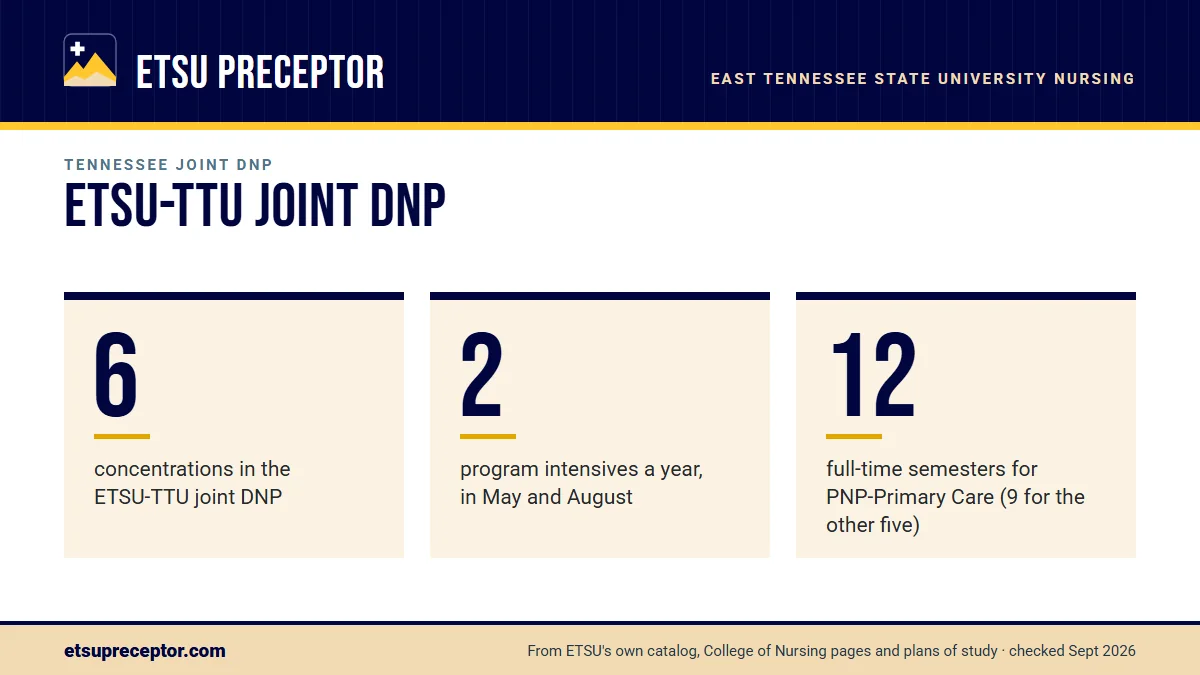
East Tennessee State University (ETSU) runs a joint Doctor of Nursing Practice with the Whitson-Hester School of Nursing at Tennessee Tech University. It offers six concentrations, three of which ETSU teaches nowhere else, and meets twice a year for intensives. The joint program describes clinical placement as a shared effort between you and the two schools, but it has not published its clinical hours or course lists on the web.
Plan your joint DNP clinicals
Tell us your concentration, your home school and where you live.
Two universities, one DNP
The Tennessee Joint DNP pairs ETSU's College of Nursing with Tennessee Tech's Whitson-Hester School of Nursing. You apply through the graduate college of either university, and the catalog then calls the university you entered through your home school. ETSU's catalog lists an ETSU-TTU DNP Program Director among the College's roles, the natural first contact for program questions.
Admission to the BSN-to-DNP route calls for a BSN and an unencumbered RN license, with the remaining criteria in the catalog, and no GRE. BSN-entry students start in fall. An MSN-to-DNP route exists as well, listed at 32 to 35 credits.
Keep the joint program separate in your mind from the ETSU DNP. The two share some concentration names, but they differ in intensives, in how they word placement help, in ETSU's consumer-information state disclosures and in how much of their curriculum is posted online.
Six concentrations and the patients each one serves
Each NP concentration leads to its own national certification exam, and each describes a different patient population. That population is what your preceptors' practices have to match.
| Concentration | Population ETSU describes | Certification | Offered in ETSU's own programs? |
|---|---|---|---|
| Adult-Gerontology Acute Care NP | Adolescents to older adults in hospitals and clinics | AGACNP | No |
| Family NP | Patients across the lifespan | FNP | Yes, MSN and ETSU DNP |
| Pediatric NP-Primary Care | Children of all ages | PNP-Primary Care | No |
| Psychiatric/Mental Health NP | Patients across the lifespan | PMHNP | Yes, MSN and ETSU DNP |
| Women's Health Care NP | Women in varied settings | WHNP | No |
| Nursing and Healthcare Leadership | Leadership, not an NP track | None named on the joint DNP page | Yes, ETSU DNP |
The acute care concentration is the one most unlike ETSU's other tracks, since ETSU places it in hospitals as well as clinics. For the pediatric concentration, the catalog names precepted practicums, and our joint DNP pediatric practicums page covers them.
Length, credits and the twice-yearly intensives
BSN-entry credits run from 77 to 92 depending on concentration. Full-time study takes nine semesters in five concentrations and twelve in PNP-Primary Care, and part-time study takes fifteen in any of them.
Coursework is blended, mostly asynchronous with some live sessions. Every joint DNP student attends program intensives in May and August. ETSU describes them as currently held on Zoom and lasting two to four days, which differs from the ETSU DNP's pattern of intensives tied to each semester. Put both on your calendar before you agree clinical days with a preceptor, since the May intensive falls close to the start of ETSU's summer term.
Some NP concentrations also have skills-lab requirements, satisfied through hands-on clinical hours close to where you live. Ask your program which courses carry that requirement and how those in-person hours are supervised and logged.
What the joint program has not published
The joint DNP's web pages leave several planning facts to the catalog, so your plan of study is the place to find them. Until your plan of study is in hand, treat these as open questions.
Ask your program for these in writing
- Total clinical hours for your concentration, which appear nowhere on the joint DNP's web pages
- The course list and the term each practicum runs, including any residencies
- Which catalog courses belong to the joint DNP, since the catalog lists NURS-prefixed courses next to ETSU's NRSE courses
- Whose clinical coordinator, ETSU's or Tennessee Tech's, files your placement entries and sets up contracts
- The right preceptor form for your track, since the Intent Form posted online lists only AGPCNP, FNP and PMHNP concentrations
For context on how ETSU counts DNP hours in its own program, see DNP clinical hours. Do not assume the joint program's totals match.
State disclosures for the joint program
ETSU's licensure information for the joint DNP does not line up with its ETSU DNP information. The College's DNP page, updated in April 2026, gives both DNPs the same list of 24 states where the curriculum meets requirements, with Maryland left off. ETSU's consumer-information page for the joint DNP, dated July 2024, marks California, Colorado, Hawaii, Louisiana, Maryland, Montana, Oklahoma, Oregon, Pennsylvania, Utah, West Virginia and Wyoming as not determined, where the ETSU DNP's page says the program does not meet requirements there.
If you live or plan clinicals outside Tennessee, check with your own state board before you apply, as ETSU asks. The full comparison is on the licensure disclosures page.
Moving partway through matters too. ETSU's DNP page says a student who relocates out of Tennessee can continue only if the board of nursing where they now live allows it, and that both the College and ETSU's records office need to hear about a change of physical address. Our guide to moving during your program covers what that means for clinicals.
Why joint DNP students choose us
The joint DNP asks you to bring local knowledge to a shared search, and that is exactly what we supply. We find preceptors in person in your own community for your concentration, whether that means an acute care NP in a hospital, a women's health practice or a pediatric primary care clinic, and we check early whether a site already works with the program.
When the clinician is a Tennessee-licensed APRN, the state's Nurse Preceptor Incentive supports APRNs who precept APRN students from accredited Tennessee schools, a useful point when we approach a busy practice. We assemble the credentials, license and certification details, patient mix and planned hours your program's forms ask for, and flag contract needs for whichever school handles your placement. Your faculty approve and credentials are verified by the program; we deliver a complete file. A preceptor who withdraws partway through a term is replaced by our team without delay. Tell us your concentration.
Questions ETSU students ask
Is the ETSU-TTU joint DNP the same program as the ETSU DNP?
No. They are separate programs that share some concentration names. The joint DNP adds three NP tracks ETSU offers nowhere else, in women's health, pediatric primary care and acute care for adults and older adults, holds intensives each May and August, and describes placement as a shared effort. The ETSU DNP asks its students to be proactive in the search and lists AGPCNP instead.
Do I apply to ETSU or to Tennessee Tech?
Either one. ETSU says applicants apply through the graduate college of either university, and the catalog then treats the university you entered through as your home school. Ask before you apply which school would handle your clinical placement paperwork, since contracts and onboarding run through a clinical coordinator.
How many clinical hours does the joint DNP require?
ETSU's web pages for the joint program do not give a clinical-hour total or a course list for any of the six concentrations. Those details sit in catalog program pages. Put the question to the ETSU-TTU DNP Program Director, asking for your concentration's hours and practicum sequence before you start asking preceptors for time.
Which joint DNP concentrations are not available in ETSU's other programs?
Adult-Gerontology Acute Care NP, Pediatric NP-Primary Care and Women's Health Care NP. ETSU's master's concentrations are Nursing Administration, Nursing Education, FNP and PMHNP, and its own DNP covers AGPCNP, FNP, PMHNP and Nursing and Healthcare Leadership. The three acute, pediatric and women's health tracks exist at ETSU only through the joint program.
Where do joint DNP students complete clinical hours?
ETSU's joint DNP page expects students to draw on sites and preceptors they know in their own region, and it notes that some NP concentrations meet skills-lab requirements through in-person clinical hours near the student. Intensives are currently held on Zoom, and your plan of study shows which terms carry clinical hours.
Related pages
Last checked 2026-09-25
We check these pages against ETSU's own catalog, College of Nursing pages, plans of study and ProjectConcert guides. Your plan of study, your syllabus, your course faculty and the graduate clinical coordinator have the final word.
ETSU asks you to lead the preceptor search. We make it the fastest part of your program.
Tell us your ETSU concentration, where you live and which semester your next practicum starts. We find preceptors who fit the course's patient population and prepare everything your Preceptor Intent Form and ProjectConcert entry need.
- Preceptors matched to the course: young and middle adults for
NRSE 5012, older adults forNRSE 5014, women forNRSE 5022, children forNRSE 5024, psychiatric care forNRSE 5405 - Credentials, license numbers, certification dates and the site's patient mix ready for faculty approval
- In your own community, in Northeast Tennessee or wherever ETSU approves your clinicals
Start your placement plan
Program, city and semester is all we need to begin.