ETSU post-graduate certificates: online coursework, in-person clinicals
East Tennessee State University (ETSU) offers post-graduate certificates for nurses who already hold a graduate degree and want a new specialty. The coursework is entirely online, the clinicals must happen in person, and ETSU asks certificate students to take an active part in finding their own preceptors and sites.
Plan your certificate clinicals
Tell us the certificate, your start term and where you live.
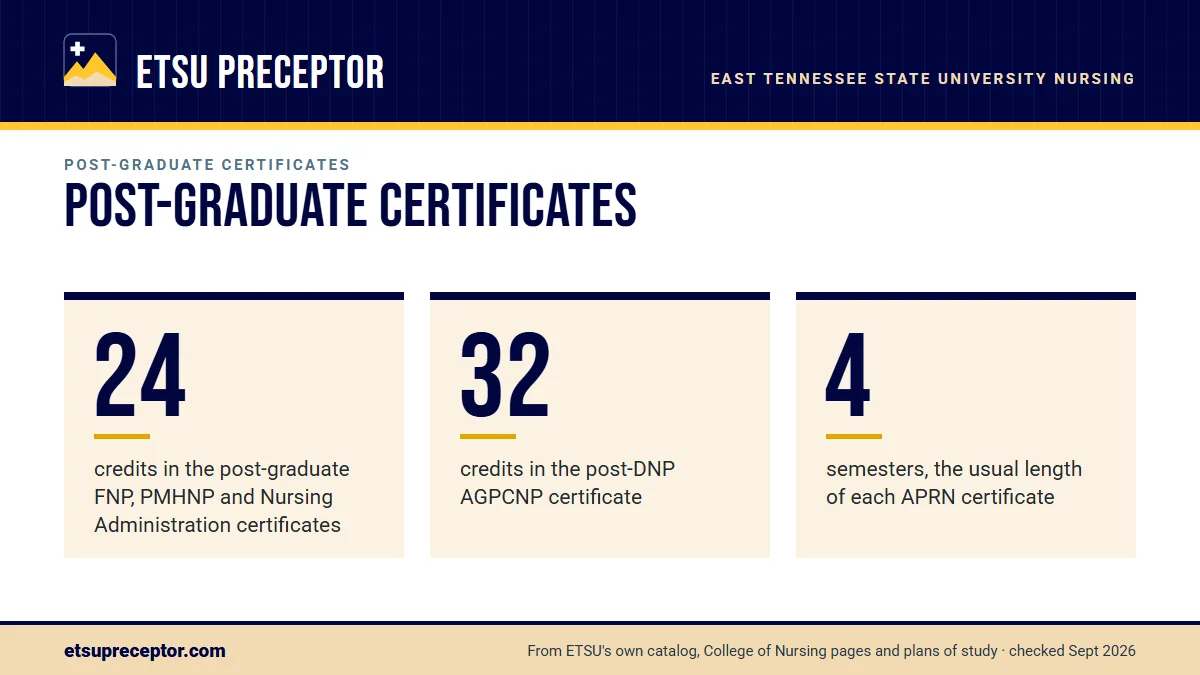
The certificates side by side
ETSU's certificate pages list four certificates with clinical work, plus a genetics certificate. Each admits in one term only, so the certificate you choose also sets when your first clinical search has to start.
| Certificate | Credits | Usual length | Admits | Deadline |
|---|---|---|---|---|
| Post-Graduate Family Nurse Practitioner | 24 | 4 semesters | Summer | March 1 |
| Post-Graduate Psychiatric Mental Health NP | 24 | 4 semesters | Spring | September 1 |
| Post-DNP Adult/Gerontology Primary Care NP | 32 | 4 semesters | Summer | March 1 |
| Post-Graduate Nursing Administration | 24 | 5 semesters | Fall | May 1 |
| Health Care Genetics and Genomics | 12 | Not stated | Fall | May 1 or June 1 (the page lists both) |
The FNP, PMHNP and Nursing Administration certificates ask for an MSN, a 3.0 GPA in the nursing major and a US RN license with eligibility for Tennessee or compact-state licensure. For the FNP certificate, ETSU Online requires an MSN while the College's certificate page also accepts DNP holders. The post-DNP AGPCNP certificate asks for an earned DNP in advanced clinical practice or nursing administration, or current enrollment in the ETSU DNP, plus US RN licensure with Tennessee eligibility, a cover letter and a resume.
Who finds certificate clinicals
ETSU's certificate FAQ gives the same answer as its MSN FAQ: a coordinator with a deep contact list and records of earlier preceptors stands ready to help, while the certificate student carries responsibility for an active search. The certificate page adds that you can arrange local or distance placement with the College of Nursing as needed.
In practice, you bring candidates, the coordinator helps, and each name you propose is written up on an Intent Form, entered in ProjectConcert, reviewed by faculty and the Office of Student Services, and covered by a contract before your clinical time counts. The Intent Form's concentration choices (AGPCNP, FNP and PMHNP) line up with the three APRN certificates. The full sequence is laid out in the ETSU placement process.
ETSU designed the APRN certificates for APRNs who want a new specialty, which cuts both ways. You probably know plenty of clinicians already, but a new specialty needs a preceptor in that specialty: an FNP adding the PMHNP certificate needs psychiatric preceptors, and a PMHNP adding FNP needs primary care preceptors who see patients across the lifespan.
Hours and practicum courses: ask for your plan
ETSU's web pages do not publish the practicum courses or clinical hours for any certificate, and no certificate plan of study is posted. The course list and hours sit on the catalog program page, for example the 2025-26 Post-Graduate FNP certificate page, so ask for the plan that matches your admission term. ETSU describes the APRN certificates as supplying the core courses and the clinical experiences needed for national certification without a second degree.
So request your plan of study at admission, and have your advisor mark which semesters carry clinical hours and which population each practicum serves. The MSN plans give a sense of scale, with 540 hours each for FNP and PMHNP across five courses, but they are not a substitute for your own certificate plan. Every ETSU hour figure we could verify, and the conflicts between them, sits on ETSU clinical hours.
Do not assume a certificate copies the MSN hours. Get the certificate's own plan of study in writing before you promise a preceptor a number.
The AGPCNP certificate and a pending termination
ETSU's 2026-27 pending curriculum actions list terminating the DNP Adult-Gerontology Primary Care NP concentration. The post-DNP AGPCNP certificate still appears on ETSU's certificate pages, but its future is unclear while that action is pending.
Its focus is primary care for patients from adolescence through old age, in nursing homes, health departments and primary care clinics, and completers are eligible for national certification. If you are enrolled or applying, confirm with the College that your cohort can finish as planned. Look for preceptors whose patients match that adolescent-to-older-adult focus; ETSU's dated preceptor form names NRSE 5032, an older adult chronic health practicum, for AGPCNP students. The concentration's status is tracked on the DNP AGPCNP page.
Licenses, states and accreditation
Certificate students fall under ETSU's graduate license rule: every RN license you hold stays clear of encumbrances, and any problem goes straight to the Associate Dean of Graduate Programs. A clinical site outside Tennessee depends on regulator approval, decided for each student after admission. If you relocate during the certificate, your new state's nursing board has to allow you to continue, and both the College and the records office need your new address.
Two gaps in ETSU's pages matter here. First, no licensure disclosure is specific to certificates: the certificate page points to the College home page, which carries disclosures only for the BSN, MSN, DNP and joint DNP, and those lists conflict with the university's own; ETSU's licensure disclosures compares them. Second, ETSU Online says all nursing certificates are CCNE accredited, but the College's own accreditation statement mentions only the post-graduate APRN certificates. If a site or board asks, get the College's answer in writing.
ETSU's graduate time limit for certificates runs four to six years, so a paused clinical sequence has room, though not unlimited room.
Where certificate clinicals take place
ETSU names typical settings for two certificates. For the FNP certificate it lists primary care clinics, nursing homes, health departments and education; the AGPCNP list is the same minus education. The PMHNP certificate prepares you for the PMHNP national exam, and the Nursing Administration certificate makes you eligible for the ANCC Nurse Executive exam; the MSN versions of those two tracks show the kind of placement involved, psychiatric practicums in one and a nurse administrator preceptor in the other, as the MSN PMHNP and MSN Nursing Administration pages explain.
The Health Care Genetics and Genomics certificate includes NRSE 5326, a seminar and practicum in the genetics clinical setting. ETSU's pages do not say who arranges that placement, so ask the program before you plan around it.
Why certificate students hand us the search
You are already practicing, so your time is the scarcest resource in the certificate. We take the preceptor search off your desk: clinicians in your new specialty, in your own community, with their credentials, license and certification numbers and the site's patient mix assembled for your ETSU paperwork.
We bring up the contract requirement at the very start, which lets the College arrange it without a last-minute rush, and we remain on call until your final clinical hour. The decision to approve stays with ETSU's faculty, and the credential review with the Office of Student Services; our part is to hand them a file with nothing missing. Use the form below with your certificate and start term.
Questions ETSU students ask
How many clinical hours are in ETSU's post-graduate FNP certificate?
ETSU's web pages do not say. The certificate's course list and hours are on its catalog program page, and no certificate plan of study is posted on the College's site. Ask for your plan of study at admission and confirm the hours with course faculty. The MSN FNP plan's 540 hours are a comparison point only, not the certificate's requirement.
Can I do certificate clinicals at the practice where I work?
Nothing on ETSU's pages allows or bars it. Faculty will see the connection anyway, because the preceptor form asks about employment at the agency and any earlier training with the same preceptor. A new specialty usually means learning from a different kind of provider than your current role, so confirm with course faculty first; see clinicals where you work.
Does ETSU offer more than a post-master's FNP certificate?
Yes, though ETSU's own pages disagree. The graduate programs overview and the prospective student page describe a post-master's certificate in the FNP role only. The certificate pages list five: FNP, PMHNP, post-DNP AGPCNP, Nursing Administration, and Health Care Genetics and Genomics. Confirm the current list with the College before you apply.
Can I complete an ETSU certificate while living outside Tennessee?
Possibly. Clinical placement outside Tennessee needs approval from the appropriate regulators and is decided case by case after admission, and applicants outside Tennessee should check with their own board of nursing first. Because ETSU publishes no licensure disclosure specific to certificates, ask the College directly how your state is treated for the certificate you want.
Related pages
Last checked 2026-09-25
We check these pages against ETSU's own catalog, College of Nursing pages, plans of study and ProjectConcert guides. Your plan of study, your syllabus, your course faculty and the graduate clinical coordinator have the final word.
ETSU asks you to lead the preceptor search. We make it the fastest part of your program.
Tell us your ETSU concentration, where you live and which semester your next practicum starts. We find preceptors who fit the course's patient population and prepare everything your Preceptor Intent Form and ProjectConcert entry need.
- Preceptors matched to the course: young and middle adults for
NRSE 5012, older adults forNRSE 5014, women forNRSE 5022, children forNRSE 5024, psychiatric care forNRSE 5405 - Credentials, license numbers, certification dates and the site's patient mix ready for faculty approval
- In your own community, in Northeast Tennessee or wherever ETSU approves your clinicals
Start your placement plan
Program, city and semester is all we need to begin.