ETSU MSN Family Nurse Practitioner: one program, five preceptor searches
East Tennessee State University (ETSU) delivers the coursework for its MSN Family Nurse Practitioner concentration online, yet every one of its 540 clinical hours is spent face to face with patients, under a preceptor close to home. Those hours are split across five practicum courses, four of them tied to a specific patient population, and ETSU expects you to lead the search for every one.
Plan your FNP placements
Tell us your start term, your pace and where you live.
The FNP concentration at a glance
ETSU's FNP concentration trains you for primary care from infancy through adulthood, covering acute and chronic illness, with particular attention to underserved communities in both rural and urban areas. Courses are online and asynchronous, with a few optional synchronous sessions, and graduates are prepared for FNP national certification.
To be admitted you need an unencumbered RN license, a BSN from a nationally accredited program (or a bachelor's in another field plus four bridge courses), a 3.0 bachelor's GPA and the other catalog criteria. There is no GRE. Registered nurses without a nursing bachelor's start in ETSU's RN to MSN bridge.
Full-time students finish in five semesters and ETSU's part-time FNP plans run eight. The last semester also holds the closing MSN requirement: pass the written comprehensive exam or complete the culminating experience.
Five practicums, five patient populations
ETSU's plan of study builds the 540 hours from five practicum courses. The first builds assessment skills across the lifespan; each of the other four centers on one population, which is why a single preceptor rarely carries an FNP student from start to finish. These figures come from plans dated 2023, so compare them with the plan of study issued for your catalog year.
| Course | Title | Hours | Population the site must serve |
|---|---|---|---|
NRSE 5010 | Advanced Health Assessment Lifespan Practicum | 60 | All ages; lab practice plus clinical placement |
NRSE 5012 | Nurse Practitioner I Practicum (Young & Middle Adults) | 120 | Young and middle adults |
NRSE 5022 | Women's Health Practicum | 120 | Women, in rural, urban and underserved settings |
NRSE 5014 | Nurse Practitioner II Practicum (Older Adults) | 120 | Older adults |
NRSE 5024 | Children and Adolescents Practicum | 120 | Children and adolescents, in rural, urban and underserved settings |
Each course has its own guide: health assessment, young and middle adults, women's health, older adults and children and adolescents. For part-time timing and the arithmetic behind the total, see ETSU FNP clinical hours.
Fall or spring: how your start shapes the clinical calendar
FNP is the only ETSU MSN concentration with two intakes. Applications for fall are due May 1 and for spring November 1, and the spring intake belongs to FNP alone. Either way, NRSE 5010 sits in your first term alongside NRSE 5009, the health assessment didactic course.
The start term then decides where the heavy clinical semesters fall. A full-time fall starter reaches the first NP practicums in summer 3, the older adults course in fall 4 and pediatrics in spring 5. A full-time spring starter hits both summer practicums in only the second semester, then older adults in fall 3 and pediatrics in spring 4, with Health Policy Leadership and two more didactic courses left for a fifth, summer term.
| Start | NRSE 5010 | NRSE 5012 and 5022 | NRSE 5014 | NRSE 5024 |
|---|---|---|---|---|
| Fall | Fall 1 | Summer 3 | Fall 4 | Spring 5 |
| Spring | Spring 1 | Summer 2 | Fall 3 | Spring 4 |
One ETSU conflict hits spring starters directly: in the 2026-27 catalog, NRSE 5009 and NRSE 5010 are offered in fall only, while the spring-start plans schedule both in spring. If you are admitted for spring, confirm your sequence with your advisor and course faculty before you plan the first placement.
Full-time students take NRSE 5012 and NRSE 5022 in the same summer: two preceptors, two populations and 240 hours in one term.
Who lines up the FNP preceptors
The search is yours, with help available. ETSU Online's MSN FAQ points to the graduate clinical coordinator's network of contacts and record of past preceptors, and then puts the job of searching actively for a preceptor and site on the student. For an FNP student that can mean five separate searches, each timed to a different semester.
Every candidate goes on the Preceptor Intent Form. Its credential examples (FNP, ANP, MD) show that ETSU expects both nurse practitioners and physicians to precept NP courses. The form also asks what share of the site's patients, and how many each day, are children, adolescents, women, adults and older adults. Faculty compare that mix with the course's population focus, so a busy adult internal medicine practice can suit NRSE 5012 and still fall short for NRSE 5024. Our page on reading the patient mix shows how to present it.
From there the preceptor is submitted in ProjectConcert, approved by clinical faculty and credential-checked by student services staff, and a contract has to be in place before any hour you log will count.
Planning backward from each practicum
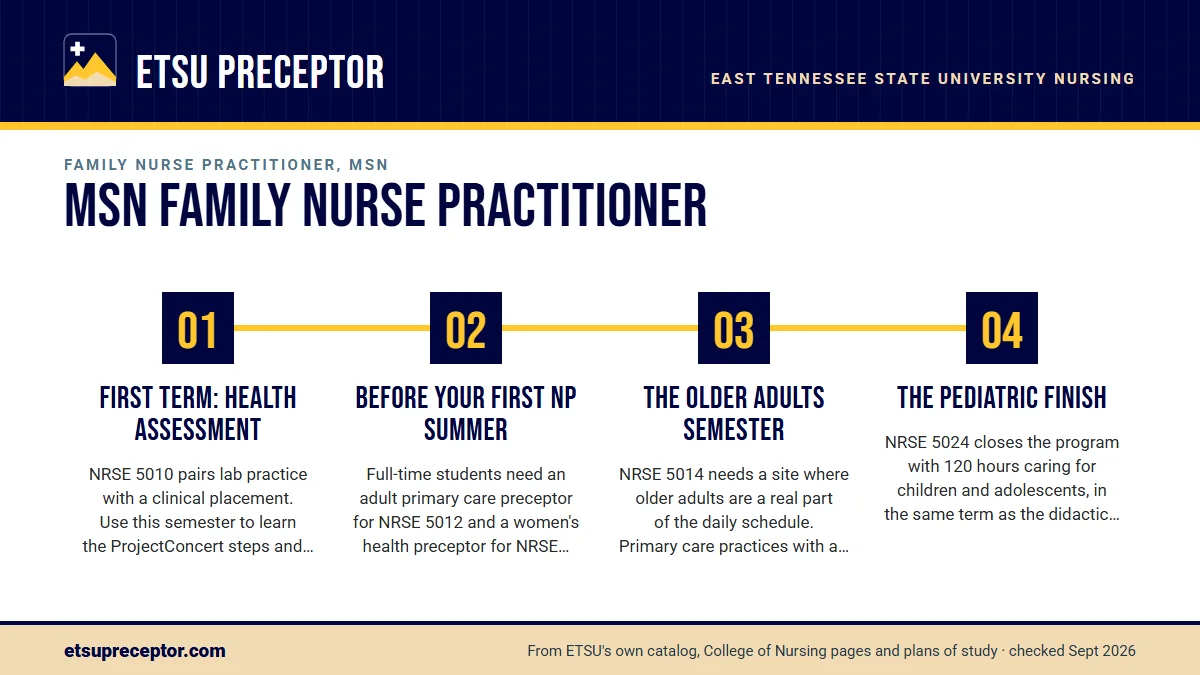
- First term: health assessment
NRSE 5010pairs lab practice with a clinical placement. Use this semester to learn the ProjectConcert steps and to begin the search for your first 120-hour course, not just this one. - Before your first NP summerFull-time students need an adult primary care preceptor for
NRSE 5012and a women's health preceptor forNRSE 5022approved before summer.NRSE 5011, the didactic partner ofNRSE 5012, listsNRSE 5000,5009,5010,5016and5018as prerequisites unless the instructor permits otherwise. - The older adults semester
NRSE 5014needs a site where older adults are a real part of the daily schedule. Primary care practices with a large older adult panel are the natural place to begin. - The pediatric finish
NRSE 5024closes the program with 120 hours caring for children and adolescents, in the same term as the didactic courseNRSE 6400. The site must see enough young patients to satisfy faculty, so give this search the longest runway.
Nothing on ETSU's pages sets a date by which a preceptor must be submitted, or says how long a new site contract takes. Begin each search a full semester or more ahead, and ask the graduate clinical coordinator how early your cohort should file.
FNP clinicals close to home
Because coursework is online, your clinical sites can be near where you live, in the Tri-Cities, around Knoxville or in another region entirely. An FNP site in another state is possible only with the relevant regulators' approval, which ETSU weighs one student at a time once you are admitted. Before you sign on with an out-of-state practice, compare ETSU's two state-by-state licensure lists, which do not match; our licensure disclosure guide puts them side by side.
Students near Johnson City, Mountain City or Sneedville can also ask about the College's nurse-led clinics. The Office of Practice takes rotation requests in fixed windows (October 1 opens requests for a spring rotation, March 1 for summer and May 1 for fall) and does not consider requests sent early.
How we help ETSU FNP students
We treat your five FNP practicums as one plan rather than five last-minute scrambles. You tell us your start term and pace; we map each course to its semester and search your own community for preceptors whose patients fit it: adults for NRSE 5012, women for NRSE 5022, older adults for NRSE 5014, children and adolescents for NRSE 5024.
Every match arrives with the details your paperwork needs: who the preceptor is on paper (credentials, degrees, each license and certification number with its expiry), how many patients of each age group the site sees daily, and your planned hours. We bring up the site contract at the first step, giving ETSU time to finalize it. Approval of the preceptor belongs to ETSU's clinical faculty, and credential checks to the College; our job is a package that is complete and correct when it reaches them. If a preceptor drops out mid-semester, we begin the replacement search right away. Start with the form below.
Questions ETSU students ask
Can I start ETSU's FNP program in spring?
Yes. Of ETSU's four MSN concentrations, only FNP admits in spring, with applications due November 1; the fall deadline is May 1. Full-time spring starters take NRSE 5010 in the first term and reach both summer practicums in their second semester. Because the current catalog lists NRSE 5010 as a fall course, confirm your exact sequence with your advisor after admission.
Can one preceptor cover more than one FNP practicum?
Sometimes. Faculty judge each preceptor against one course's population, so a family practice with many adults and older adults might suit both NRSE 5012 and NRSE 5014 if faculty agree. ETSU publishes no rule for or against repeat preceptors. Ask your course faculty before you build your plan around one person, and keep a backup for the pediatric course.
Does ETSU hand FNP students a list of preceptors?
ETSU points students to the graduate clinical coordinator, who holds contacts and names of people who have precepted before. Treat those names as a head start, not an assignment. You still reach out, confirm the preceptor can take you for the semester you need, collect credentials and license numbers, and file the Intent Form and the ProjectConcert entry yourself.
Is ETSU's MSN FNP accredited?
Yes. ETSU Online lists CCNE, the Commission on Collegiate Nursing Education, as the MSN's accreditor, and the College notes Tennessee Board of Nursing approval for its programs. Neither page gives a date for the last or next review, so if a clinical site asks, put the site in touch with the College of Nursing rather than guessing.
What happens if I cannot finish a practicum's hours on time?
Talk to course faculty early. Graduate nursing courses at ETSU need a final grade of B or higher, and a course graded lower may be retaken once. An Incomplete requires 75% of the course work to be done already, becomes an F if not resolved within a year, and a second one halts progression. A late preceptor change still needs full approval before hours count.
Related pages
Last checked 2026-09-25
We check these pages against ETSU's own catalog, College of Nursing pages, plans of study and ProjectConcert guides. Your plan of study, your syllabus, your course faculty and the graduate clinical coordinator have the final word.
ETSU asks you to lead the preceptor search. We make it the fastest part of your program.
Tell us your ETSU concentration, where you live and which semester your next practicum starts. We find preceptors who fit the course's patient population and prepare everything your Preceptor Intent Form and ProjectConcert entry need.
- Preceptors matched to the course: young and middle adults for
NRSE 5012, older adults forNRSE 5014, women forNRSE 5022, children forNRSE 5024, psychiatric care forNRSE 5405 - Credentials, license numbers, certification dates and the site's patient mix ready for faculty approval
- In your own community, in Northeast Tennessee or wherever ETSU approves your clinicals
Start your placement plan
Program, city and semester is all we need to begin.