ETSU Nursing Education practicums: NRSE 5115, 5046 and 5045
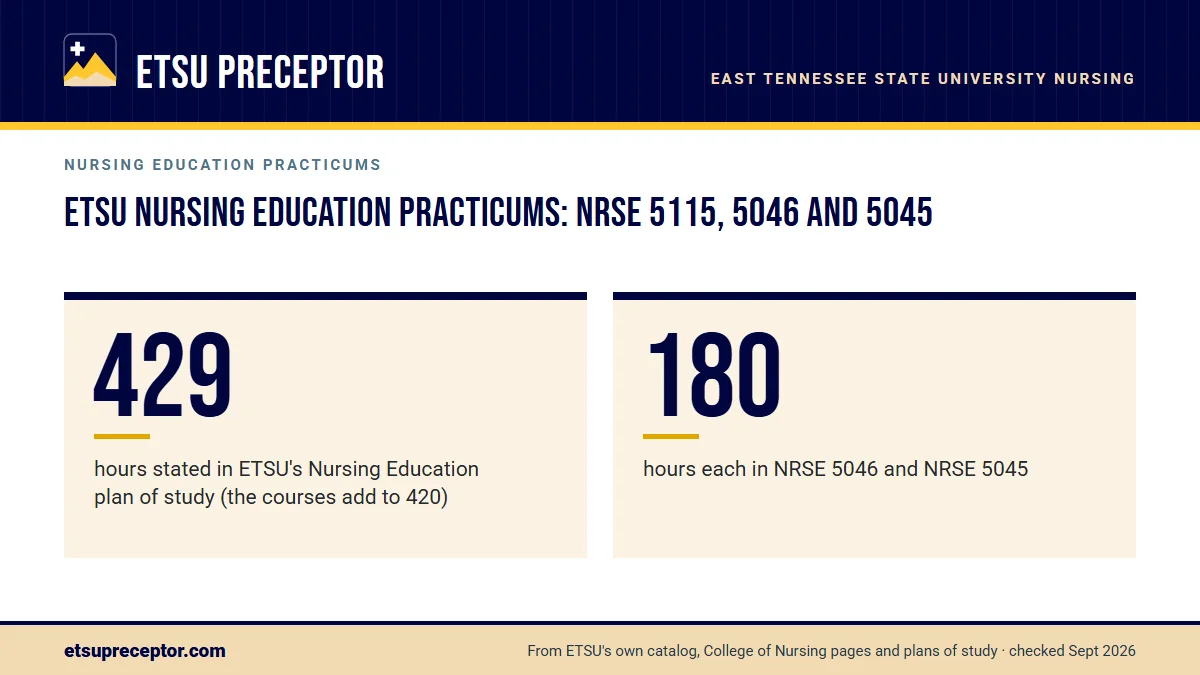
East Tennessee State University (ETSU) gives MSN Nursing Education students three practicums: NRSE 5115, a 60-hour clinical specialization practicum, then two 180-hour education practicums, NRSE 5046 and NRSE 5045, with experienced academic nurse educators. The coursework is mostly online, but these practicums need you on site with a preceptor. ETSU's plan states 429 hours while its courses add to 420, so confirm your total with faculty.
Need an education preceptor?
Tell us your specialty track and start term. We search for an experienced nurse educator near you.
Three practicums, two kinds of placement
ETSU's 2023 plan of study for Nursing Education (the full-time and part-time pages show the same five-semester, 42-credit sequence) places all three practicums in the second half of the program. The first follows your clinical specialty; the other two follow the educator role.
| Course | Title in the plan | Semester | Credits | Hours | Paired with |
|---|---|---|---|---|---|
NRSE 5115 | Clinical Specialization Practicum | 3 | 1 | 60 | Your specialization course: NRSE 5025, NRSE 5026, NRSE 6412 or NRSE 5028 |
NRSE 5046 | Nursing Education Didactic Practicum | 4 | 3 | 180 | Experienced academic nurse educators |
NRSE 5045 | Nursing Education Clinical Practicum | 5 | 3 | 180 | Experienced academic nurse educators |
The 2026-27 catalog says NRSE 5045 and NRSE 5046 are completed with experienced academic nurse educators and that each includes a clinical preceptorship placement. The current catalog's program page would not open during research for this site, so treat your own plan of study as the final word.
429 or 420: the hour conflict
The plan of study states 429 clinical hours for the concentration. Its three practicums add to 420: 60 plus 180 plus 180. ETSU gives no explanation for the nine-hour gap, and this page does not guess at one. Nine hours is about one long clinical day, small but real if you plan your schedule to the minimum.
Until faculty confirm the figure for your catalog year, schedule toward 429 rather than 420, and find out from them which total ETSU will count for you. The same plan has other slips: its full-time page labels all five semesters "Spring."
Every ETSU program's hour figures, with the other conflicts ETSU publishes, sit together on clinical hours by program. Education's 180-hour practicums share the leadership courses' rate of 60 hours per credit, which hours per credit explains.
NRSE 5115 and your clinical specialty
ETSU Online says the concentration prepares you to meet nurse educator competencies in one of five clinical areas: adult health, psychiatric/mental health, critical care, women's health and perinatal, or pediatric. The plan of study offers four specialization courses in semester 3: NRSE 5025 advanced women's health and perinatal, NRSE 5026 advanced pediatric, NRSE 6412 clinical prevention in mental health services and NRSE 5028 advanced adult and geriatric.
Critical care appears in the first list and not the second. If critical care is your area, ask your advisor how the plan handles it well before semester 3.
NRSE 5115 is the 60-hour practicum tied to whichever specialization you pick, so the site should see the patients that specialty is about: women and families, children, people with mental health needs, or adults and older adults. The Preceptor Intent Form posted on ETSU's site lists NRSE 5045 and NRSE 5046 among its courses but not NRSE 5115, so ask the coordinator how to submit a preceptor for it and what kind of clinician faculty expect.
NRSE 5046 and NRSE 5045 with an academic nurse educator
The two 180-hour practicums carry most of the concentration's clinical time. Their titles divide the work: NRSE 5046 is the Didactic Practicum in semester 4 and NRSE 5045 the Clinical Practicum in semester 5. Both pair you with experienced academic nurse educators.
ETSU says graduates are prepared for the NLN Certified Nurse Educator (CNE) exam and go on to teach in LPN, ADN, BSN and RN to BSN programs or to work as clinical educators. Those are the places academic nurse educators work, so a nursing program near you is the natural first stop in the search.
ETSU publishes no written qualifications for education preceptors, such as a degree level or years of teaching. Ask course faculty before you approach a program. A school or agency that agrees to host you still needs a contract with ETSU in place before you start.
Online coursework, on-site practicums
Most Nursing Education courses are asynchronous, but ETSU Online is direct about the practicums: reaching the required hours takes an on-site presence with a preceptor, and some faculty require synchronous sessions. The concentration starts in fall only, with a May 1 application deadline.
Semester 3 is summer on ETSU's part-time plan page, so a fall 2026 start would put NRSE 5115 in summer 2027, a session that opens May 17 and ends August 13. The 180-hour practicums then follow in fall and spring.
Teaching practicums follow an academic calendar of their own. If your preceptor's program runs on different term dates from ETSU, map both calendars early so your hours fit inside ETSU's term, and ask how exam weeks and breaks at the host program affect the hours you can log.
Getting an education preceptor approved
Education preceptors clear the usual gates. Your Intent Form and ProjectConcert onboarding entry go in first; then faculty review the educator, Student Services confirms their credentials, and the host school signs an agreement with ETSU. Your own requirements, such as immunizations and liability insurance, have to be current before day one too. The approvals are laid out on preceptor approval.
If you already teach or work at the school that would host you, the Intent Form asks about it, and ETSU publishes no rule either way. Working where you work covers how to raise it with faculty. ETSU publishes no submission deadline or contract lead time either, so start the search a term ahead and ask the coordinator how long a new school's agreement usually takes.
Why ETSU nurse educator students choose us
Education practicums ask for specific partners: an experienced academic nurse educator who can bring you into both the didactic and clinical sides of teaching, plus a clinician in your specialty for NRSE 5115. We search for both in your own community, gather the degrees, license and certification details the College needs, confirm the program can host you for the full 180 hours, and put the agreement on the College's radar at the start.
ETSU's clinical faculty make the approval call and the College confirms your educator's credentials; the file we prepare answers their questions up front, so nothing stalls. If a preceptor steps away between NRSE 5046 and NRSE 5045, we find a replacement. Share your specialty track through our form.
Questions ETSU students ask
Is ETSU's Nursing Education MSN 429 or 420 clinical hours?
ETSU's 2023 plan of study states 429 hours, but the three practicums it lists add to 420: 60 in NRSE 5115 and 180 each in NRSE 5046 and NRSE 5045. ETSU does not explain the difference. Ask course faculty which figure applies to your catalog year before you plan your preceptor hours.
What is NRSE 5115 at ETSU?
NRSE 5115 Clinical Specialization Practicum is a 1-credit, 60-hour practicum in semester 3 of ETSU's Nursing Education plan. It pairs with the specialization course you choose that term: women's health and perinatal, pediatric, mental health, or adult and geriatric, making it the clinical side of your chosen specialty.
Is a critical care focus available in ETSU's Nursing Education MSN?
ETSU Online lists critical care among five clinical focus areas, but the 2023 plan of study offers only four specialization courses: women's health and perinatal, pediatric, mental health, and adult and geriatric. Ask your advisor how a critical care focus fits the plan before semester 3.
Can I do my nursing education practicum at the school where I teach?
No published ETSU policy settles this. Because the Intent Form asks about your employment at the site, faculty will know about it from the start. Raise it with course faculty early, and plan how the practicum work will differ from your current duties.
What certification does ETSU's Nursing Education MSN prepare you for?
ETSU says graduates are prepared for the National League for Nursing's Certified Nurse Educator (CNE) exam. Graduates teach in LPN, ADN, BSN and RN to BSN programs or work as clinical educators, which is also where the academic nurse educators who precept NRSE 5046 and NRSE 5045 tend to work.
Related pages
Last checked 2026-09-25
We check these pages against ETSU's own catalog, College of Nursing pages, plans of study and ProjectConcert guides. Your plan of study, your syllabus, your course faculty and the graduate clinical coordinator have the final word.
ETSU asks you to lead the preceptor search. We make it the fastest part of your program.
Tell us your ETSU concentration, where you live and which semester your next practicum starts. We find preceptors who fit the course's patient population and prepare everything your Preceptor Intent Form and ProjectConcert entry need.
- Preceptors matched to the course: young and middle adults for
NRSE 5012, older adults forNRSE 5014, women forNRSE 5022, children forNRSE 5024, psychiatric care forNRSE 5405 - Credentials, license numbers, certification dates and the site's patient mix ready for faculty approval
- In your own community, in Northeast Tennessee or wherever ETSU approves your clinicals
Start your placement plan
Program, city and semester is all we need to begin.