ETSU RN to BSN: three online semesters and one practicum to plan
East Tennessee State University (ETSU) runs its RN to BSN online over three semesters, with a single in-person course at the end: NRSE 4026 R.N. Practicum. Where that practicum happens depends on your job and your address. Nurses in full-time direct patient care can use their current employer; everyone else arranges a site with the College, and students living outside Tennessee may need Tennessee hours.
Plan your R.N. Practicum early
Tell us your city, your role and the summer you start.
How the online RN to BSN runs
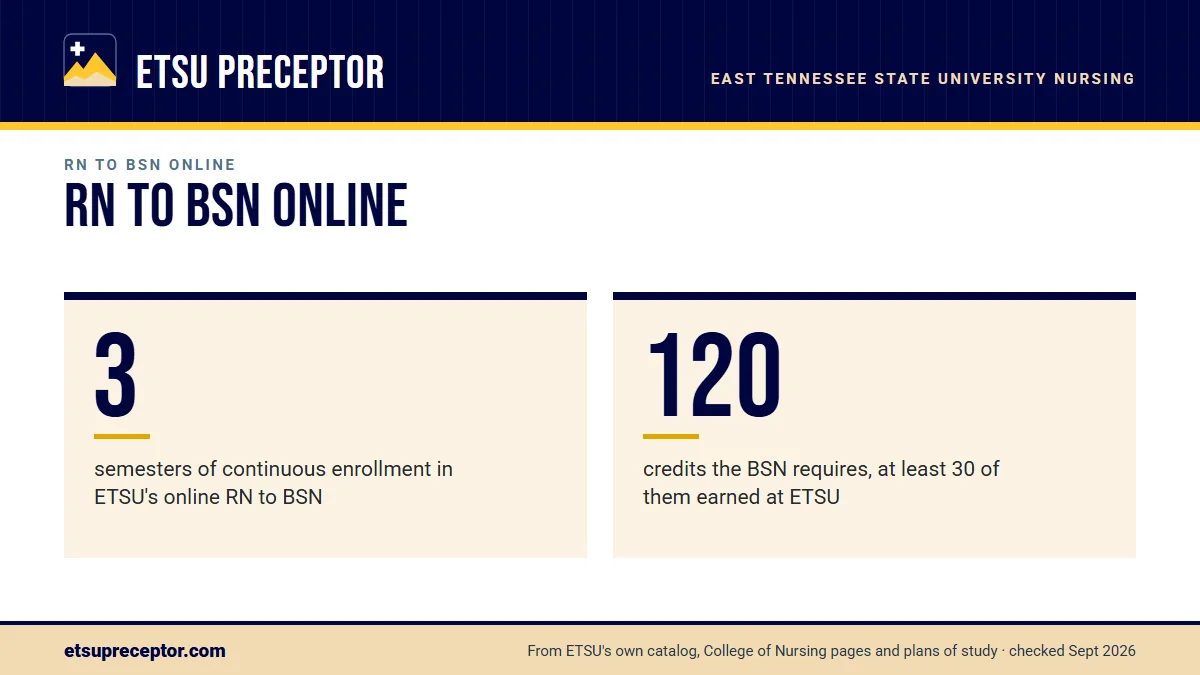
The track is built for nurses who already hold an RN license and want the bachelor's degree without stepping away from work. It admits one cohort a year, in summer, and moves through three semesters of continuous enrollment. Course work is online and asynchronous, so you study on your own schedule; the one exception is the R.N. Practicum in the last semester.
Apply to both ETSU and NursingCAS by February 15 for the summer start. Admission calls for a 3.0 overall GPA and 2.75 across prerequisites, plus four specific courses: Anatomy and Physiology I and II with labs, Introduction to Microbiology with lab, and Probability and Statistics. Each prerequisite allows no more than one failure.
The degree needs at least 120 credits, with 50 or more from a four-year school and at least 30 earned at ETSU. You can fit general education courses in at any stage of the track, which helps transfer students who arrive with a gap or two.
A sample three-semester sequence
ETSU's RN to BSN page posts no semester plan. One possible order appears in a 2025 articulation plan ETSU agreed with Northeast State Community College:
| Term | ETSU nursing courses | Notes |
|---|---|---|
| Summer | NRSE 3010 Pharmacology in Nursing | Taken with general education courses |
| Fall | NRSE 3200, NRSE 3510, NRSE 3525 | Professional practice; population, community and public health; health promotion and research |
| Spring | NRSE 4355 Healthcare Systems and Informatics in Nursing (4), NRSE 4620 Leadership and Professional Practice (3), R.N. Practicum (5) | The practicum is numbered NRSE 4062 in this plan |
That articulation document numbers the practicum NRSE 4062, while the College's own RN to BSN and Dual Degree pages list it as NRSE 4026. Treat the numbers, credits and order as a sketch until you hold your own plan of study and know your catalog year, because the 2026-27 catalog is the official record for your year.
The R.N. Practicum: two routes to a site
The whole track leads to one in-person course in the final semester, and ETSU offers two routes to a site for it. When your current job is full-time direct patient care, you may complete the practicum with the employer you already have. When your role sits away from the bedside, the College of Nursing arranges a clinical with you instead.
No clock-hour total or site standard for the course appears on ETSU's web pages beyond those two routes. The syllabus and your course faculty set the hours, the focus and what the College needs from a site, so read them as soon as they post. Our R.N. Practicum page looks at the course itself in more depth.
An employer placement is usually the fastest to arrange, but the unit still has to serve the course. If your own hospital is the natural choice, the guide to clinicals where you work covers keeping your staff role and your student role apart.
The employer route belongs to nurses in full-time direct patient care. In any other role, start the conversation with the College early in the track, not in the final semester.
Living outside Tennessee
The online format draws nurses from beyond the state line, and ETSU's RN to BSN page flags a catch for them: state regulations may mean a student who lives in another state has to earn the clinical hours with an agency or institution in Tennessee. That can apply even when your own employer is a hospital just across the border.
For nurses in Southwest Virginia or western North Carolina, this is often workable, since Johnson City, Kingsport and Bristol sit close to those lines. Farther away, it can mean days of travel and time off work during the last semester. Ask the College early whether your state triggers the rule, then plan the drive and your work schedule around the answer.
Our page on clinicals outside Tennessee explains how ETSU treats out-of-state clinical work more broadly, including the case-by-case review that applies to graduate students.
Your license and clinical health requirements
Your RN license is part of your clinical file. The undergraduate catalog has RN to BSN students present it, and the College reviews it under its Clinical Health Requirements Policy. A license that becomes encumbered or is revoked means withdrawal from the program. Keep it current and unencumbered right through the final semester.
The same catalog asks BSN students to meet and maintain Clinical Health Requirements, with a background check and a urine drug screen from vendors the College selects, at the student's cost. Clinical partners, not only the College, decide whether a student satisfies them. ETSU nursing tracks requirements in ProjectConcert, where each item shows a status and a due date.
Ask the College which items apply to the R.N. Practicum and when they fall due. The detail is on our pages for clinical health requirements and background checks.
Dual Degree students reach the same practicum
The Dual Degree route lets students in a partner community college's ADN program begin ETSU courses before they finish the associate degree. After graduating and passing the NCLEX-RN, they move into the RN to BSN track, which admits in summer, and finish with the same R.N. Practicum.
The Northeast State version shows how the pieces fit. Students take NRSE 2016 and NRSE 2030 online at ETSU in the summer after their first ADN year, then receive 12 credits by assessment for NRSE 2020, NRSE 2310, NRSE 3500 and NRSE 3501. The plan totals 131 credits: 66 plus 8 at Northeast State, 12 by assessment and 45 at ETSU.
Because the pace depends on when your ADN ends, ETSU recommends meeting an advisor one to one before you apply.
If the MSN or DNP comes next
If advanced practice is the goal, the BSN is the door to it. Admission to ETSU's MSN requires a clear RN license, a BSN from a nationally accredited school and a 3.0 bachelor's GPA. ETSU's BSN carries accreditation from the Commission on Collegiate Nursing Education (CCNE).
The practicum picture then changes completely. In ETSU's graduate programs you lead the preceptor search, and the graduate clinical coordinator offers contacts along the way. The MSN Family Nurse Practitioner plan of study lists 540 clinical hours across five practicums, each tied to a patient population, and the full-time FNP plan puts 120 practicum hours into the very first summer.
The clinicians you work beside now, and the ones you meet during the R.N. Practicum, are often where a future NP preceptor search starts. Read finding your own preceptor and the MSN FNP page before you apply.
Why RN to BSN students choose us
For a nurse in full-time direct care with a supportive employer, the practicum can come together quickly. Our work counts most in the other cases, and we give them the same thoroughness we bring to graduate placements.
Where we step in
- Away from the bedside: we find a site and a nurse willing to supervise near you, then bring the details to your conversation with the College so the setup moves quickly.
- Living outside Tennessee: we search for a Tennessee agency within a workable drive of home and plan the clinical days around your work schedule.
- Employer placements: we check that your unit fits the course and gather the site details the College asks for.
- Looking ahead: we start mapping preceptors for your first MSN or DNP practicum while you finish the BSN.
The College of Nursing sets up and approves your clinical; our part is making sure the information that reaches it is complete and ready the first time. Send your city and start term with the form below, or read how it works.
Questions ETSU students ask
How many clinical hours is ETSU's RN to BSN practicum?
ETSU's web pages publish no clock-hour figure for the R.N. Practicum, so confirm it in the current catalog and your syllabus. A 2025 Northeast State articulation plan lists the course at 5 credits. Your syllabus and course faculty give the hours for your cohort, so check them before you promise dates to a site or an employer.
Can new ADN graduates begin ETSU's RN to BSN before licensure?
Yes, for one term. Recent associate degree graduates may enroll in BSN courses for a single semester while still unlicensed, provided they pass the NCLEX-RN before that opening semester ends. The license you earn carries through the BSN, so there is no second licensing exam at the end. The TEAS, required for ETSU's prelicensure tracks, is not part of RN to BSN admission.
Can I do the R.N. Practicum on my own unit?
ETSU's rule speaks of your current employer and says nothing about your usual unit. Ask course faculty whether the unit you staff each week meets the course goals or whether another department serves them better. A different unit often makes it easier to keep student time apart from paid shifts.
Does ETSU's RN to BSN meet licensure rules in my state?
ETSU publishes two state disclosures for the BSN that disagree. The College's own pages name 25 states where the curriculum qualifies, while the university's consumer information pages say it meets everywhere except California, Hawaii, Louisiana and some territories. Licensed nurses feel this less than new graduates, but read the licensure disclosures comparison and check with your board.
Can a placement service set up my R.N. Practicum?
For nurses outside direct care, the College of Nursing arranges and approves the clinical, so the decision is always the College's. What we add is the legwork: a site and a supervising nurse near you, confirmed availability and the details the College needs, ready well before your final semester begins.
Related pages
Last checked 2026-09-25
We check these pages against ETSU's own catalog, College of Nursing pages, plans of study and ProjectConcert guides. Your plan of study, your syllabus, your course faculty and the graduate clinical coordinator have the final word.
ETSU asks you to lead the preceptor search. We make it the fastest part of your program.
Tell us your ETSU concentration, where you live and which semester your next practicum starts. We find preceptors who fit the course's patient population and prepare everything your Preceptor Intent Form and ProjectConcert entry need.
- Preceptors matched to the course: young and middle adults for
NRSE 5012, older adults forNRSE 5014, women forNRSE 5022, children forNRSE 5024, psychiatric care forNRSE 5405 - Credentials, license numbers, certification dates and the site's patient mix ready for faculty approval
- In your own community, in Northeast Tennessee or wherever ETSU approves your clinicals
Start your placement plan
Program, city and semester is all we need to begin.