NRSE 6950: the PMHNP Internship in Advanced Nursing Practice
NRSE 6950 Internship in Advanced Nursing Practice closes the PMHNP plan at East Tennessee State University (ETSU): 3 credits, 120 clock hours, in the final spring after the three psychiatric practicums. The same term holds the MSN's comprehensive exam or culminating experience, and BSN-DNP students move straight on to the residencies, so losing a preceptor here costs more than anywhere else in the sequence.
Planning your final practicum?
Tell us your internship term and home area.
Where the internship sits
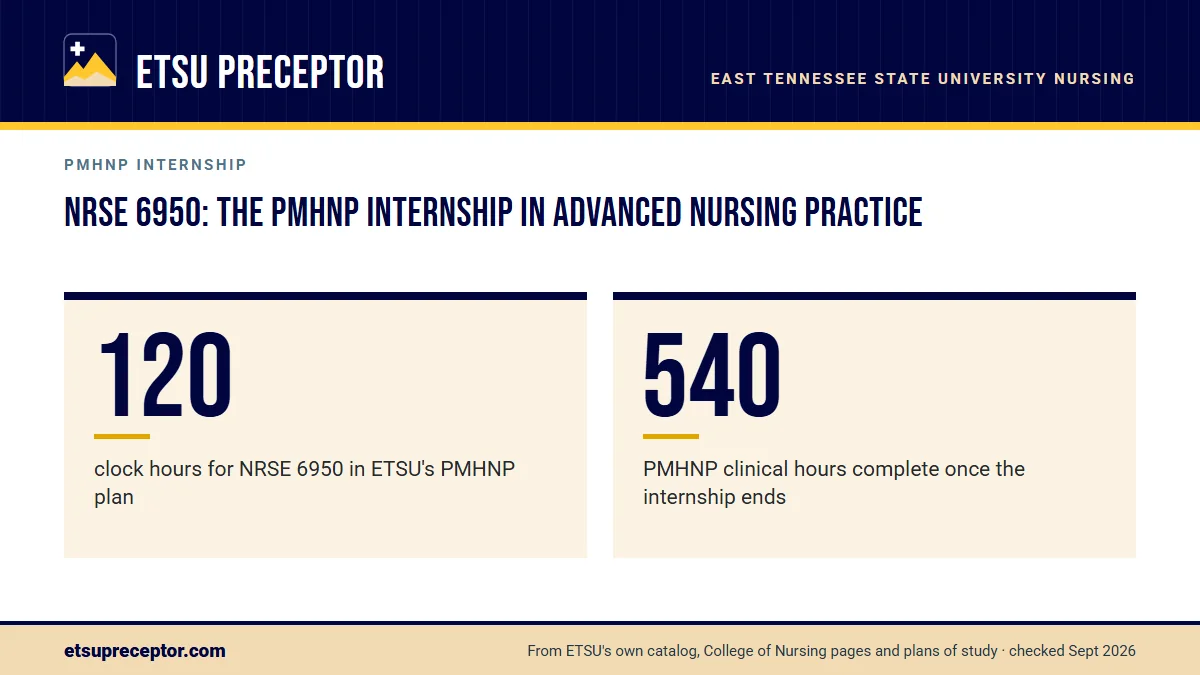
ETSU's 2023 MSN PMHNP plans schedule NRSE 6950 in Spring 5 for full-time students, together with NRSE 5001, NRSE 5006 and the IPE 672E seminar, and in Spring 8 for part-time students. The 2020 BSN-DNP PMHNP plans place it identically. In every version it carries 3 credits and 120 clock hours, the last block of the program's 540.
NRSE 6950 Internship also appears on the Preceptor Intent Form's course menu, one of the entries still matching today's plans even though the form's year options end at 2021 and some of its other course numbers are outdated. With the 2026-27 catalog text unavailable, the syllabus has the final word on requirements; the Preceptor Intent Form page covers the form.
What the internship title means for your preceptor
The title is broad, but in the PMHNP plan this course caps the psychiatric sequence built by NRSE 5405, NRSE 5409 and NRSE 5411. Before asking a preceptor to host it, settle these points with course faculty:
- Whether the setting must be psychiatric-mental health, or whether an integrated primary care team qualifies.
- Whether returning to an earlier site or preceptor is allowed.
- Whether faculty expect a wider or more independent caseload than in earlier rotations.
- How the 120 hours fit around the comprehensive exam or culminating experience.
- When the two preceptor evaluations are due and whether the internship carries a letter grade.
Share the answers in writing. A final-term preceptor who knows the expectations from day one can plan your hours around them.
The Quillen integrated behavioral health option
For NRSE 5411 and this internship, ETSU's Quillen College of Medicine has run integrated behavioral health training for second-year PMHNP students, with the hours counting toward both courses. The funded slots on its page cover 2021 to 2025, and whether it continues is not stated.
Ask the graduate clinical coordinator about the current status before you rely on it, and keep a community search going until you hold a confirmed seat. If a seat does open, confirm with course faculty how integrated team hours should be logged in ProjectConcert and how they fit the internship's focus. ETSU PMHNP integrated behavioral health has the detail.
Final-semester stakes
If your internship falls in spring 2027, clinical weeks sit between the January 19 start of classes and their April 29 end, with exams from May 1 through 6, commencement on May 8 and final grades posted May 10. ETSU's deadline to file for spring graduation is September 1 of the prior fall.
A final grade under B means repeating the course, and one repeat is permitted, which in a closing term adds a semester. An open I also blocks the degree: graduate policy requires 75% of the work finished and a cause outside your control, and unfinished work turns the I into an F after one calendar year. Master's students have six years in total. See grades and progression and delayed graduation.
BSN-DNP students: from internship to residency
On the full-time BSN-DNP PMHNP plan, NRSE 6801 Residency I follows NRSE 6950 directly in Summer 6, then NRSE 6802 through NRSE 6804 at 125 hours apiece. Forty of Residency I's hours must be supervised practicum time for students who entered with a BSN, and a practice site has to agree to host a site-based project before faculty approve it.
An internship site may be a natural place to raise a DNP project, but that is a separate approval involving the project chair and faculty. ETSU's DNP totals also conflict, 1,040 hours in the plans against 1,000 in the catalog; the DNP residencies page sets out both.
After the internship: certification and Tennessee practice
ETSU says its PMHNP graduates are ready for PMHNP certification. The Tennessee APRN certificate then rests on three things: an unencumbered RN license (Tennessee or multistate), a graduate nursing degree in the specialty and current national certification. A certificate of fitness adds prescribing authority. The application goes through Tennessee's LARS system, and the board wants the official transcript sent directly from ETSU once the degree has posted.
Prescribing NPs in Tennessee work with a collaborating physician, and the 2024 bills to exempt experienced psychiatric NPs did not pass, so new PMHNPs follow the collaboration rules too. Tennessee APRN practice covers them, and seeing how your internship preceptor's own collaboration works is useful preparation.
How we protect your final practicum
A final-term placement leaves no later semester to absorb a delay. Our placement desk starts the internship search while you are still in NRSE 5411, looks in your own community for a psychiatric preceptor whose setting fits what faculty expect, and prepares the Intent Form and ProjectConcert record: the preceptor's education, credentials, license and certification numbers with renewal dates, the site's patient mix and your 120-hour schedule.
We flag any new agency's contract at once, and your placement advisor stays on call until the last hour is logged. ETSU faculty approve, the College confirms credentials, and we make certain nothing is missing when the request arrives. Plan your internship with us.
Questions ETSU students ask
Is NRSE 6950 a psychiatric practicum?
Within ETSU's PMHNP plans it is the closing clinical course after three psychiatric practicums, under the general title Internship in Advanced Nursing Practice. No setting rule is published, so ask course faculty whether the site must be psychiatric or may be an integrated primary care team.
How many hours is the ETSU PMHNP internship?
ETSU's plans of study give NRSE 6950 3 credits and 120 clock hours. With NRSE 5010 (60) and the three psychiatric practicums (120 each), it completes the 540 hours in the PMHNP plan. Check your catalog year, since the plans are dated 2020 to 2023.
Can I stay with my NRSE 5411 preceptor for the internship?
No ETSU rule addresses it. The Intent Form does ask about any previous training with the same preceptor or agency, so that history is visible to faculty. Raise it with course faculty early, and ask the coordinator whether the internship needs its own form and ProjectConcert entry.
What if I cannot finish NRSE 6950 hours by the end of spring?
Tell course faculty before the term closes. The Incomplete route has strict conditions and holds up graduation until it is cleared, so the earlier the conversation, the more options remain. Behind on clinical hours explains ways to close a gap quickly.
Do post-graduate PMHNP certificate students take NRSE 6950?
ETSU does not post a plan of study for the post-graduate PMHNP certificate; its course list and hours sit in the catalog by catalog year. The certificate admits in spring and usually takes four semesters, so ask the graduate clinical coordinator which practicums your plan includes.
Related pages
Last checked 2026-09-25
We check these pages against ETSU's own catalog, College of Nursing pages, plans of study and ProjectConcert guides. Your plan of study, your syllabus, your course faculty and the graduate clinical coordinator have the final word.
ETSU asks you to lead the preceptor search. We make it the fastest part of your program.
Tell us your ETSU concentration, where you live and which semester your next practicum starts. We find preceptors who fit the course's patient population and prepare everything your Preceptor Intent Form and ProjectConcert entry need.
- Preceptors matched to the course: young and middle adults for
NRSE 5012, older adults forNRSE 5014, women forNRSE 5022, children forNRSE 5024, psychiatric care forNRSE 5405 - Credentials, license numbers, certification dates and the site's patient mix ready for faculty approval
- In your own community, in Northeast Tennessee or wherever ETSU approves your clinicals
Start your placement plan
Program, city and semester is all we need to begin.