The ETSU Preceptor Intent Form, field by field
East Tennessee State University (ETSU) relies on the Preceptor Intent Form so faculty can weigh whether a proposed preceptor and site suit a course's population focus and intended outcomes. The copy posted online is old: the last year it offers is 2021, and it still prints retired course numbers. Here is what each part asks, what it tells your faculty, and how to fill it in so it holds up.
Get your placement plan
Tell us your ETSU program and where you live. A placement advisor replies with the preceptor and site options that fit your ETSU course.
What the form is for
The Intent Form is the evidence file behind a preceptor request. ETSU describes it as a tool for faculty to decide whether the preceptor can meet the course's population focus and outcomes, which means every field is there to answer a teaching question, not an administrative one.
It also spells out what has to happen before clinicals begin and notes that placement progress is tracked in ProjectConcert. Our process overview shows where the form sits in the full sequence.
Because the posted PDF predates the current catalog, ask the graduate clinical coordinator for the version in use now before you fill anything in. In ProjectConcert, the completed form travels with the preceptor's CV and any other files you attach to the onboarding entry.
Each part, and what faculty can read in it
Faculty read these fields together. A strong preceptor at a site whose patient mix misses the course population can still be the wrong match, which is why the mix gets its own page: matching the patient population.
| Part of the form | What it asks | What it tells faculty |
|---|---|---|
| Student details | Concentration (AGPCNP, FNP or PMHNP), student ID, ETSU email | Which program outcomes apply |
| Course | The practicum the preceptor is requested for | The population focus and hours expected |
| Link to the agency | Whether you work for the agency; whether you trained with this preceptor or agency before | How the rotation relates to your job and earlier clinicals |
| Hours | Hours planned with this preceptor | Whether this site covers the course total or part of it |
| Other preceptor | Whether another preceptor will share the rotation | How the course hours are divided |
| Credentials and degrees | Preceptor credentials (examples given: FNP, ANP, MD) and degrees | Whether the preceptor's role suits the course |
| Licenses | License numbers with state and expiration date | Whether licensure is current where the preceptor practices |
| Certifications | Certification numbers with expiration date | The preceptor's national certification status |
| Supervision load | How many students the preceptor supervises at the same time | The preceptor's teaching load during your rotation |
| Agency | Name and address | Where the site is and which agreement covers it |
| Patient mix | Share and daily number of children, adolescents, women, adults and older adults | Fit with the course's population focus |
The outdated course numbers on the form
The posted form lists courses by numbers the 2026-27 catalog no longer uses. Two stand out, and both affect students outside the NP practicums.
| On the posted form | In the 2026-27 catalog | Who it affects |
|---|---|---|
| NRSE 5500 Executive Leadership Practicum | NRSE 5502, NRSE 5503, NRSE 5504 (Practicum I to III) | MSN Nursing Administration and leadership DNP students |
| NRSE 6800 Residency I to IV | NRSE 6801, NRSE 6802, NRSE 6803, NRSE 6804 | ETSU DNP students in the project residencies |
The other listings line up with numbers in ETSU's current plans of study: NP practicums such as NRSE 5012 and NRSE 5024, the education practicums NRSE 5045 and NRSE 5046, the psychiatric practicums NRSE 5405, NRSE 5409 and NRSE 5411, and the NRSE 6950 Internship. Check yours against your own plan of study anyway.
If your course is missing from the version you have, that is a strong sign the copy is old. Ask the coordinator for the current file, or for how to record your actual course number, rather than picking the nearest retired option.
Concentrations the form leaves out
The concentration box offers only AGPCNP, FNP and PMHNP, yet the course list includes the education practicums and the leadership practicum. Students in MSN Nursing Administration, MSN Nursing Education and the leadership DNP therefore meet a form that does not name their concentration.
Those programs also need a different kind of preceptor. The catalog pairs NRSE 5502 with a nurse administrator and describes NRSE 5045 and NRSE 5046 as practicums with experienced academic nurse educators. Each type is covered under who can precept an ETSU student.
DNP residency students have one more document to think about. ETSU's 2020 project guide requires the practice site's agreement first; only then will faculty approve a project based there. Confirm with your project chair which form and which agreement your residency uses.
Filling it in so it holds up the first time
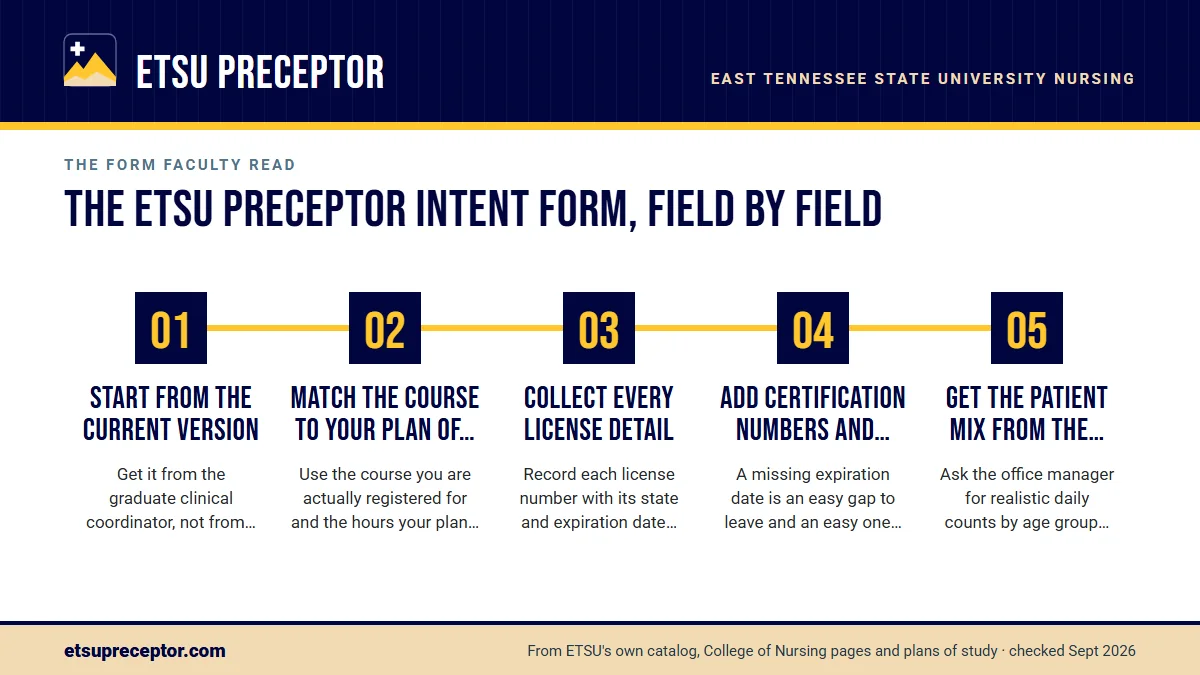
- Start from the current versionGet it from the graduate clinical coordinator, not from an old download.
- Match the course to your plan of studyUse the course you are actually registered for and the hours your plan lists, such as 120 for an FNP specialty practicum.
- Collect every license detailRecord each license number with its state and expiration date, exactly as issued.
- Add certification numbers and expiry datesA missing expiration date is an easy gap to leave and an easy one to prevent.
- Get the patient mix from the practiceAsk the office manager for realistic daily counts by age group instead of estimating them yourself.
- Answer the agency questions plainlyIf you work there or trained there before, say so on the form.
- Name any second preceptorSplit the planned hours so the total matches the course.
- Attach it with the preceptor's CVBoth go into the ProjectConcert onboarding entry; see the submission steps.
Why ETSU students have us assemble the form
Most of the work on this form is chasing details: a license expiration date, a certification number, a patient count from a busy front desk. Your placement advisor collects all of it from the preceptor and the practice as part of the match, checks it against the course you are placing, and hands you a complete set ready for the current form and the ProjectConcert upload.
The reviewers at ETSU make the call; what they read from you will have no blank lines and no mismatched course. If a preceptor withdraws partway through, your advisor lines up a replacement and prepares a fresh set of details for the new request. Tell us your next practicum with the form below.
Questions ETSU students ask
Where do I get the ETSU Preceptor Intent Form?
A copy is posted as a PDF on the College of Nursing site, but its year choices end at 2021 and some of its course numbers are retired. Ask the graduate clinical coordinator for the version in use now, then upload the completed form in the ProjectConcert Preceptor & Clinical Agency Onboarding entry.
Who fills in the Intent Form, me or my preceptor?
ETSU does not say who must complete each part. The student details, course and hours are yours to supply, while licenses, certifications and the patient mix come from the preceptor and the practice. A practical approach is to gather the preceptor's details in one conversation, fill in your own parts, then check every number before upload.
Is the Intent Form the same as the On-Boarding form in ProjectConcert?
ETSU's ProjectConcert guide tells students to upload the completed Preceptor & Clinical Agency On-Boarding form on the entry's Documents tab, while the College's PDF is titled Preceptor Intent Form. If the file you receive from the coordinator carries a different name, confirm which document the entry expects before you submit.
Do I need a new form for every practicum?
The form names a single course, so a request for a different practicum is a new request tied to that course's population focus. Even when you keep the same preceptor, check with the coordinator whether a fresh form is needed, and update the hours and patient mix for the new course.
What if my preceptor's certification expires during my rotation?
The form records expiration dates so that the credential check can confirm everything is current. If a date falls inside your term, raise it before you submit and ask the preceptor for proof of renewal. Telling the coordinator early is better than having a verification question surface after your start date.
Related pages
Last checked 2026-09-25
We check these pages against ETSU's own catalog, College of Nursing pages, plans of study and ProjectConcert guides. Your plan of study, your syllabus, your course faculty and the graduate clinical coordinator have the final word.
ETSU asks you to lead the preceptor search. We make it the fastest part of your program.
Tell us your ETSU concentration, where you live and which semester your next practicum starts. We find preceptors who fit the course's patient population and prepare everything your Preceptor Intent Form and ProjectConcert entry need.
- Preceptors matched to the course: young and middle adults for
NRSE 5012, older adults forNRSE 5014, women forNRSE 5022, children forNRSE 5024, psychiatric care forNRSE 5405 - Credentials, license numbers, certification dates and the site's patient mix ready for faculty approval
- In your own community, in Northeast Tennessee or wherever ETSU approves your clinicals
Start your placement plan
Program, city and semester is all we need to begin.