ETSU MSN Psychiatric Mental Health NP: from health assessment to the final internship
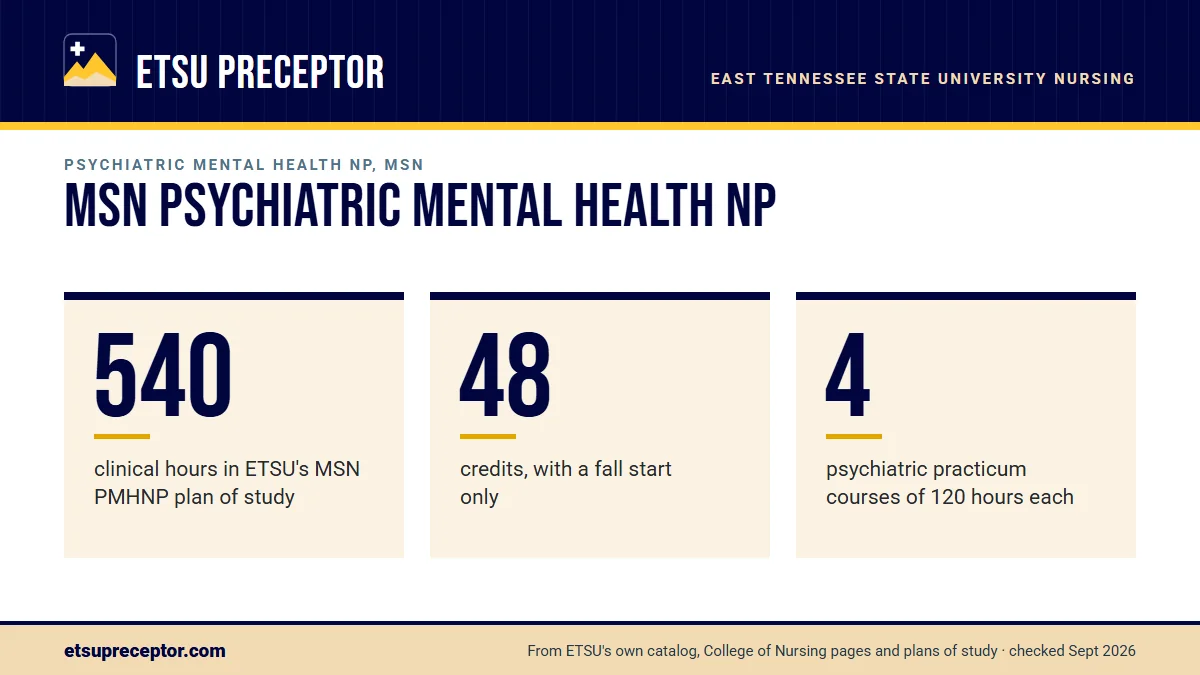
East Tennessee State University (ETSU) runs its MSN Psychiatric Mental Health Nurse Practitioner concentration online, with 540 clinical hours completed in person under preceptors near you. A lifespan health assessment practicum comes first, then four 120-hour psychiatric courses, and full-time students need a psychiatric preceptor by spring of their first year.
Plan your PMHNP placements
Tell us your pace and where you live.
What ETSU's PMHNP concentration covers
ETSU's PMHNP graduates are trained to assess and treat mental health conditions at every age, working with single patients as well as families and groups, in a range of settings. All coursework is online and asynchronous, and graduates are prepared for PMHNP certification.
The concentration admits once a year, in fall, with applications due May 1. The full-time plan takes five semesters and the part-time plan eight. Didactic anchors include NRSE 5303 Psychopharmacology and NRSE 5410 Interpersonal Treatment Modalities, and the two zero-credit interprofessional seminars, IPE 572E and IPE 672E, sit in the last two full-time semesters. Like every ETSU MSN student, you finish with a written comprehensive exam or a culminating experience.
The same practicum sequence opens ETSU's BSN-DNP PMHNP plan, which adds four DNP residencies after it; see the DNP PMHNP page if you are weighing the doctorate.
The practicum sequence in ETSU's plans
Across both paces, ETSU's 2023 plans total 540 clinical hours. Because the plans on ETSU's site predate the newest catalog, treat the plan you are issued as the final word.
| Course | Title | Hours | Full-time | Part-time |
|---|---|---|---|---|
NRSE 5010 | Advanced Health Assessment Lifespan Practicum | 60 | Fall 1 | Fall 1 |
NRSE 5405 | Advanced Family Psychiatric Nursing Care I Practicum | 120 | Spring 2 | Spring 5 |
NRSE 5409 | Psychiatric Nursing Care II Practicum | 120 | Summer 3 | Summer 6 |
NRSE 5411 | Interpersonal Treatment Modalities Practicum | 120 | Fall 4 | Fall 7 |
NRSE 6950 | Internship in Advanced Nursing Practice | 120 | Spring 5 | Spring 8 |
The three psychiatric practicums are covered course by course in ETSU PMHNP practicums, the capstone course in the PMHNP internship guide, and the first-term course in the health assessment practicum page.
Two title conflicts in ETSU's own plans
Two PMHNP course numbers carry different labels depending on which ETSU document you open. In the 2023 MSN plan, NRSE 5408 appears as a practicum, and NRSE 5411 is titled "Health Policy Leadership" with 120 hours beside it. The 2020 BSN-DNP plan instead treats NRSE 5408 as the didactic Care II course and names NRSE 5411 as the practicum in interpersonal treatment modalities.
The hour total is the same under either reading: NRSE 5010 plus four 120-hour psychiatric courses. What the conflict changes is which course number and title go on your Intent Form and your ProjectConcert entry. Before filing, settle both with the faculty teaching the course, and request the current Intent Form from the coordinator, since the one on ETSU's site has year choices that stop at 2021.
Put the course number your syllabus uses on every form. A mismatch between the Intent Form and ProjectConcert is an avoidable reason for a rejection.
Timing: the first psychiatric preceptor comes early
Full-time students take NRSE 5405 in spring of year one, a single semester after starting. The search for that psychiatric preceptor therefore runs during your first fall, while you are also in NRSE 5010 and three didactic courses. NRSE 5409 follows in summer, which ETSU treats as a full clinical semester, so a second psychiatric placement, or an extension with the first preceptor if faculty approve it, must be ready within months. The 2027 complete summer term runs May 17 to August 13 on the approved calendar.
Part-time students face the reverse pattern. After NRSE 5010 in fall 1, no practicum appears until spring 5, and then four run back to back through spring 8. The quiet middle semesters are the time to recruit preceptors who could host consecutive terms, because once the sequence starts there is no break to search.
No filing date or contract turnaround appears anywhere on ETSU's pages, so the coordinator is the person to ask how far ahead your cohort should submit.
Who can precept a psychiatric practicum
ETSU's live pages set no written list of accepted psychiatric preceptor credentials, no minimum years in practice and no ratio. What the Intent Form does collect is telling: sample credentials (FNP, ANP, MD), degrees held, each license number with its state and expiry, each certification number with its expiry, and the number of students the preceptor already oversees. Ask your course faculty which credentials they accept for each psychiatric course before you approach anyone.
Tennessee's nursing board adds a baseline in Rule 1000-01: your preceptor's license must sit at your target level or higher, carry no encumbrance, be issued by the state where the teaching happens, and match the competencies you are learning. The fuller picture is on who can precept an ETSU student.
Collaboration is part of the Tennessee picture too. Prescribing NPs in the state practice with a collaborating physician, and 2024 bills that would have exempted experienced psychiatric NPs did not pass, so a Tennessee psychiatric NP preceptor who prescribes has a physician collaborator in the background.
An ETSU training option worth asking about
ETSU's medical school has offered second-year PMHNP students a place on integrated primary care teams through its behavioral health institute, with the time counting toward NRSE 5411 and NRSE 6950. ETSU's page describes funded slots for academic years 2021 to 2025, and nothing published confirms a later round, so ask the coordinator before counting on it; our integrated behavioral health page has the details ETSU published.
Outside ETSU, federal shortage data shows the need in the region: HRSA's designated mental health shortage areas include a low-income catchment area covering Sevier County and the ETSU FQHC facility in Washington County. Several other regional mental health designations carry a proposed-withdrawal status, so treat them as uncertain.
How we support ETSU PMHNP students
Psychiatric placements reward a plan made early, and that plan is our specialty. We lay your four psychiatric courses onto their semesters, then search your own community for psychiatric preceptors whose patients reflect ETSU's lifespan focus. Where faculty allow it, we look for a preceptor who can host consecutive courses, so each new term does not mean a new search.
Each match comes ready for faculty review, with degrees, license and certification numbers and their expiration dates, the site's patient mix by age group, and the hours you plan to complete there. We point out the contract requirement at the outset, giving the College room to finalize it before your start date. Approval rests with your ETSU clinical faculty, and credential verification with the Office of Student Services; everything we send them is complete and built to ETSU's rules. Should a preceptor leave during a term, we start on a replacement at once. Use the form below to begin.
Questions ETSU students ask
Does ETSU's MSN PMHNP admit students in spring?
No. The PMHNP concentration starts in fall only, with applications due May 1; ETSU's only spring MSN intake is for FNP. Nurses who already hold an MSN and want to add the psychiatric specialty can look at ETSU's post-graduate PMHNP certificate, which admits in spring with a September 1 deadline.
When should I start looking for my first psychiatric preceptor?
Right after admission. Full-time students reach NRSE 5405 in their first spring, and ETSU sets no public cutoff for submitting a preceptor. Searching during your first fall, alongside NRSE 5010, leaves time for the paperwork, faculty sign-off and a site contract before the January start.
Can one preceptor host all four psychiatric courses?
ETSU publishes no rule against it. Each Intent Form is tied to one course, and faculty judge the preceptor against that course every time. A psychiatric clinician with a broad caseload across ages may suit several courses, but confirm with course faculty before you plan around a single person for the whole sequence.
What if my psychiatric preceptor leaves partway through a term?
Contact course faculty the same week. A new preceptor goes through the full approval path before any hours count with them. If the semester closes before your hours are done, ask about an Incomplete: it needs most of the work (75%) already complete, it must be cleared within a year, and holding two at once stops your progression.
Do PMHNP students have to come to campus?
ETSU describes all PMHNP coursework as online and asynchronous. The clinical hours are the in-person part, completed with preceptors at sites near where you live. If a course adds a synchronous session or an on-campus element for your cohort, your syllabus and course faculty will say so.
Related pages
Last checked 2026-09-25
We check these pages against ETSU's own catalog, College of Nursing pages, plans of study and ProjectConcert guides. Your plan of study, your syllabus, your course faculty and the graduate clinical coordinator have the final word.
ETSU asks you to lead the preceptor search. We make it the fastest part of your program.
Tell us your ETSU concentration, where you live and which semester your next practicum starts. We find preceptors who fit the course's patient population and prepare everything your Preceptor Intent Form and ProjectConcert entry need.
- Preceptors matched to the course: young and middle adults for
NRSE 5012, older adults forNRSE 5014, women forNRSE 5022, children forNRSE 5024, psychiatric care forNRSE 5405 - Credentials, license numbers, certification dates and the site's patient mix ready for faculty approval
- In your own community, in Northeast Tennessee or wherever ETSU approves your clinicals
Start your placement plan
Program, city and semester is all we need to begin.