Clinical hour logs, the patient journal and the self-scheduler
Graduate nursing students at East Tennessee State University (ETSU) plan clinical days in ProjectConcert's self-scheduler and record hours and a patient journal under Experience. Preceptors and course faculty review what you enter, so a current, accurate log is what turns clinical days into a completed practicum.
Get your placement plan
Tell us your ETSU program and where you live. A placement advisor replies with the preceptor and site options that fit your ETSU course.
Three records, one system
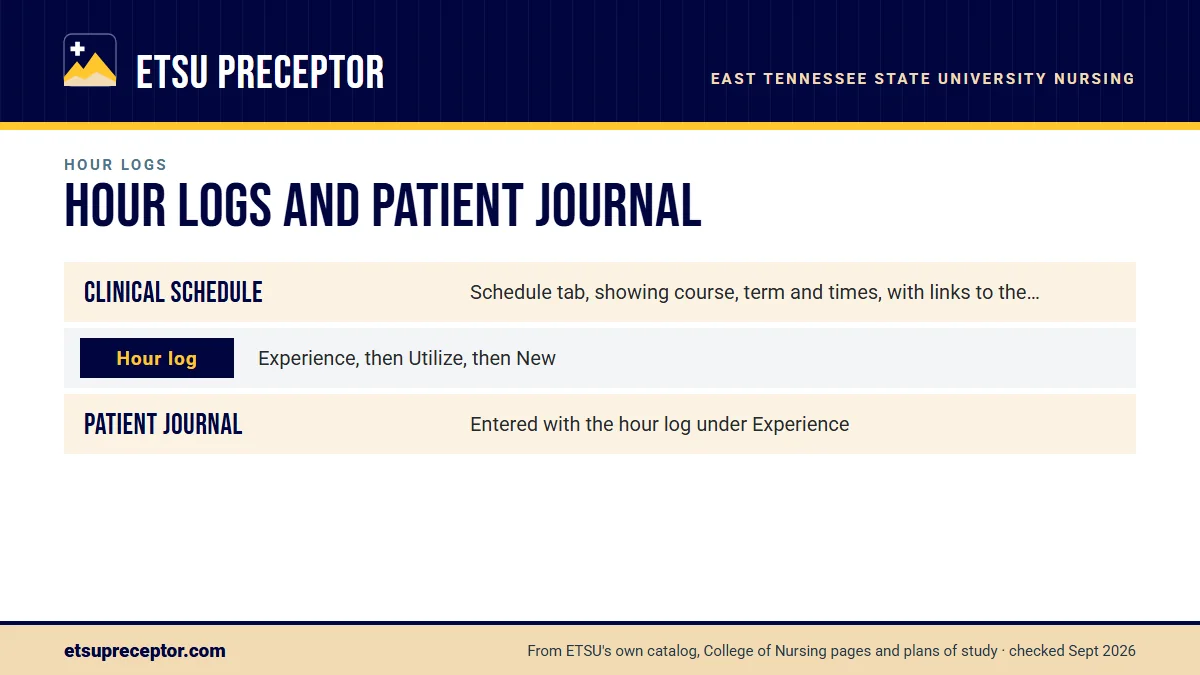
ETSU keeps three clinical records in ProjectConcert, each in its own part of the system, and they work best when they agree. The schedule says when you will be at the site, the hour log says how much time you spent, and the patient journal says what you saw and did.
| Record | Where in ProjectConcert | ETSU guide |
|---|---|---|
| Clinical schedule | Schedule tab, showing course, term and times, with links to the site, faculty and preceptor | Self-scheduler guide |
| Hour log | Experience, then Utilize, then New | Hour log and patient experience guide |
| Patient journal | Entered with the hour log under Experience | Hour log and patient experience guide |
ETSU's ITS page supplies the other half: the people who check your work, faculty and preceptors, approve it and pull reports from the same system. The ProjectConcert overview shows how these records sit beside your compliance file and your evaluations.
Build the schedule before the first clinical day
Agree on clinical days with your preceptor first, then enter them in the self-scheduler. Because the Schedule tab ties each day to the course and term and links it to the site, the faculty member and the preceptor, an early schedule lets course faculty see your plan before hours start to add up.
Plan against the course's full hour total, not a round number of weeks. A 120-hour NP practicum and a 180-hour administration practicum ask very different things of a preceptor, and the summer complete term runs about 13 weeks against fall's 15. The hours-per-credit page converts each total into a weekly pace.
When a preceptor's availability shifts, change the schedule to match the days you will actually attend rather than leaving old dates in place.
Logging hours and journal entries
Open Experience, choose Utilize, then New: that is where ETSU's October 2024 guide places both the hour log and the patient journal. ETSU's public pages do not list the journal's required fields or how many entries a course expects, so read the practicum syllabus in D2L alongside the guide and ask course faculty about anything it leaves open.
Habits that keep a log clean
- Enter each day's hours exactly as worked, matching the days in your schedule.
- Write journal entries without names, dates of birth or other identifiers, as your ETSU HIPAA training teaches.
- Keep days with a second preceptor clearly separate, so each preceptor reviews only the time they supervised.
- Compare your running total with the course total every couple of weeks, not only in the final month.
- When a preceptor asks for a correction, make it promptly so the entry is ready for review again.
How preceptors and faculty review your log
Review happens inside ProjectConcert as well. Your preceptor's way in is the Preceptor Welcome Email from the Graduate Clinical Placement Coordinator, which arrives once the preceptor is approved. If that email never reached your preceptor, raise it with the coordinator before unreviewed hours pile up.
ETSU's separate preceptor hour-approval guide opened as a web page rather than a document when this page was checked, so the approval screens themselves are not described here. The practical step is simple: ask your preceptor to sign in during your first week and confirm they can see your entries.
DNP residencies add another reviewer. A 2020 ETSU project guide has the DNP project chair confirm residency hours as each semester closes; the preceptor evaluations page covers that step with the mid-term and final evaluations.
Which hours count, and when counting starts
Your hours count toward the total in your plan of study, and the clinical hours page lists every program's figure, including where ETSU's sources disagree. Two ETSU DNP rules shape residency logs. Interprofessional time, a minimum of 40 hours, sits inside the program total, and Residency I sets aside 40 supervised practicum hours for students entering from the BSN or changing specialty, so mark those days clearly.
Counting begins once the placement is cleared. Under the Preceptor Intent Form, clinicals begin only after faculty approve the preceptor, the Office of Student Services verifies them, the site's contract is signed and your own requirements are complete, so set your first logged day after all four.
Shadowing days at a site before those four conditions are met fall outside ETSU's rule for starting clinicals. Ask course faculty before you count any of them.
When the log falls behind
A log short of its total near the end of term calls for a talk with course faculty early, well before Fall 2026's December 5 to 10 exam week.
ETSU's graduate rules set the limits. An Incomplete is granted only when three-quarters of the course work is finished and the shortfall comes from circumstances outside your control; the rest is due within a calendar year, after which the I turns into an F. Nursing adds a limit of its own: holding more than one Incomplete stops progression. Tell your preceptor as well, since a few added days now can close a gap that an Incomplete would carry into the next term.
Every graduate nursing course also needs a final grade of B or higher. The incompletes and leave page sets out those rules, and behind on clinical hours covers practical ways to recover a term.
How we keep your hours on pace
We place ETSU students with preceptors whose calendars can hold the whole course total inside the term, and we settle clinical days before your first shift so the self-scheduler reflects a real plan. Your placement advisor checks that the preceptor expects the welcome email and knows they will review your hours in ProjectConcert. When a site needs a new contract, we flag it before the term so a late contract leaves your hours untouched.
Through the term we stay on call. If a preceptor cuts days or leaves, we line up a replacement in your area and prepare the new ProjectConcert entry, so your log keeps growing toward its total. Start on our contact page or with the form below.
Questions ETSU students ask
Does my preceptor need a ProjectConcert account to approve my hours?
Yes. ETSU describes preceptors reviewing and approving student submissions inside ProjectConcert, with the username that arrives in their welcome email after approval. If your preceptor cannot find that email, ask the Graduate Clinical Placement Coordinator to confirm it went to the address your preceptor actually checks.
What goes in the ProjectConcert patient journal?
The journal records the patients and cases you saw on each clinical day, entered together with your hours under Experience. ETSU's public pages leave the required fields and the number of entries to each course, so your syllabus and course faculty set them. Leave out anything that could identify a patient.
How often should I log my clinical hours?
ETSU's public pages set no logging deadline, though a course syllabus may. Logging within a day or two keeps times accurate and lets your preceptor review a few entries at once instead of a whole month at the end of term, when a correction is harder to make.
Can I change my clinical days in the self-scheduler mid-term?
ETSU's self-scheduler guide covers building the schedule and describes no separate change process. Agree any change with your preceptor first, update the schedule so it shows the days you will really attend, and tell course faculty if the change moves the date you expect to reach your hour total.
Do hours at my own workplace count?
The Intent Form has a question about whether the agency employs you, but ETSU publishes no graduate rule for or against it. For the RN to BSN, full-time direct-care nurses may complete NRSE 4026 at their employer. For graduate courses, hours there count once that preceptor and site clear the same approvals as any other. See working where you work.
Related pages
Last checked 2026-09-25
We check these pages against ETSU's own catalog, College of Nursing pages, plans of study and ProjectConcert guides. Your plan of study, your syllabus, your course faculty and the graduate clinical coordinator have the final word.
ETSU asks you to lead the preceptor search. We make it the fastest part of your program.
Tell us your ETSU concentration, where you live and which semester your next practicum starts. We find preceptors who fit the course's patient population and prepare everything your Preceptor Intent Form and ProjectConcert entry need.
- Preceptors matched to the course: young and middle adults for
NRSE 5012, older adults forNRSE 5014, women forNRSE 5022, children forNRSE 5024, psychiatric care forNRSE 5405 - Credentials, license numbers, certification dates and the site's patient mix ready for faculty approval
- In your own community, in Northeast Tennessee or wherever ETSU approves your clinicals
Start your placement plan
Program, city and semester is all we need to begin.