ETSU MSN-to-DNP: four residencies and a project site from day one
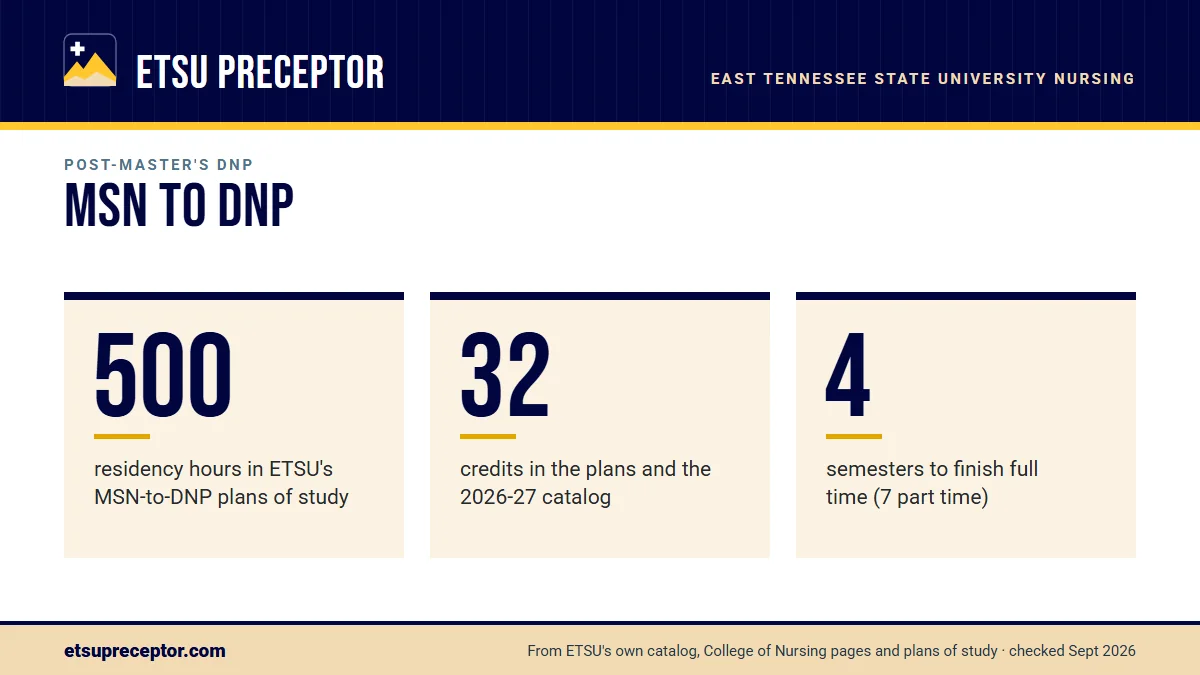
East Tennessee State University (ETSU) admits master's-prepared nurses to the DNP each summer. ETSU's plans list 32 credits and 500 clinical hours, spread over four residencies of 125 hours each and all tied to your DNP project, and a full-time student starts Residency I in the first term. The organization that will host your project is the first placement to secure.
Line up your DNP project site
Tell us your MSN specialty, your planned concentration and where you live.
The MSN-to-DNP at a glance
The post-master's route serves nurses who already hold an MSN, and ETSU's DNP admission page also lists RNs with a non-nursing master's degree among those who may apply. The committee weighs GPA, a writing sample and interview, work experience, honors and interest in rural and underserved groups. No GRE is required.
Admission happens once a year for a summer start, with applications due March 1. You can follow the FNP, PMHNP or Executive Leadership concentration. Full time takes four semesters and part time seven.
Most ETSU sources line up for this route. Both the 2020 plans and the current catalog put the clock-hour total at 500, and the plans, the catalog and ETSU Online agree on 32 credits. The outlier is the College's DNP page, which lists 40 credits for MSN entry, so check the credit total printed on your own plan of study.
Your first residency starts in your first term
Full-time students take NRSE 6801 Residency I in Summer 1, the same term they enroll. Residency I is where the project gets identified, and a site-based project needs its host's agreement before faculty sign off, so for MSN entrants the host conversation belongs in the months between acceptance and the first day of class.
No ETSU page sets a date for naming a site or says how long contracts take. The one fixed rule is that the contract comes before any clinical time, and an organization hosting its first ETSU student will need the whole paperwork cycle. Waiting for the summer term to open leaves little room for it.
Expect one mismatch in the forms. ETSU's posted Intent Form lumps all four residencies under the retired number NRSE 6800, so request the current form from the graduate clinical coordinator before you send anything to a host.
Full-time MSN-to-DNP students begin Residency I in their first summer, so finding a project host starts before classes do.
Four residencies, full time and part time
The same four residencies appear in every MSN-to-DNP concentration, each worth 3 credits. Only their timing changes with your pace, and in both plans the sequence opens and closes in a summer term.
For a 2027 entrant, ETSU's approved calendar sets the complete summer term at May 17 to August 13, so a full-time student's first residency hours fall inside that window.
| Residency | Focus | Full-time term | Part-time term | Hours |
|---|---|---|---|---|
NRSE 6801 | Project identification | Summer 1 | Summer 4 | 125 |
NRSE 6802 | Project development | Fall 2 | Fall 5 | 125 |
NRSE 6803 | Project implementation | Spring 3 | Spring 6 | 125 |
NRSE 6804 | Evaluation and dissemination | Summer 4 | Summer 7 | 125 |
Part-time students spend their first three semesters on coursework alone, which leaves more time to secure a host before Summer 4. What happens inside each residency, from evaluations to the project chair's sign-off, is on the DNP residencies page.
What sits beside the residencies, by concentration
Each concentration adds its own doctoral courses around the residencies. The FNP full-time plan also lists NRSE 5100 and NRSE 5030 in Summer 1, NRSE 6050 in Fall 2 and NRSE 6713 in Spring 3.
| Concentration | Concentration courses | Plan totals |
|---|---|---|
| FNP | NRSE 6614 Advanced Intervention DNP Practicum, NRSE 6613 Advanced Nursing for Rural/Underserved Populations, an elective | 32 credits, 500 hours |
| PMHNP | NRSE 6414 Neurobiology of Psychiatric Disorders, NRSE 6415 Mental Health Care Delivery Systems, an elective | 32 credits, 500 hours |
| Executive Leadership | NRSE 6712 Strategic Fiscal Management, NRSE 6714 Executive Leadership, NRSE 6715 Contemporary Problems in Executive Leadership | 32 credits, 500 hours |
NRSE 6614 carries the word practicum in its title, yet the MSN-to-DNP FNP plan assigns it no clinical hours beyond the residencies. Ask your course faculty whether it involves site time in your year before Fall 2.
Same specialty or a new one
Your MSN specialty decides how simple your plan is. ETSU says MSN holders certified in the concentration they choose can finish in four semesters. Students changing concentration receive an individual plan instead of the standard one.
Changing specialty also adds clinical time. Under the current catalog, specialty changers owe supervised practicum hours inside Residency I, and any specialty practicums written into an individual plan will each need a preceptor whose patients match that course. Ask for the full list of clinical courses when your individual plan is drawn up.
ETSU also leaves one gap unfilled: none of its pages says whether you must prove a set number of precepted hours from your master's program. The MSN-entry plans list the four residencies and nothing more. If your master's was in a non-clinical specialty, bring this up with your advisor at the start. Every ETSU DNP hour figure is compared on the DNP clinical hours page.
Where your residency hours can happen
Residency time can be spent close to home once ETSU approves the site, and the organization where you already work may be the first place you look. The Intent Form does ask whether the agency employs you and whether you trained there before; ETSU has published nothing that rules an employer in or out. Our page on clinicals where you work covers how to make that case.
The DNP-wide interprofessional requirement applies to you as well: a minimum of 40 practicum hours alongside other professions, counted within your total. On the standard MSN-entry plan the residencies are the only clinical courses listed, so settle early where those hours will fit; the interprofessional hours page lays out the options.
If you live outside Tennessee, ETSU weighs each out-of-state graduate clinical individually, and regulators in that state have to approve it. ETSU also publishes two DNP licensure lists that part ways on several states; see licensure disclosures.
Why MSN-prepared nurses choose us for the DNP
The MSN-to-DNP is short, and its first clinical course comes immediately, so speed matters. We identify organizations near you that suit your project and concentration, open the conversation about hosting a DNP project, and have the details ready for your faculty before Summer 1 or Summer 4.
For specialty changers, we also find the precepted practicum sites your individual plan requires. Each request carries the site and preceptor details the Intent Form and ProjectConcert ask for, and we tell the College about a new host early so its contract can be drafted. Faculty approve and the College verifies; our part is a complete, rule-ready submission. If a host or preceptor falls through partway through a residency, we source a new one without delay. Tell us your MSN specialty and start term.
Questions ETSU students ask
When does ETSU's MSN-to-DNP start?
Summer only. ETSU's DNP pages set a March 1 application deadline for the MSN-to-DNP and a May 1 deadline for BSN-to-DNP, which starts in fall. Full-time MSN-entry students begin Residency I in that first summer, so plan your project site conversation for the spring before you start.
Do I need a preceptor for the MSN-to-DNP residencies?
ETSU's 2020 project guide assumes one. Under that guide your preceptor evaluates you in ProjectConcert each residency term, separately from faculty, and your project chair signs off on the logged hours. Students changing specialty also owe supervised practicum hours in Residency I. Confirm the preceptor role for your project with your course faculty.
Can I apply with a non-nursing master's degree?
ETSU's DNP admission page lists RNs with a non-nursing master's degree among eligible applicants, alongside BSN and MSN holders. Your plan may differ from the standard 32-credit MSN-to-DNP plan, so ask admissions and the DNP program director which courses and clinical hours you would need.
How long does the part-time MSN-to-DNP take?
Seven semesters in ETSU's part-time plans. The first three semesters carry no residency; Residency I starts in Summer 4 and the last residency, NRSE 6804, finishes in Summer 7. The Graduate School allows seven years to complete a doctorate, so part-time study fits well inside that limit.
Is the MSN-to-DNP 32 or 40 credits?
ETSU's 2020 plans, the 2026-27 catalog and ETSU Online all list 32 credits, while the College's DNP page gives 40 for MSN-to-DNP. No ETSU page accounts for the gap. Treat your plan of study as the working document, and if its total differs from what you see online, raise it with your advisor.
Related pages
Last checked 2026-09-25
We check these pages against ETSU's own catalog, College of Nursing pages, plans of study and ProjectConcert guides. Your plan of study, your syllabus, your course faculty and the graduate clinical coordinator have the final word.
ETSU asks you to lead the preceptor search. We make it the fastest part of your program.
Tell us your ETSU concentration, where you live and which semester your next practicum starts. We find preceptors who fit the course's patient population and prepare everything your Preceptor Intent Form and ProjectConcert entry need.
- Preceptors matched to the course: young and middle adults for
NRSE 5012, older adults forNRSE 5014, women forNRSE 5022, children forNRSE 5024, psychiatric care forNRSE 5405 - Credentials, license numbers, certification dates and the site's patient mix ready for faculty approval
- In your own community, in Northeast Tennessee or wherever ETSU approves your clinicals
Start your placement plan
Program, city and semester is all we need to begin.