Finding your own preceptor at ETSU: what "be proactive" means for your program
East Tennessee State University (ETSU) puts the preceptor search in the hands of its graduate nursing students, with the graduate clinical coordinator supplying contacts and names of past preceptors. The ETSU-TTU joint DNP words it as a shared effort, and the BSN tracks are assigned by the College. Here is how the rule plays out in each program, and how to act on it.
Get your placement plan
Tell us your ETSU program and where you live. A placement advisor replies with the preceptor and site options that fit your ETSU course.
The sentence behind the search
ETSU Online's MSN FAQ answers the placement question in two parts. First, it says the graduate clinical coordinator can draw on a wide network and on records of earlier preceptors. Second, it states that "the student is responsible to be proactive in the preceptor and clinical site search." The ETSU DNP FAQ and the post-graduate certificate FAQ carry the same message.
Read together, the two halves describe a division of labor. The coordinator is a resource you can draw on; the search itself, the calls, the site visits and the follow-up, sit with you. Clinical faculty still decide whether the preceptor you bring fits the course, so being proactive means bringing a candidate who can pass that review, not just any available clinician.
Tennessee's Board of Nursing rules do not say whether the school or the student must find APRN preceptors, so ETSU's own program pages set the expectation.
Program by program
The FAQ wording is shared, but each program adds its own detail about where clinicals happen and who can supervise them.
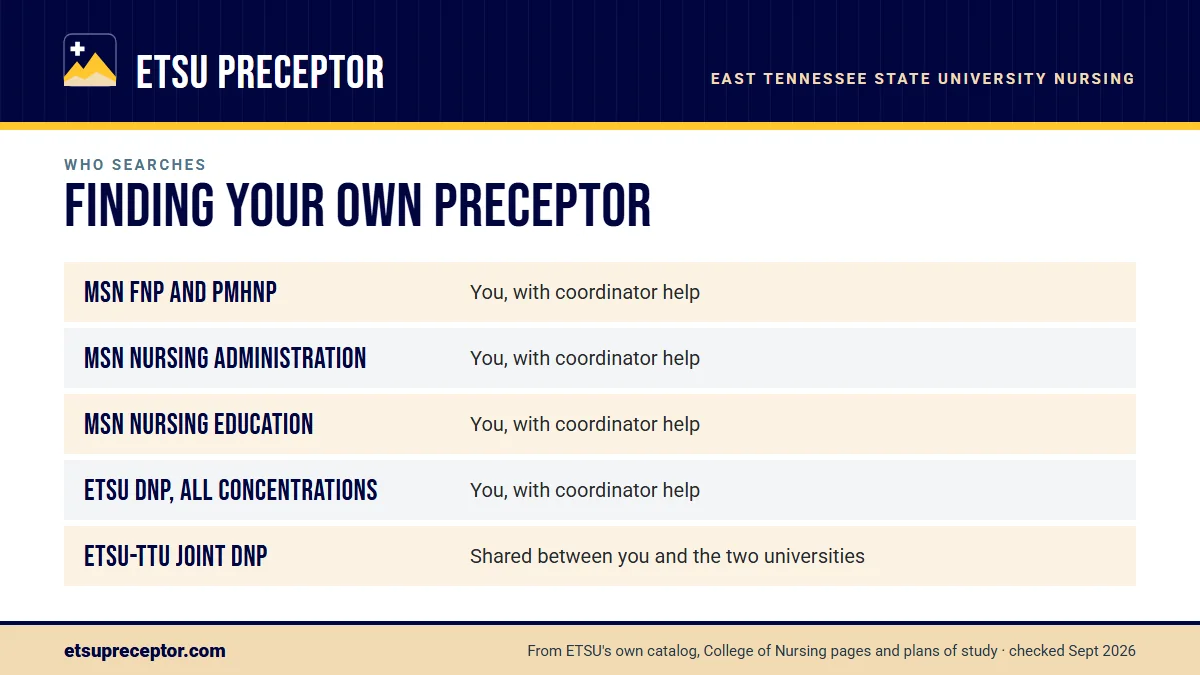
| Program | Who leads the search | What ETSU's page adds |
|---|---|---|
| MSN FNP and PMHNP | You, with coordinator help | Coursework is online; practicums happen in person under a preceptor near you |
| MSN Nursing Administration | You, with coordinator help | Three practicum courses with a preceptor at a location near you; no campus visits |
| MSN Nursing Education | You, with coordinator help | Education practicums need an on-site presence with a preceptor |
| ETSU DNP, all concentrations | You, with coordinator help | Hours may be done in your home community if approved |
| ETSU-TTU joint DNP | Shared between you and the two universities | ETSU and TTU hold many existing agreements with sites and preceptors |
| Post-graduate certificates | You, with coordinator help | Clinicals are in person; local or distance placement is arranged with the College as needed |
| RN to BSN | Your employer or the College | Full-time direct-care RNs may complete NRSE 4026 where they work |
| BSN, Accelerated BSN, LPN to BSN | The College assigns | LPN to BSN clinicals stay inside Tennessee |
DNP students have one extra search of their own: no fewer than 40 practicum hours of interprofessional work, either in a formal interprofessional clinic or set up personally with course faculty, the academic advisor and partners at the organization. Our page on DNP interprofessional hours covers it.
Where the College assigns instead
Prelicensure BSN students, whether traditional, accelerated or LPN to BSN, skip the search entirely. The College places them, and the undergraduate catalog cautions that a given course may not run each term at each campus or clinical facility. A student repeating a clinical course may need to travel or wait for an open clinical space, at the student's own cost.
For LPN to BSN students, clinical sites sit in Northeast, East or Middle Tennessee, and the program page rules out any placement beyond the state line. It also warns of long drives, nights away from home and weekend shifts of 12 hours. Our BSN clinicals page has the detail.
RN to BSN sits in between. An RN working full time in direct patient care can complete the final practicum at a current employer, while an RN outside direct care works with the College to arrange one.
What a proactive search looks like
Start from the course, not from whoever happens to have an open calendar. Each practicum has a population focus, and the Intent Form asks for the site's patient counts across children, adolescents, women, adults and older adults, so a pediatric course needs a site that sees many children.
Places ETSU students can look
- The graduate clinical coordinator's past-preceptor lists, especially for your county
- Your own employer, if the site fits the course and faculty agree (see clinicals where you work)
- The College's nurse-led clinics through the Office of Practice request windows
- For second-year PMHNP students, Quillen's Institute for Integrated Behavioral Health training, whose status after 2025 is unclear
- Independent practices and community clinics in your area
Large health systems publish their own terms. Ballad Health, for example, says on its own site that advanced practice students reach it through their school's clinical coordinator, and only under an active affiliation agreement with Ballad. Keep a simple log of every practice you contact and every reply.
Searching from outside Tennessee
Online graduate students often live outside Tennessee, and the search works the same way with one added layer. ETSU makes out-of-state graduate clinicals conditional on sign-off from the relevant regulators, and it looks at each request individually once a student has been admitted.
Your RN license also has to match where you train: the MSN asks for an unencumbered RN license issued by Tennessee or by the state that hosts your clinicals. Check both points before you commit a preceptor in another state, and read our guide to clinicals outside Tennessee for the full picture.
If you applied from outside Tennessee, ETSU expected you to check with your home state's nursing board first. Its two published licensure disclosures also disagree about some states, and our licensure disclosures page lines them up.
Why ETSU students hand the search to us
ETSU hands you the search; we turn it into a quick, thorough one. Your placement advisor phones practices near you whose patients fit the course, checks that the preceptor can cover the hours on your plan of study, and collects the credential details the Preceptor Intent Form asks for.
You keep the coordinator's lists as a second track, and you get a candidate ready for faculty review. The approval call stays with your course faculty, and they receive a candidate whose paperwork is already whole. If a preceptor leaves partway through the term, we go back to work on a new match for you. Compare the options on our page about placement help versus searching alone, or use the form below.
Questions ETSU students ask
Does ETSU find preceptors for MSN students?
ETSU helps but does not take over the search. The MSN FAQ says the graduate clinical coordinator has contacts and lists of past preceptors, and that the student must be proactive in finding the preceptor and site. In practice you bring a candidate, and that candidate then goes through faculty review and a credential check before clinicals begin.
Will the coordinator give me a list of preceptors near me?
ETSU says the coordinator keeps lists of past preceptors to help students, so asking for names in your area is a reasonable first step. ETSU does not publish what those lists contain or how current they are. Treat any name as a lead to contact yourself, and confirm the preceptor still takes students before you fill in any forms.
Can I do ETSU clinicals in my hometown?
For graduate programs, generally yes. The DNP FAQ allows clinical hours in your home community once approved, and the MSN practicums run under a preceptor near you. If home is outside Tennessee, ETSU reviews out-of-state clinicals case by case after admission, and your RN license must fit the state where you train.
What if I cannot find a preceptor before the term starts?
ETSU does not publish a set consequence, so bring the gap to your course faculty and the coordinator as soon as it appears. Moving between full-time and part-time study takes a written request, which the Office of Student Services weighs against available clinical slots. Our page for students who cannot find a preceptor lays out options.
Do Accelerated BSN students ever arrange their own clinicals?
No. ETSU's College of Nursing assigns clinical groups for every prelicensure track (traditional, accelerated and LPN to BSN), in Johnson City, Kingsport, Sevierville or the LPN to BSN regions. The catalog warns that a course is not offered at every site each semester, so a repeated clinical may mean travel or waiting for space.
Related pages
Last checked 2026-09-25
We check these pages against ETSU's own catalog, College of Nursing pages, plans of study and ProjectConcert guides. Your plan of study, your syllabus, your course faculty and the graduate clinical coordinator have the final word.
ETSU asks you to lead the preceptor search. We make it the fastest part of your program.
Tell us your ETSU concentration, where you live and which semester your next practicum starts. We find preceptors who fit the course's patient population and prepare everything your Preceptor Intent Form and ProjectConcert entry need.
- Preceptors matched to the course: young and middle adults for
NRSE 5012, older adults forNRSE 5014, women forNRSE 5022, children forNRSE 5024, psychiatric care forNRSE 5405 - Credentials, license numbers, certification dates and the site's patient mix ready for faculty approval
- In your own community, in Northeast Tennessee or wherever ETSU approves your clinicals
Start your placement plan
Program, city and semester is all we need to begin.