ETSU BSN-to-DNP Family Nurse Practitioner: nine semesters of clinical sites
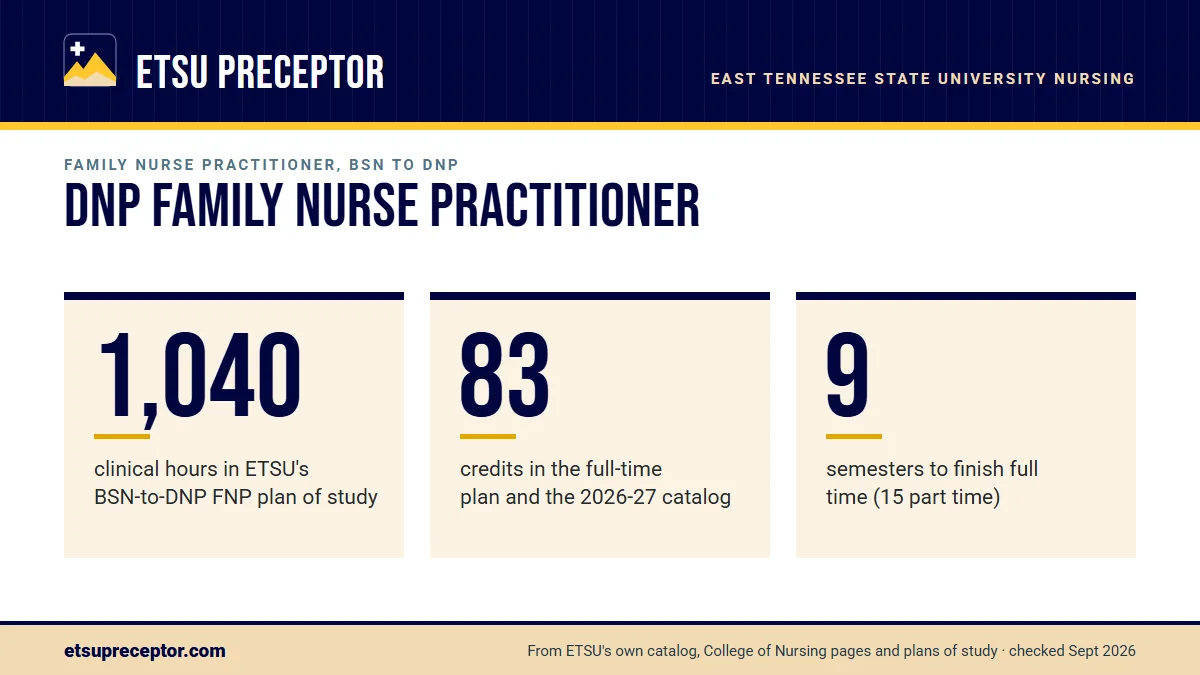
East Tennessee State University (ETSU) lets BSN-prepared nurses go straight to the Doctor of Nursing Practice in the Family Nurse Practitioner concentration. ETSU's plan of study lists 83 credits and 1,040 clinical hours: five precepted practicums across the lifespan, then four 125-hour residencies built around your DNP project. You lead the search for every site, and the graduate clinical coordinator can help.
Map your DNP FNP placements
Share your start year, your pace and your home county. We plan each practicum and residency site in order.
How the BSN-to-DNP FNP is built
ETSU describes its DNP as centered on rural clinical practice in primary care, and the FNP concentration prepares you to care for patients across the lifespan. Graduates are eligible for FNP national certification. Coursework is online and blended, and ETSU allows clinical hours where you live, subject to approval.
The BSN entry route opens once a year, for fall, and its applications close on May 1. Full time runs nine semesters and part time fifteen. ETSU's 2020 full-time plan and the 2026-27 catalog both give 83 credits, while the College's DNP page quotes a BSN-to-DNP range of 82 to 86, so rely on the plan of study that matches your catalog year.
The first five semesters mirror ETSU's MSN FNP course for course. The last four add doctoral coursework and the residencies. That split shapes the whole search: the first half calls for clinicians whose patients fit each population course, and the second half calls for an organization willing to host a project.
Nine semesters, nine clinical courses
This is where each clinical course falls in the full-time plan. The hours come from ETSU's BSN-to-DNP FNP plan dated 2020, so hold every figure up against your own copy of the plan.
| Semester | Clinical course | Hours | Population or focus |
|---|---|---|---|
| Fall 1 | NRSE 5010 Advanced Health Assessment Lifespan Practicum | 60 | All ages, lab practice plus a clinical placement |
| Summer 3 | NRSE 5012 Nurse Practitioner I Practicum | 120 | Young and middle adults |
| Summer 3 | NRSE 5022 Women's Health Practicum | 120 | Women |
| Fall 4 | NRSE 5014 Nurse Practitioner II Practicum | 120 | Older adults |
| Spring 5 | NRSE 5024 Children and Adolescents Practicum | 120 | Children and adolescents |
| Summer 6 | NRSE 6801 Residency I | 125 | DNP project identification |
| Fall 7 | NRSE 6802 | 125 | DNP project development |
| Spring 8 | NRSE 6803 | 125 | DNP project implementation |
| Summer 9 | NRSE 6804 | 125 | DNP project evaluation and dissemination |
Semester 3 is the heaviest stretch, because the women's health and young-adult practicums share one summer and each needs its own site. Our guides to the young and middle adults practicum and the women's health practicum explain what each population course asks of a preceptor.
Part time: fifteen semesters with gaps between sites
The part-time plan spreads the same nine clinical courses across fifteen terms, and the gaps between them grow. The table sets the two paces side by side.
| Clinical course | Full-time term | Part-time term |
|---|---|---|
NRSE 5010 | Fall 1 | Fall 1 |
NRSE 5012 | Summer 3 | Summer 3 |
NRSE 5022 | Summer 3 | Summer 6 |
NRSE 5014 | Fall 4 | Fall 7 |
NRSE 5024 | Spring 5 | Spring 8 |
NRSE 6801 to NRSE 6804 | Summer 6 to Summer 9 | Summer 12 to Summer 15 |
Long gaps change how you search. A clinician who agrees in year one may have changed practices or taken other students by the time a later course arrives, and the Intent Form asks for license and certification numbers with expiration dates that must still be current. Reconfirm each preceptor a semester ahead rather than relying on an early yes.
Keep the calendar in view as well. ETSU gives doctoral students seven years to finish, a clock that starts when your first counted term ends, and a non-military leave of absence does not pause it. Fifteen semesters fits, but a stalled placement or a repeated course narrows the margin; the time limits page covers leave and extensions.
The doctoral semesters: residencies plus coursework
From Summer 6 on, each term pairs a residency with doctoral coursework. Summer 6 adds NRSE 5100 Principles of Population Health and Data Analysis and NRSE 5030 Scholarly Writing. Fall 7 brings NRSE 6050 on quality and translation plus NRSE 6614 Advanced Interventions. Spring 8 adds NRSE 6713 Systems Management, and Summer 9 closes with NRSE 6613, the course on rural and underserved populations, plus an advisor-approved elective. NRSE 6400, on mental health outcomes in primary care, lands in Spring 8 if you have not already taken it.
NRSE 6614 is worth a direct question. The part-time plan titles it a DNP practicum yet assigns it no clinical hours, so ask your course faculty whether it calls for a preceptor or site time in your year before you lock in fall plans.
Each residency carries 3 credits and 125 hours, and Residency I includes 40 supervised practicum hours for BSN-entry students. How those hours, the site agreement and your project chair fit together is set out on the DNP residencies page. Note that the 2026-27 catalog lists 1,000 clock hours for BSN-to-DNP rather than 1,040, and ETSU does not explain the difference; the DNP clinical hours page sets the figures side by side.
Two scheduling pieces: interprofessional hours and intensives
Every ETSU DNP concentration needs at least 40 practicum hours in an interprofessional experience, and they count inside your total rather than on top of it. Decide which practicum or residency will carry them and get faculty agreement before those hours begin. The interprofessional hours page compares the formal-clinic route with an experience you arrange yourself.
ETSU also describes its required DNP intensives in more than one way. The College's DNP page says they happen one to two times per semester. The ETSU Online DNP page speaks of an intensive lasting two to five days as each semester opens, attended on site or over Zoom; another passage on that page calls for one on-campus intensive per semester, and its FAQ puts the length at two to three days.
Because intensives sit at the start of a term, exactly when clinical schedules are being set, get your intensive dates from the program before you give a preceptor a first clinical day.
Ready before your first clinical course
The DNP catalog lists what must be in place before any clinical course. For FNP students the first clinical course arrives in the very first fall, so this checklist belongs in your summer before you start.
- An RN license or authorization to practice in Tennessee or a compact state
- Professional malpractice insurance at the nurse practitioner student limits the College sets
- Current CPR and knowledge of universal precautions
- The College of Nursing clinical requirements, tracked in ProjectConcert
- A criminal background check through the vendor the College specifies; clinical agencies review the results and decide
- Your own transportation to clinical sites
The Intent Form also lists liability insurance among the clinical requirements to meet before clinicals start, and the malpractice insurance page explains what the form and ETSU's catalog each say about coverage.
Why ETSU BSN-to-DNP FNP students choose us
A nine-semester FNP doctorate means up to nine site decisions, and we plan them as one sequence. We find family practice, women's health, geriatric and pediatric preceptors in person in your own community, matched to the population each practicum names, and we start lining up a project-ready organization long before Summer 6.
Every file we assemble is shaped for ETSU's process: which licenses and board certifications the preceptor holds and when each one expires, their degrees, the age groups the practice sees and the hours you intend to spend there, ready to drop into the Intent Form and your ProjectConcert onboarding submission.
We bring up the site contract at our very first call, giving the College room to arrange it. Your clinical faculty decide on each preceptor while the Office of Student Services handles the credential check, and we hand both a submission with nothing missing. When a preceptor has to leave partway through a course, we source the next one. Send us your semester map.
Questions ETSU students ask
Can I start ETSU's BSN-to-DNP FNP in spring?
Not under ETSU's published admission terms. BSN-entry students begin only in fall, after a May 1 application deadline, and MSN-entry students begin in summer after a March 1 deadline. The spring intake with a November 1 deadline belongs to the MSN FNP, a separate program. If a spring start matters to you, compare the two with an ETSU graduate advisor before you apply.
Are the DNP FNP practicums the same courses as the MSN FNP practicums?
Yes, in ETSU's plans of study. Semesters 1 to 5 of the full-time BSN-to-DNP FNP plan match the MSN FNP plan: the health assessment practicum plus the four population practicums, 540 hours in all. The difference is what follows them: four DNP residencies and doctoral coursework in semesters 6 through 9.
How long can I take to finish the ETSU DNP?
ETSU's Graduate School allows seven years for doctorates other than the EdD, beginning when the first term that counts toward your program ends. A leave of absence for personal or family reasons leaves that limit unchanged; military leave is the exception and can add as many as three semesters. Courses that expire can be revalidated only with the Graduate Dean's approval.
Is it possible to use the same preceptor for two FNP population courses?
ETSU publishes no rule limiting a preceptor to a single course. Faculty judge each placement against that course's population focus, drawing on the patient-mix figures you enter on the Preceptor Intent Form for each age group and for women. Ask your course faculty before you plan to reuse a site for a second population course.
What grade do I need in an ETSU DNP practicum?
The College of Nursing sets B as the minimum passing grade in each graduate nursing course, and its scale places a B between 84 and 92. A grade below B allows one repeat, and every attempt counts in your graduate GPA. In a nine-semester sequence a repeated practicum can push back each later placement, so talk to your course faculty early if a course is at risk.
Related pages
Last checked 2026-09-25
We check these pages against ETSU's own catalog, College of Nursing pages, plans of study and ProjectConcert guides. Your plan of study, your syllabus, your course faculty and the graduate clinical coordinator have the final word.
ETSU asks you to lead the preceptor search. We make it the fastest part of your program.
Tell us your ETSU concentration, where you live and which semester your next practicum starts. We find preceptors who fit the course's patient population and prepare everything your Preceptor Intent Form and ProjectConcert entry need.
- Preceptors matched to the course: young and middle adults for
NRSE 5012, older adults forNRSE 5014, women forNRSE 5022, children forNRSE 5024, psychiatric care forNRSE 5405 - Credentials, license numbers, certification dates and the site's patient mix ready for faculty approval
- In your own community, in Northeast Tennessee or wherever ETSU approves your clinicals
Start your placement plan
Program, city and semester is all we need to begin.