ETSU's DNP residencies, NRSE 6801 to NRSE 6804
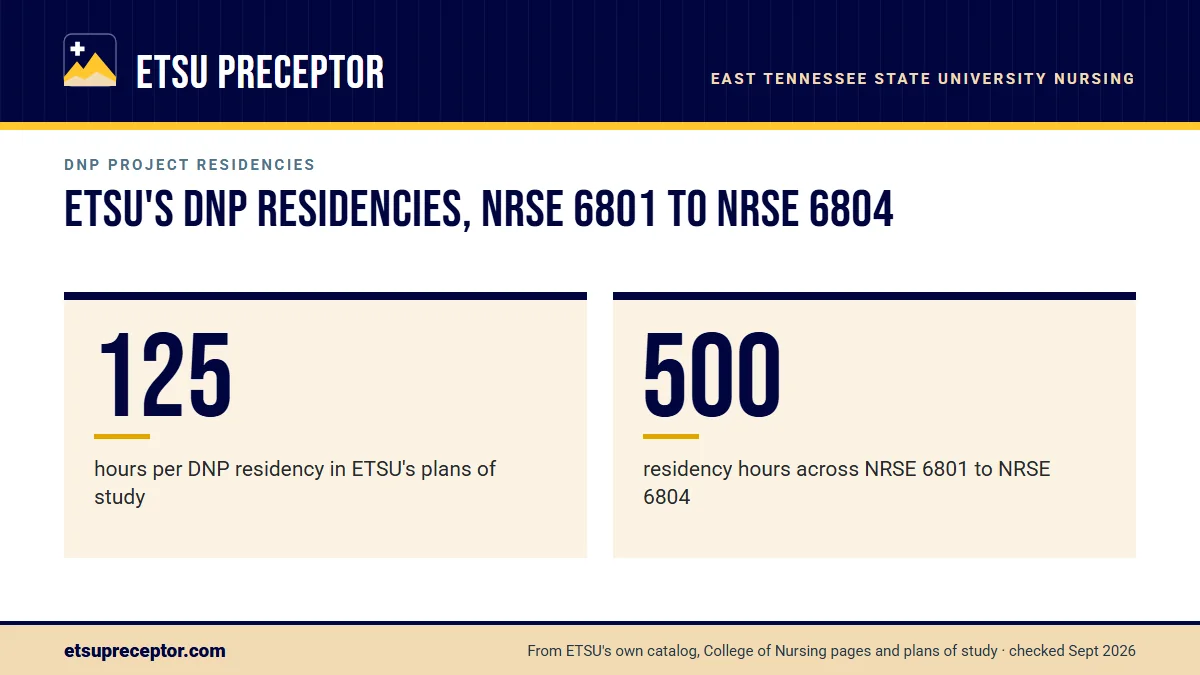
Every East Tennessee State University (ETSU) DNP student completes four project residencies (NRSE 6801 to NRSE 6804), each worth 125 hours in ETSU's plans of study, 500 in all. They carry your DNP project from identification to dissemination at a practice site, and a site-based project needs that site's agreement before faculty approve it. This page lays out the sequence, the supervised-hour rule and who signs off on your hours.
Planning your residency site?
Tell us your concentration and residency start term. We look for a practice site and preceptor near you.
Four residencies, one project
ETSU's residency titles follow the life of a single project. The 2020 plans list each residency at 3 credits and 125 hours, taken beside other doctoral courses in the same term.
| Course | Title in the plan | Taken alongside | Hours |
|---|---|---|---|
NRSE 6801 | Residency I: DNP Project Identification | NRSE 5100 Principles of Population Health and Data Analysis; NRSE 5030 Scholarly Writing | 125 |
NRSE 6802 | DNP Project Development | NRSE 6050 Quality/Translation, plus a concentration course | 125 |
NRSE 6803 | DNP Project Implementation | NRSE 6713 Systems Management, plus a concentration course in most plans | 125 |
NRSE 6804 | DNP Project Evaluation and Dissemination | Concentration course or elective, by plan | 125 |
The concentration courses differ by track. The FNP plan pairs the residencies with NRSE 6614 Advanced Interventions and NRSE 6613 Advanced Nursing for Rural/Underserved Populations, the PMHNP plan with NRSE 6414 and NRSE 6415, and the leadership plan with NRSE 6712, NRSE 6714 and NRSE 6715. The College presents its DNP as a program built around rural primary care practice.
When the residencies fall
Residency I always starts in a summer. MSN-to-DNP students are admitted in summer only, with a March 1 deadline, so full-time students on the MSN to DNP path begin their project in their very first term. BSN-to-DNP students reach it after the MSN-level practicums. For a 2027 start, the full summer session on ETSU's approved calendar opens May 17 and closes August 13.
The four residencies supply 500 hours, which matches the College DNP page's statement that at least 500 hours tie to the DNP project. How those hours sit inside ETSU's larger DNP totals, where plans say 1,040 and the catalog says 1,000, is covered on DNP clinical hours.
| Path | Residency I | Residency II | Residency III | Residency IV |
|---|---|---|---|---|
| BSN-DNP, full time | Summer 6 | Fall 7 | Spring 8 | Summer 9 |
| BSN-DNP, part time | Summer 12 | Fall 13 | Spring 14 | Summer 15 |
| MSN-DNP, full time | Summer 1 | Fall 2 | Spring 3 | Summer 4 |
| MSN-DNP, part time | Summer 4 | Fall 5 | Spring 6 | Summer 7 |
The practice-site agreement and your project team
ETSU's DNP project guide (2020-21) says you must get an agreement from the practice site before faculty approve a site-based DNP project. That sits beside the Intent Form's rule that no clinical work begins until a contract exists, so a new site can mean two approvals to line up. Ask your project chair early what form the site's agreement should take.
The same guide describes the team around the project. A DNP project chair, who is a doctorally prepared ETSU faculty member, guides the work and verifies your hours. A Concentration Coordinator approves the project with course faculty and the DNP Program Director. A project team member may come from the practice site itself.
ETSU lets DNP clinical hours happen in your home community when approved, so the project can grow out of a problem you already see where you live or work. Choose a site where someone in leadership will stay engaged across four semesters, since the project moves from identification to evaluation there.
Supervised hours inside the residencies
Not every residency hour is the same. ETSU's 2026-27 catalog description of NRSE 6801 sets Residency I at 125 project hours. For BSN-to-DNP students, and for MSN-to-DNP students who change specialty, 40 of those hours must be supervised practicum time.
The older 2020-21 project guide asks the same two groups for a minimum of 40 clinical hours every residency semester, and tells BSN-to-DNP students to follow the "NP Clinical Placement Guidelines" to secure a clinical preceptor. Those guidelines are not published on ETSU's site. The catalog ties the 40 hours to Residency I; the older guide ties them to every residency. Ask your project chair and course faculty which applies to your catalog year.
Separately, all ETSU DNP concentrations also require 40 or more interprofessional practicum hours within the overall total. Ask faculty whether residency time can carry any of them: see interprofessional hours.
BSN-to-DNP students and MSN-to-DNP students changing specialty have supervised practicum hours inside their residencies, so they need a preceptor as well as a project site.
Logging, evaluations and hour verification
Residency hours go into ProjectConcert like other clinical hours, under Experience. Per ETSU's project guide, three sign-offs close each term: your preceptor's evaluation of you in ProjectConcert, a separate faculty evaluation, and the project chair's check of your logged hours. How to schedule the preceptor's evaluation is covered on preceptor evaluations.
Keep entries current week by week so the chair's end-of-term check goes quickly. A gap found in the last week of a term is the hardest kind to close, so log each session the day it happens and note what project work it covered.
One more paperwork detail: the Intent Form posted on ETSU's site predates the renumbering and shows a single NRSE 6800 covering Residencies I to IV. Today each residency has its own number, NRSE 6801 through NRSE 6804, so request the up-to-date form from the coordinator before you submit a residency preceptor.
Why ETSU DNP students choose us
A residency needs two things: a practice site whose leaders will sign an agreement and stay involved for four semesters, and, for many students, a preceptor for the supervised hours. We search your own community for both, match the site to the problem your project will address, gather the preceptor details the Intent Form and ProjectConcert call for, and raise the contract and site agreement at the start so nothing waits on paperwork.
If a site contact or preceptor leaves partway through, we find a replacement quickly so your project keeps moving. Your project chair and faculty make the decisions; we give them a site and preceptor file they can approve without chasing missing details. Send us your residency start term through the contact form.
Questions ETSU students ask
What is the hour load of each ETSU DNP residency?
ETSU's plans of study list 125 hours for each of NRSE 6801, NRSE 6802, NRSE 6803 and NRSE 6804, at 3 credits each, for 500 residency hours in total. The plans date from 2020 and 2021, so check the numbers with your project chair against the plan you were issued.
Do I need a preceptor for ETSU DNP residencies?
If you entered as a BSN-to-DNP student, or you are an MSN-to-DNP student changing specialty, yes: ETSU requires supervised practicum hours inside the residencies, at least 40 in Residency I per the 2026-27 catalog. Other MSN-to-DNP students still need a practice site and its agreement for a site-based project.
Can my DNP project be at my own workplace?
ETSU publishes no rule against it, and DNP clinical hours may be done in your home community when approved. You still need the site's agreement before faculty approve a site-based project, and a contract before clinicals start. Expect the Intent Form's employment question to bring it up, and talk it through openly with your project chair.
What was NRSE 6800 at ETSU?
NRSE 6800 Residency I to IV is how the older Preceptor Intent Form lists the DNP residencies. ETSU's current plans and 2026-27 catalog number them NRSE 6801 to NRSE 6804. Use the current numbers, and ask the graduate clinical coordinator for the latest version of the form.
Do ETSU-TTU joint DNP students take NRSE 6801 to 6804?
ETSU's web pages do not publish the joint DNP's course list or clinical hours; they live in the catalog program pages. The residency sequence on this page comes from the ETSU DNP plans. Joint DNP students should check their own plan of study and ask the ETSU-TTU DNP Program Director.
Related pages
Last checked 2026-09-25
We check these pages against ETSU's own catalog, College of Nursing pages, plans of study and ProjectConcert guides. Your plan of study, your syllabus, your course faculty and the graduate clinical coordinator have the final word.
ETSU asks you to lead the preceptor search. We make it the fastest part of your program.
Tell us your ETSU concentration, where you live and which semester your next practicum starts. We find preceptors who fit the course's patient population and prepare everything your Preceptor Intent Form and ProjectConcert entry need.
- Preceptors matched to the course: young and middle adults for
NRSE 5012, older adults forNRSE 5014, women forNRSE 5022, children forNRSE 5024, psychiatric care forNRSE 5405 - Credentials, license numbers, certification dates and the site's patient mix ready for faculty approval
- In your own community, in Northeast Tennessee or wherever ETSU approves your clinicals
Start your placement plan
Program, city and semester is all we need to begin.