How many clinical hours is the ETSU FNP program?
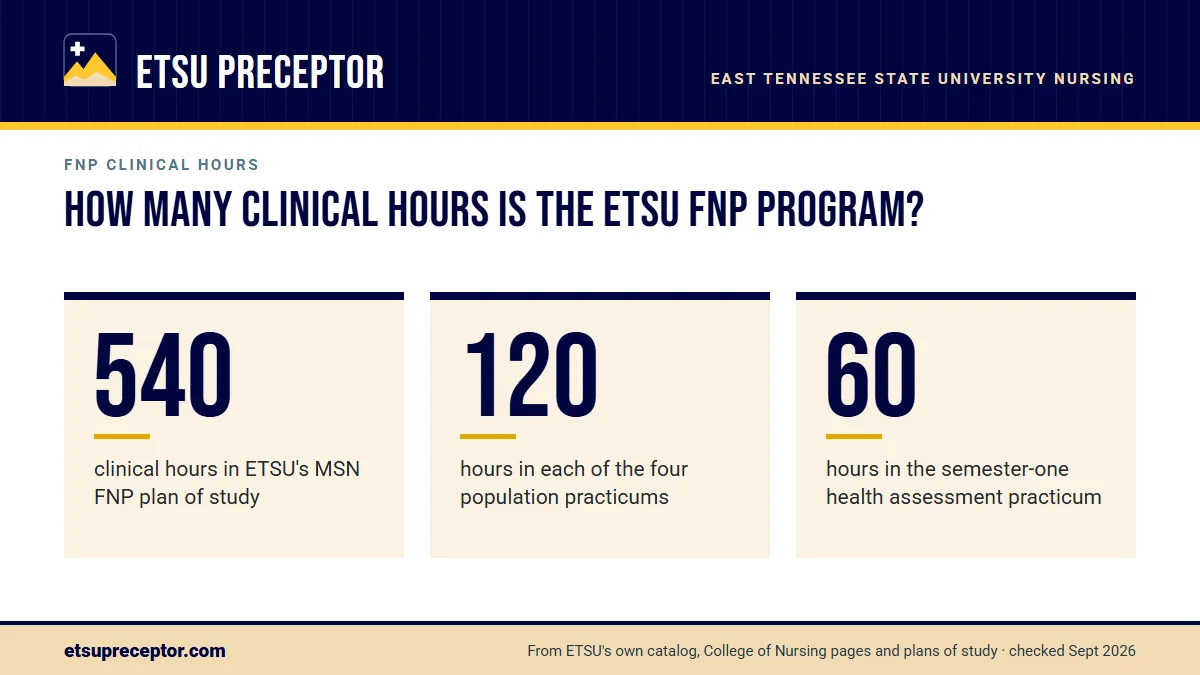
East Tennessee State University (ETSU) lists 540 clinical hours in its MSN Family Nurse Practitioner plan of study: a 60-hour health assessment practicum and four 120-hour practicums, each built around a different patient population. The total is the same full time or part time. What changes is when each practicum lands, and so when you need each preceptor.
Plan your five FNP practicums
Tell us your start term and where you live. We map each practicum to a preceptor whose patients fit the course.
The 540 hours, course by course
ETSU's plan of study lists five practicum courses for the MSN FNP, each worth 3 credits. The first is a 60-hour health assessment practicum. The other four carry 120 clock hours apiece, and each one centers on a patient population rather than a setting.
The plans that give these figures are dated 2023, so read the table as ETSU's published plan and check it against your catalog year and the plan of study your advisor gave you.
| Course | Title on the plan or Intent Form | Credits | Clock hours | Population focus |
|---|---|---|---|---|
NRSE 5010 | Advanced Health Assessment Lifespan Practicum | 3 | 60 | Across the lifespan, lab practice plus clinical placement |
NRSE 5012 | Nurse Practitioner I Practicum (Young & Middle Adults) | 3 | 120 | Young and middle adults |
NRSE 5022 | Women's Health Practicum | 3 | 120 | Women |
NRSE 5014 | Nurse Practitioner II Practicum (Older Adults) | 3 | 120 | Older adults |
NRSE 5024 | Children and Adolescents Practicum | 3 | 120 | Children and adolescents |
| Total | Five practicums | 15 | 540 | Infancy through older adulthood |
Each course has its own page here, starting with the young and middle adults practicum, the first 120-hour course most FNP students meet. Hour totals for every other ETSU program sit on the clinical hours hub.
What each population asks of a preceptor
The four 120-hour practicums are split by who the patients are, which is why an FNP student often works with more than one preceptor. On ETSU's Preceptor Intent Form, NRSE 5012 is labeled Young & Middle Adults Practicum, NRSE 5014 Older Adults Practicum, NRSE 5022 Women's Health Practicum and NRSE 5024 Children & Adolescents Practicum. Faculty read the site's patient mix on that form to decide whether a preceptor fits the course.
The 2026-27 catalog places the women's health and children and adolescents practicums in rural, urban and underserved communities, supervised by nursing faculty alongside clinical preceptors. For NRSE 5024, look for a site where children and teens fill the schedule daily, not now and then. A women's health course needs a practice where women make up a real share of the schedule. A broad family practice may suit more than one course, but that is your course faculty's decision, one course at a time.
NRSE 5010 works differently. The catalog pairs it with NRSE 5009 and describes extensive lab practice combined with clinical placements, so ask your course faculty how the 60 hours divide between lab and clinic in your term. How faculty read the form's percentages and daily counts is explained on the patient population mix page.
Full-time timing: fall start and spring start
Full time, the FNP runs five semesters, and both start terms put the first two 120-hour practicums in the first summer. That summer is the heaviest stretch of the program: NRSE 5012 and NRSE 5022 run side by side, 240 clock hours in one term, next to the didactic courses NRSE 5011 and NRSE 5021.
| Course | Hours | Fall start | Spring start |
|---|---|---|---|
NRSE 5010 | 60 | Semester 1 (fall) | Semester 1 (spring) |
NRSE 5012 | 120 | Semester 3 (summer) | Semester 2 (summer) |
NRSE 5022 | 120 | Semester 3 (summer) | Semester 2 (summer) |
NRSE 5014 | 120 | Semester 4 (fall) | Semester 3 (fall) |
NRSE 5024 | 120 | Semester 5 (spring) | Semester 4 (spring) |
A spring starter finishes the last practicum in semester 4 and spends the fifth semester, a summer, on NRSE 6002, NRSE 5006 and NRSE 5001 with no clinical course. One timing wrinkle to raise with your advisor: the current catalog shows NRSE 5009 and NRSE 5010 offered in fall only, yet the spring-start plans put both in the spring term. The summer semester page covers the 13-week term that holds your two summer practicums.
Part-time timing: eight semesters, wider gaps
Part-time FNP plans stretch to eight semesters and space the practicums out, so you search for preceptors at intervals rather than in one burst. Health assessment still comes first, but the first 120-hour practicum waits until Summer 3 for a fall starter and Summer 5 for a spring starter.
| Course | Part-time, fall start | Part-time, spring start |
|---|---|---|
NRSE 5010 | Fall 1 | Spring 1 |
NRSE 5012 | Summer 3 | Summer 5 |
NRSE 5022 | Summer 6 | Summer 8 |
NRSE 5014 | Fall 7 | Fall 6 |
NRSE 5024 | Spring 8 | Spring 7 |
The two part-time plans end on different courses: the spring-start plan closes with women's health in its final summer, while the fall-start plan closes with children and adolescents in spring. A change of pace in either direction has to be requested in writing through the Office of Student Services, and approval turns on your grades and on open clinical slots, so a switch can reshuffle every row of this table.
Where 540 fits in ETSU's other FNP routes
The same five practicums sit inside ETSU's BSN-to-DNP FNP. Its full-time plan runs them in semesters 1 to 5 in the same order as the MSN, then adds four DNP residencies. That route's total, and the catalog figure that disagrees with it, are laid out on the DNP clinical hours page.
Two other FNP routes publish no hour count on the web. The Post-Graduate FNP certificate is 24 credits, usually four semesters from a summer start, with online courses and in-person clinicals; its course list and hours appear only in the catalog. The ETSU-TTU joint DNP's FNP concentration also has no published total.
If you are in either route, ask the graduate clinical coordinator for your hour count and course order before you contact preceptors. A practice deciding whether to take you will want to know how many hours you are asking for and across which weeks, and the Intent Form asks you to state planned hours anyway.
Why ETSU FNP students choose us
We treat your FNP hours as four searches, one per population, instead of one generic request. For each 120-hour practicum we look for a preceptor whose patient mix clearly matches the course, in person in your own community. Then we collect what ETSU's intent form and the onboarding submission in ProjectConcert ask for: the preceptor's credentials and degrees, each license and board certification number with its expiration date, the site's patient percentages and daily counts, and the hours you plan to spend there.
We also plan around your calendar. Full-time students facing two summer practicums get preceptors who can carry 240 hours between them in a 13-week term. We raise the contract question early, since ETSU needs a contract with the site before your first clinical day and the College needs time to arrange it. Course faculty sign off on every preceptor and credential checks belong to the Office of Student Services; our part is making sure the file arrives whole and within ETSU's rules the first time they open it.
If a preceptor drops, we find a replacement. Share your start term with us and we will map all five practicums with you.
Questions ETSU students ask
Does ETSU's 540 FNP hours include health assessment?
Yes. In the 2023 plans of study, the 540 total is 60 hours in NRSE 5010, the health assessment practicum, plus 480 spread across the four population practicums at 120 hours apiece. Confirm the split for your catalog year, since the 2026-27 program page could not be checked.
Do part-time ETSU FNP students complete fewer clinical hours?
No. Both part-time plans list the same five practicums and the same 540 hours as the full-time plans. Part time spreads them over eight semesters instead of five, so each practicum arrives later and on its own, and you usually search for one preceptor at a time rather than two for the same summer.
Can one preceptor cover several ETSU FNP practicums?
ETSU publishes no rule that forbids or requires it. The Intent Form is completed for a specific course, and faculty judge each preceptor against that course's population. A family practice with a broad patient mix might suit more than one course, but ask your course faculty before you plan on it.
How early should I search for my first 120-hour FNP preceptor?
ETSU publishes no submission deadline, so earlier is safer. If you study full time, your first summer holds both NRSE 5012 and NRSE 5022, so the search runs during your first fall or spring while health assessment is still underway. Approval, credential checks and a contract must all be done before day one, so talk with the graduate clinical coordinator early.
Are the FNP hours the same in ETSU's BSN-to-DNP?
The five FNP practicums and their 540 hours appear unchanged in the first five semesters of the BSN-to-DNP FNP plan, dated 2020. The DNP then adds four 125-hour residencies. ETSU's sources disagree on the DNP's overall total, so check your plan of study and catalog year.
Related pages
Last checked 2026-09-25
We check these pages against ETSU's own catalog, College of Nursing pages, plans of study and ProjectConcert guides. Your plan of study, your syllabus, your course faculty and the graduate clinical coordinator have the final word.
ETSU asks you to lead the preceptor search. We make it the fastest part of your program.
Tell us your ETSU concentration, where you live and which semester your next practicum starts. We find preceptors who fit the course's patient population and prepare everything your Preceptor Intent Form and ProjectConcert entry need.
- Preceptors matched to the course: young and middle adults for
NRSE 5012, older adults forNRSE 5014, women forNRSE 5022, children forNRSE 5024, psychiatric care forNRSE 5405 - Credentials, license numbers, certification dates and the site's patient mix ready for faculty approval
- In your own community, in Northeast Tennessee or wherever ETSU approves your clinicals
Start your placement plan
Program, city and semester is all we need to begin.