Clinical hours per credit at ETSU
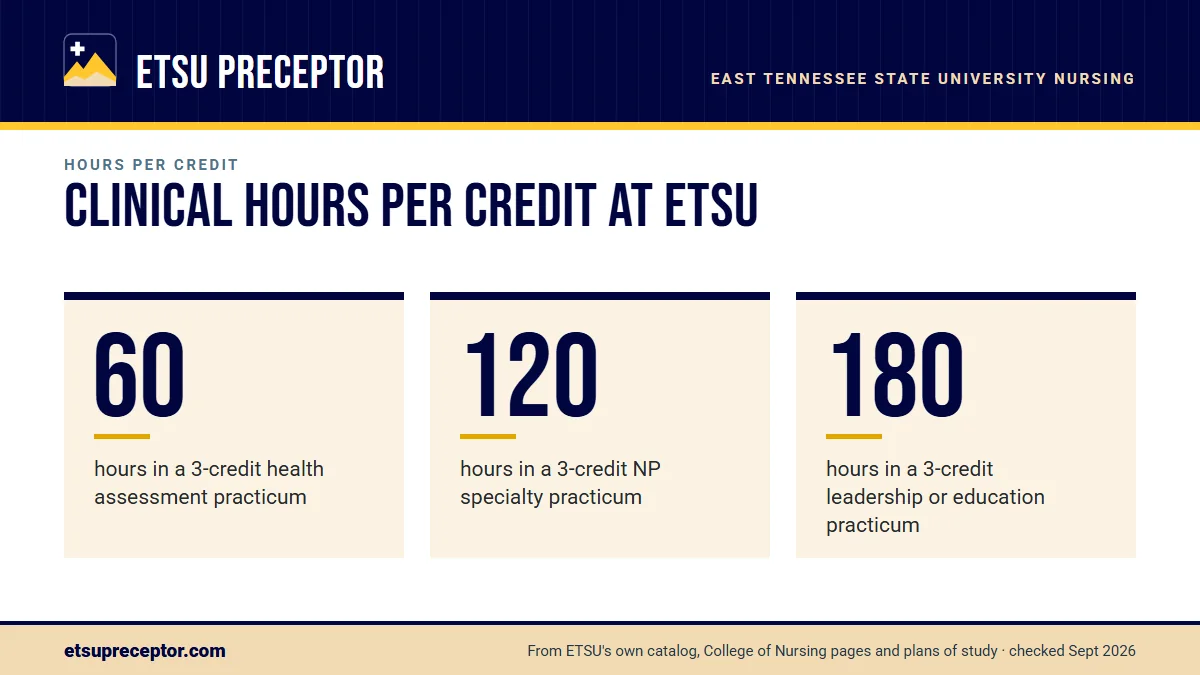
At East Tennessee State University (ETSU), a 3-credit practicum can mean 60, 120, 180 or 125 clinical hours depending on the kind of course. ETSU does not publish these as a rule; we worked the ratios out from its graduate plans of study. Knowing which ratio your course follows tells you how many hours a week to ask of a preceptor.
Turn your hours into a schedule
Tell us your course and term. We look for a preceptor whose calendar can carry the weekly load.
Four ratios hiding in ETSU's plans
Most ETSU graduate practicums carry 3 credits, but the clock hours behind those credits change with the type of course. The table shows the pattern in the plans of study, which are dated 2020 to 2023. The last column is our own division of hours by credits, not a figure ETSU publishes.
| Course type | Examples | Credits | Clock hours | Hours per credit (our math) |
|---|---|---|---|---|
| Health assessment practicum | NRSE 5010 | 3 | 60 | 20 |
| NP specialty practicum | NRSE 5012, NRSE 5405, NRSE 6950 | 3 | 120 | 40 |
| Leadership and education practicum | NRSE 5502, NRSE 5046, NRSE 5045 | 3 | 180 | 60 |
| DNP residency | NRSE 6801 to NRSE 6804 | 3 | 125 | About 41.7 |
| Education specialization practicum | NRSE 5115 | 1 | 60 | 60 |
The last row shows why one conversion rule would mislead you. NRSE 5115, the Nursing Education clinical specialization practicum, carries 1 credit but 60 clinical hours, the same clock time as the 3-credit health assessment practicum.
Why this is arithmetic, not an ETSU rule
No ETSU page we found states a clinical-hours-per-credit formula for graduate nursing. The ratios come from dividing the hours each plan lists by the credits it lists. Those plans were posted between 2020 and 2023, and the 2026-27 catalog is the official record for your year, so a newer catalog year could change a course's hours without touching its credits.
ETSU's own documents also disagree in places. The Nursing Education plan states 429 hours while its practicums add to 420, and the full-time Executive Leadership DNP plan lists NRSE 5504 at 120 hours where the part-time plan lists 180. Program totals and every known conflict are gathered on the clinical hours hub.
Whatever the table suggests, the hours you must log in a given term are the ones in your syllabus and plan of study for your catalog year. If they differ from the numbers here, follow your course faculty.
From hours to weeks
The practical question is how many hours a week you need with your preceptor. If a course's hours were spread evenly across the term, ETSU's 2026-27 calendar gives you a 15-week full term in fall and spring and a 13-week complete term in summer, and the math looks like this.
| Clock hours | Over 15 weeks (fall or spring) | Over 13 weeks (summer) | Eight-hour days |
|---|---|---|---|
| 60 | 4 a week | About 4.6 a week | 7.5 |
| 120 | 8 a week | About 9.2 a week | 15 |
| 125 | About 8.3 a week | About 9.6 a week | About 15.6 |
| 180 | 12 a week | About 13.8 a week | 22.5 |
Real schedules rarely spread that evenly. Clinical hours cannot begin until your preceptor is approved, a contract is in place and your clinical requirements are met, so a late approval squeezes the same hours into fewer weeks. Build in a margin by asking a preceptor for a little more weekly time than the even split, not less.
Terms that stack two practicums
The weekly load doubles when a plan puts two practicums in one term, and ETSU's plans do that at a busy point. Full-time FNP students take NRSE 5012 and NRSE 5022 together in their first summer: 240 hours in a 13-week term, about 18.5 hours a week if spread evenly. That is more than two eight-hour clinic days most weeks, on top of NRSE 5011 and NRSE 5021.
Other programs load their terms differently. The Nursing Administration practicums run one per term, 180 hours each, in summer, fall and spring, so the weekly load sits around 12 to 14 hours for three terms in a row. A BSN-to-DNP student moves from 120-hour practicums in semesters 2 to 5 to 125-hour residencies in semesters 6 to 9, with project work alongside. The summer semester page shows which practicums fall in the shorter summer term.
What the ratio means when you ask a preceptor
Preceptors plan in clinic days, so translate the hours before you reach out. A 120-hour practicum is about 15 eight-hour days, and a 180-hour leadership or education practicum is about 22 or 23. Say which weekdays you can be there and for roughly how many weeks, then ask whether the schedule holds for the whole term, including any weeks they already know they will be away.
The Preceptor Intent Form asks for your planned hours with the preceptor and whether a second preceptor will share the rotation, so settle the split before you submit. If one site can host only part of a 120-hour course, a second preceptor may cover the rest, provided your course faculty agree both fit the course's population. Hours are then entered in ProjectConcert as you go; the hour logs page walks through that step.
Undergraduate credits: no published hour ratio
BSN students should not borrow the graduate ratios. No ETSU page we found gives clock hours per credit for undergraduate practicums. The Continuous Enrolled (Accelerated) BSN lists eight clinical courses worth 28 credits, from NRSE 2351 in semester 1 to NRSE 4621 in semester 5, and the LPN to BSN lists 13 practicum credits across NRSE 3901, NRSE 4613 and NRSE 4621. Neither plan shows hours.
Those clinicals are assigned by the College, so the syllabus and your course faculty are the source for how many hours each one holds. The LPN to BSN runs its practicums as clinical intensives, and ETSU says they are likely to fall on weekends, including 12-hour days Friday through Sunday. The RN to BSN's NRSE 4026 R.N. Practicum also has no published hour count, so confirm it with the College of Nursing first.
Why ETSU students choose us
We start from the hours your course requires in your term and work back to a preceptor who can supply them. For a 180-hour practicum that means a site with room for roughly 12 hours a week across a full term; for a stacked summer it can mean two preceptors whose calendars together cover 240 hours in 13 weeks. We ask those questions before we introduce you, so the schedule works from the first week.
Everything we collect goes into the form ETSU faculty read: planned hours, any second preceptor, the site's patient mix, and the preceptor's license and certification details with expiry dates. We flag the contract requirement early so the College can arrange it in time. If a preceptor's availability shrinks partway through the term, we find another to cover the hours that remain. Send us your course and term.
Questions ETSU students ask
How many clinical hours equal one credit at ETSU?
It depends on the course, and ETSU publishes no single formula. Dividing the hours in ETSU's graduate plans by their credits gives 20 hours per credit for health assessment, 40 for NP specialty practicums, 60 for leadership and education practicums, and about 41.7 for DNP residencies. Your plan of study and syllabus remain the authority.
Why do ETSU's DNP residencies carry 125 hours for 3 credits?
ETSU's plans list each of the four residencies at 125 hours without explaining the figure. Four of them make the 500 residency hours in the MSN-to-DNP plans. The catalog entry for Residency I also sets out how many of its hours must be supervised practicum time for some students, which the DNP hours page explains.
Do lab or simulation hours count toward ETSU practicum hours?
ETSU's catalog says NRSE 5010 combines extensive lab practice with clinical placements, but no ETSU page we found spells out how lab time counts against clinical hours in other courses. Ask your course faculty before you assume any lab or simulation time reduces the hours you log with a preceptor.
Can I finish my practicum hours early in the term?
ETSU publishes no rule on pacing. Keep in mind that your preceptor completes mid-term and final evaluations that you schedule in ProjectConcert, and your course faculty may expect hours spread across the term. Ask your faculty before planning a compressed schedule, and agree it with your preceptor in advance.
Related pages
Last checked 2026-09-25
We check these pages against ETSU's own catalog, College of Nursing pages, plans of study and ProjectConcert guides. Your plan of study, your syllabus, your course faculty and the graduate clinical coordinator have the final word.
ETSU asks you to lead the preceptor search. We make it the fastest part of your program.
Tell us your ETSU concentration, where you live and which semester your next practicum starts. We find preceptors who fit the course's patient population and prepare everything your Preceptor Intent Form and ProjectConcert entry need.
- Preceptors matched to the course: young and middle adults for
NRSE 5012, older adults forNRSE 5014, women forNRSE 5022, children forNRSE 5024, psychiatric care forNRSE 5405 - Credentials, license numbers, certification dates and the site's patient mix ready for faculty approval
- In your own community, in Northeast Tennessee or wherever ETSU approves your clinicals
Start your placement plan
Program, city and semester is all we need to begin.