Your preceptor dropped out mid-semester: what to do next
When a preceptor leaves partway through an East Tennessee State University (ETSU) practicum, two jobs start at once: protecting the record of what you have already done, and getting a replacement through ETSU's approvals before the term runs out. Act the same day, while the departing preceptor is still reachable and the details are fresh.
Get your placement plan
Tell us your ETSU program and where you live. A placement advisor replies with the preceptor and site options that fit your ETSU course.
First, protect the hours you have
Your ProjectConcert record is the evidence of your progress, and it is easiest to complete while the departing preceptor still answers email. Log every clinical day you worked, with its patient journal entries, under Experience. Preceptors review and approve hours in ProjectConcert, so ask yours to clear anything waiting before they step away.
Then ask for an evaluation. It is yours to trigger: choose "Schedule User Evaluation" on the course dashboard and the preceptor gets an emailed link. ProjectConcert also supports Ad Hoc evaluations, so ask your course faculty which one suits a rotation that ended early. Keep your own copies. Our guides to hour logs and preceptor evaluations show where each step lives.
Tell ETSU in writing, the same day
Send one clear email from your @etsu.edu account, which ETSU's catalog makes the official channel between students and faculty. Address it to your course faculty and copy the graduate clinical coordinator, who keeps contacts and past-preceptor lists and onboards approved preceptors.
What the email should say
- The course and term, for example
NRSE 5014, fall 2026. - Hours completed and approved, and hours still needed.
- Your last clinical day and, if you know it, why the rotation ended.
- Whether the site could keep you with a different preceptor.
- What you are already doing to find a replacement.
An early, factual message gives faculty room to help, and it puts a date on the record, which matters later if you need an Incomplete or an extension.
A replacement goes through the full process
A new preceptor means a new approval. Expect a fresh Intent Form and a second onboarding submission in ProjectConcert with the preceptor's CV, then approval by your clinical faculty and a credential review by Student Services. If the new preceptor works somewhere else, that site needs its contract before you resume, and your own clinical requirements must still be current. Ask the coordinator for the current version of the form rather than copying your first one.
The course's population focus does not change either. A replacement for NRSE 5022 still needs a women's health caseload; one for a psychiatric practicum still needs psychiatric patients. The approval guide covers what each reviewer checks.
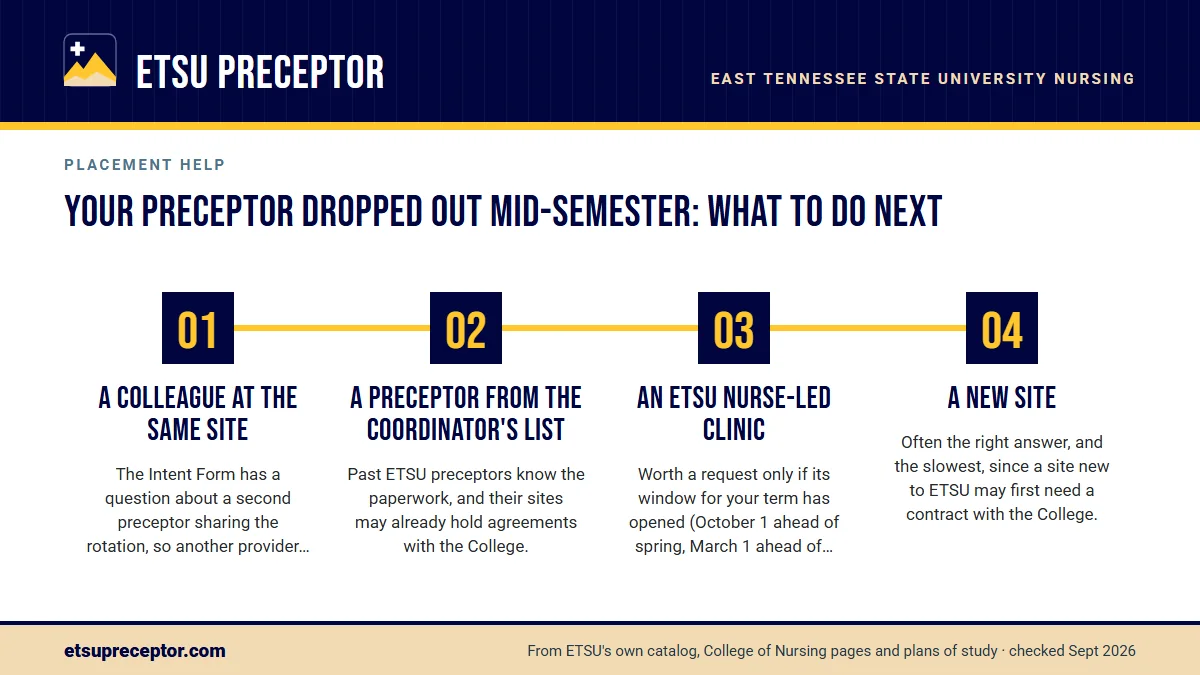
The fastest replacements, in order
- A colleague at the same siteThe Intent Form has a question about a second preceptor sharing the rotation, so another provider where you are now is a familiar request. The site has hosted you, so its agreement may already cover the change; ask the coordinator to confirm.
- A preceptor from the coordinator's listPast ETSU preceptors know the paperwork, and their sites may already hold agreements with the College.
- An ETSU nurse-led clinicWorth a request only if its window for your term has opened (October 1 ahead of spring, March 1 ahead of summer, May 1 ahead of fall) and the clinic's patients fit the course.
- A new siteOften the right answer, and the slowest, since a site new to ETSU may first need a contract with the College.
Work out what is left of the term
Put the gap against the calendar. Fall 2026 classes end December 3 with finals December 5 to 10; spring 2027 classes end April 29 with finals May 1 to 6; the Summer 2027 complete term ends August 13.
Here is the math in one example. An FNP student in NRSE 5014 loses a preceptor after logging 50 of 120 hours in week 7 of fall. If a replacement is approved by week 10, about six weeks remain for 70 hours, close to 12 a week. If approval slips to week 12, the same 70 hours need nearly 18 a week. Whether any hours may fall after the last class day is your course faculty's call. The behind on hours guide has a fuller planner.
If the hours cannot be finished this term
An Incomplete is the usual bridge, and it has conditions. ETSU grants an I when three quarters of the course work is finished and something outside your control blocked the rest. A preceptor leaving is the kind of event it exists for, but a rotation that ends in the first weeks may fall short of that line, so ask your faculty early which side you are on.
You then have a calendar year to finish before the I converts to an F, and in nursing a second open Incomplete stops progression. If an Incomplete is not available, withdrawal is the other route: a W after census, and after October 12 for fall courses or March 9 for spring courses, a W or WF by passing status. Read incompletes, leave and time limits before you decide.
How we step in when a preceptor leaves
Replacement searches are a core part of what we do. The day you tell us a preceptor has left, we start canvassing practices near you for someone whose caseload matches the same course, and we prepare the full set of Intent Form details so your new ProjectConcert entry is complete the first time.
We check early whether the new site needs a contract and flag it, so the College can move on it right away. The new preceptor is still ETSU's decision; our job is to give your faculty and Student Services a submission they can approve without chasing a single missing field. For students already working with us, staying on call for this moment is part of the service. Start through the contact form.
Questions ETSU students ask
Do my hours with the old preceptor still count?
ETSU's pages do not address a preceptor leaving mid-course, so your course faculty decide. Your best protection is a complete record: every clinical day logged in ProjectConcert, reviewed by the departing preceptor, and an evaluation on file. Raise the question in your first email to faculty rather than assuming either way.
Can another provider at my site take over as my preceptor?
Often that is the quickest route. The form already allows for an additional preceptor, so the request is a familiar one. The new preceptor still needs your clinical faculty's approval and a credential review by Student Services, and must fit the course's population focus.
Should I take an Incomplete or withdraw?
It depends on how much of the course is done. An Incomplete requires that 75% of the work be finished and that the cause was beyond your control. A late withdrawal can turn into a WF, and nursing caps WF grades at one semester per academic year. Settle it with course faculty and your advisor before the withdrawal dates pass.
Who should I tell first when my preceptor quits?
Your course faculty, in writing from your @etsu.edu account, with the graduate clinical coordinator copied. Faculty approved the preceptor and grade the course; the coordinator has past-preceptor lists and onboards the replacement. Include hours completed, hours still needed and your last clinical day.
Will losing a preceptor affect my grade?
The standard stays the same: every graduate nursing course carries the College's floor of a B, and faculty see your logged hours and your preceptor's evaluations in ProjectConcert. A complete record and a quick replacement are the best way to protect the grade you have been earning.
Related pages
Last checked 2026-09-25
We check these pages against ETSU's own catalog, College of Nursing pages, plans of study and ProjectConcert guides. Your plan of study, your syllabus, your course faculty and the graduate clinical coordinator have the final word.
ETSU asks you to lead the preceptor search. We make it the fastest part of your program.
Tell us your ETSU concentration, where you live and which semester your next practicum starts. We find preceptors who fit the course's patient population and prepare everything your Preceptor Intent Form and ProjectConcert entry need.
- Preceptors matched to the course: young and middle adults for
NRSE 5012, older adults forNRSE 5014, women forNRSE 5022, children forNRSE 5024, psychiatric care forNRSE 5405 - Credentials, license numbers, certification dates and the site's patient mix ready for faculty approval
- In your own community, in Northeast Tennessee or wherever ETSU approves your clinicals
Start your placement plan
Program, city and semester is all we need to begin.