ETSU DNP clinical hours: which number applies to you
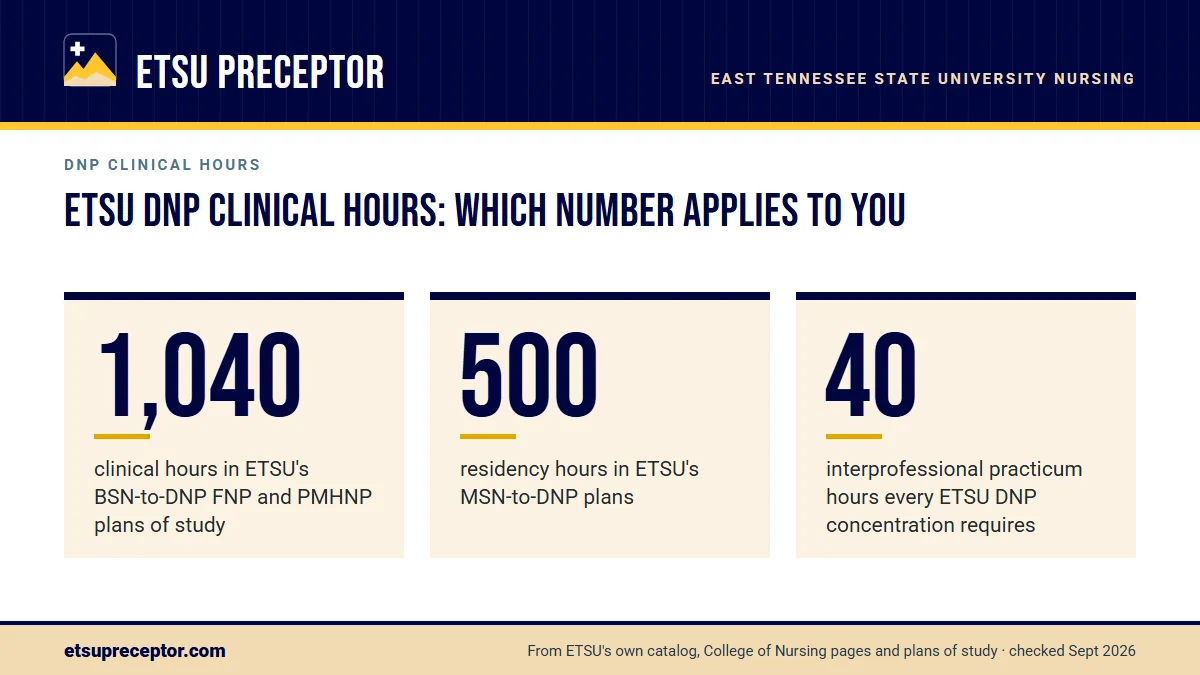
East Tennessee State University (ETSU) publishes more than one total for its DNP. The BSN-to-DNP plans of study list 1,040 clinical hours, the 2026-27 catalog gives 1,000 hours for BSN entry and 500 for MSN entry, and the College's DNP page frames the requirement as at least 500 project hours plus at least 500 specialty hours. Here is where each figure comes from and how to pin down yours.
Plan your DNP practicums and residencies
Tell us your entry route, concentration and term. We plan preceptors and residency sites around your hours.
Three ETSU sources, three ways of counting
Each ETSU source counts DNP hours its own way, and the totals do not line up exactly. Read them side by side before you plan a single residency.
| Source | BSN-to-DNP | MSN-to-DNP | What it counts |
|---|---|---|---|
| Plans of study (PDFs dated 2020) | 1,040 (FNP, PMHNP and Executive Leadership) | 500 | Every practicum and residency hour listed in the plan |
| 2026-27 Graduate Catalog | 1,000 | 500 | Program clock hours |
| College of Nursing DNP page | At least 500 project hours plus at least 500 specialty hours | At least 500 project hours | Hours tied to the DNP Project and to the concentration |
ETSU's pages do not explain the 40-hour gap between 1,040 and 1,000. Treat it as an open question rather than choosing the lower figure: your plan of study for your catalog year and your course faculty, with help from the graduate clinical coordinator, settle which number you must reach. Every ETSU program's totals, with the other conflicts, are gathered on the clinical hours hub.
How the plans reach 1,040
In ETSU's BSN-to-DNP FNP and PMHNP plans, the first five semesters hold the master's-level practicums and the last four hold the DNP residencies. The arithmetic is 540 practicum hours plus four residencies at 125 hours each.
| Part of the plan | FNP courses | PMHNP courses | Hours |
|---|---|---|---|
| Health assessment practicum, semester 1 | NRSE 5010 | NRSE 5010 | 60 |
| Four specialty practicums, semesters 2 to 5 | NRSE 5012, NRSE 5022, NRSE 5014, NRSE 5024 | NRSE 5405, NRSE 5409, NRSE 5411, NRSE 6950 | 480 |
| Residencies I to IV, semesters 6 to 9 | NRSE 6801 to NRSE 6804 | NRSE 6801 to NRSE 6804 | 500 |
| Plan total | 83 credits | 80 credits | 1,040 |
Part time, both concentrations stretch to 15 semesters, with the residencies running from Summer 12 through Summer 15. The FNP part-time plan also lists NRSE 6614 as an Advanced Interventions DNP Practicum in Fall 10 with no hours attached, so ask your faculty whether it carries clinical time in your year. Course-level detail for the FNP practicums sits on the FNP clinical hours page.
Executive Leadership: 1,040 stated, 980 added up
The Nursing and Healthcare Leadership concentration, called Executive Leadership in the plan PDFs, carries a mismatch of its own. Its full-time BSN-to-DNP plan states 1,040 hours but lists NRSE 5504 Practicum III at 120 hours instead of 180, so its courses add to 980. The part-time plan lists NRSE 5504 at 180 hours, and that version does reach 1,040.
The three leadership practicums, NRSE 5502, NRSE 5503 and NRSE 5504, are precepted by a nurse administrator, and the same four residencies follow. If you are full time, ask your course faculty in writing which figure governs NRSE 5504 before you agree hours with a preceptor, because the Intent Form has you state planned hours up front. The leadership practicums page covers the three courses in detail.
MSN-to-DNP: 500 residency hours
If you enter with an MSN, ETSU's plans list 500 clinical hours: the four residencies at 125 hours each, inside 32 credits. Full time, Residency I starts in your first summer and Residency IV closes the program in the following summer, your fourth semester. Part time, the residencies begin in Summer 4 and run through Summer 7. The FNP, PMHNP and Executive Leadership versions share the same residency sequence and differ only in their concentration courses.
What ETSU does not publish is how many clinical hours from your master's program you must document toward a post-baccalaureate total; those plans show nothing beyond the four residencies. MSN holders certified in the same concentration can finish in four semesters, while students changing specialty receive an individual plan. If you are changing specialty, or your MSN had fewer precepted hours than you expect, raise it with your advisor or the DNP program director before your first summer.
Inside each 125-hour residency
Each residency, NRSE 6801 through NRSE 6804, is 3 credits and 125 hours. The 2026-27 catalog entry for NRSE 6801 requires 125 project hours, of which 40 have to be supervised practicum time if you entered with a BSN or are an MSN entrant switching specialty. An older DNP project guide, dated 2020, set at least 40 clinical hours in each residency semester for those same students and told BSN-to-DNP students to secure a clinical preceptor.
The residencies carry paperwork of their own. Under that 2020 guide, the site has to agree to host a site-based project before faculty will approve it, the preceptor completes an evaluation in ProjectConcert, and your DNP project chair verifies hours at the end of each semester. Check the current syllabus for each residency, since the guide predates the current catalog. The four courses are covered one by one on the DNP residencies page.
The 40 interprofessional hours count inside the total
No ETSU DNP concentration is exempt from a minimum of 40 practicum hours spent in an interprofessional experience, and those hours sit within the program total rather than on top of it. You can meet them in a formal interprofessional clinic, or design the experience yourself with course faculty, your academic advisor and partners at the organization you choose.
Because they come out of hours you already owe, decide early which practicum or residency will hold them, so the preceptor or site knows the interprofessional piece is part of the plan and can line up the team you will work with. A student-arranged experience also needs faculty agreement before the hours start. ETSU's DNP page does not name specific interprofessional clinics, so ask your course faculty which formal options exist in your term. The interprofessional hours page explains both routes.
Why ETSU DNP students choose us
DNP hours are really two searches. The practicums need NP or physician preceptors whose patients fit each course; the residencies need a site willing to host your project, sign an agreement and supervise the practicum hours your residency calls for. We handle both, in person in your own community, and we plan the sequence so the next site is lined up before the current course ends.
We gather every detail your Preceptor Intent Form and ProjectConcert onboarding record require, and we raise the contract question at the start, because ETSU needs a contract with the site before any clinical day and a residency site must agree to the project before faculty sign off. Approval rests with your faculty and the credential check with the Office of Student Services; what we add is a review that opens on a full, rule-ready file. If a preceptor leaves mid-residency, we find a replacement. Tell us your entry route and term.
Questions ETSU students ask
Is the ETSU DNP 1,000 or 1,040 clinical hours?
Both figures appear on ETSU sources. The BSN-to-DNP plans of study, dated 2020, total 1,040; the 2026-27 catalog lists 1,000 for BSN-to-DNP. ETSU does not explain the difference. Go by the plan of study for the catalog year you entered under, and ask your course faculty or the graduate clinical coordinator to confirm the number before you schedule hours.
How many clinical hours does ETSU's MSN-to-DNP require?
The MSN-to-DNP plans and the 2026-27 catalog both give 500: the four 125-hour residencies numbered NRSE 6801 through NRSE 6804. Students changing specialty get an individual plan, and Residency I asks them for 40 supervised practicum hours, so their path can look different from a same-specialty student's.
Does the ETSU-TTU joint DNP publish its clinical hours?
Not on the web. The joint DNP lists 77 to 92 credits for BSN-to-DNP and 32 to 35 for MSN-to-DNP across its six concentrations, but no clock-hour figure or course list appears outside the catalog. Ask the program director or your placement contact for your concentration's requirement before approaching preceptors.
What if I am in the DNP AGPCNP concentration?
ETSU still lists the Adult-Gerontology Primary Care NP concentration, but its plan links lead to no documents and its termination is pending in the 2026-27 curriculum actions. Continuing students should get their hour requirement and course order in writing from their advisor or the DNP program director.
Can I complete DNP residency hours at my own workplace?
ETSU allows DNP clinical hours in your home community once they are approved, and the intent form includes a question about whether the agency employs you, but ETSU publishes no rule for or against an employer site. A site-based project also needs the practice's agreement before faculty approve it. Ask your course faculty early.
Related pages
Last checked 2026-09-25
We check these pages against ETSU's own catalog, College of Nursing pages, plans of study and ProjectConcert guides. Your plan of study, your syllabus, your course faculty and the graduate clinical coordinator have the final word.
ETSU asks you to lead the preceptor search. We make it the fastest part of your program.
Tell us your ETSU concentration, where you live and which semester your next practicum starts. We find preceptors who fit the course's patient population and prepare everything your Preceptor Intent Form and ProjectConcert entry need.
- Preceptors matched to the course: young and middle adults for
NRSE 5012, older adults forNRSE 5014, women forNRSE 5022, children forNRSE 5024, psychiatric care forNRSE 5405 - Credentials, license numbers, certification dates and the site's patient mix ready for faculty approval
- In your own community, in Northeast Tennessee or wherever ETSU approves your clinicals
Start your placement plan
Program, city and semester is all we need to begin.