NRSE 5010: the Advanced Health Assessment Lifespan Practicum
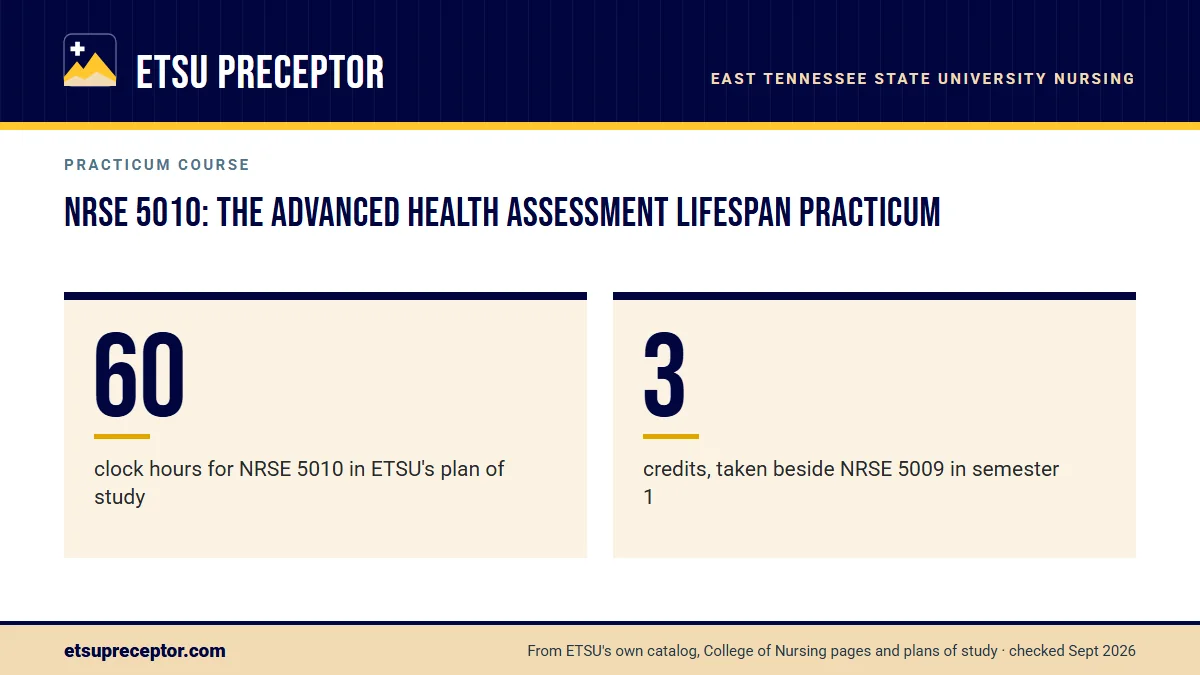
NRSE 5010 opens the clinical side of the FNP and PMHNP programs at East Tennessee State University (ETSU). It carries 3 credits and 60 clock hours in semester 1 of ETSU's plan of study, runs beside NRSE 5009, and mixes extensive lab practice with clinical placements, so your first preceptor search begins almost as soon as you accept your seat.
Need a preceptor for NRSE 5010?
Tell us your start term and where you live.
What the 2026-27 catalog says about NRSE 5010
In the 2026-27 graduate catalog the course is called Advanced Health Assessment Lifespan Practicum. It is a 3-credit course paired with NRSE 5009 Advanced Health Assessment Throughout the Life Span, it blends extensive lab practice with clinical placements, the catalog marks it as a fall offering, and only College of Nursing students may enroll.
ETSU's web plans of study still use an older title, Health Assessment Throughout the Lifespan Practicum, for the same number. Paperwork runs on numbers rather than titles: the Preceptor Intent Form's course menu covers the NP practicums from NRSE 5010 up to NRSE 5032, so copy the number exactly as it appears on your registration.
Health assessment is also one of the three graduate core subjects, with pathophysiology and pharmacology, that Tennessee Rule 1000-01-.11 expects every APRN program to teach. In ETSU's sequence, NRSE 5010 is where that required content turns into hands-on practice, ahead of any specialty rotation.
Where NRSE 5010 falls in each plan of study
All of ETSU's FNP and PMHNP plans of study on etsu.edu (dated 2023) begin with NRSE 5010. The course that follows it depends on concentration and pace, which decides how much time you have before the first 120-hour practicum.
| Plan | NRSE 5010 | Next practicum |
|---|---|---|
| MSN FNP, full-time, fall start | Fall 1 | NRSE 5012 and NRSE 5022, Summer 3 |
| MSN FNP, full-time, spring start | Spring 1 | NRSE 5012 and NRSE 5022, Summer 2 |
| MSN FNP, part-time, fall start | Fall 1 | NRSE 5012, Summer 3 |
| MSN FNP, part-time, spring start | Spring 1 | NRSE 5012, Summer 5 |
| MSN PMHNP, full-time | Fall 1 | NRSE 5405, Spring 2 |
| MSN PMHNP, part-time | Fall 1 | NRSE 5405, Spring 5 |
| BSN-DNP FNP or PMHNP | Fall 1 | Same as the matching MSN plan |
Here ETSU's documents conflict. The 2026-27 catalog marks both NRSE 5009 and NRSE 5010 as fall courses, while both spring-start FNP plans put them in spring. Spring starters should have an advisor and the Office of Student Services confirm the actual term before offering a preceptor any dates.
Why NRSE 5010 gates the rest of the sequence
NRSE 5010 is one of five prerequisites the catalog sets for NRSE 5011, the didactic partner of NRSE 5012, which is the first 120-hour FNP practicum. Instructor permission is the only listed alternative.
Trouble in NRSE 5010 therefore travels. ETSU nursing sets the graduate passing line at B for each course and permits a single repeat after a lower grade, and a repeat here can shift your first summer practicum and each one after it. The grades and progression page explains the rules.
PMHNP students feel the pace as well. On the full-time plan, NRSE 5405, the first psychiatric practicum, arrives in Spring 2, just one term after NRSE 5010, so the second preceptor search overlaps the first.
Lab practice, clinical hours and your syllabus
Beyond the short catalog entry, the details that shape a preceptor request live in the syllabus and with course faculty. Put these to faculty before the term or during week one:
- What share of the 60 clock hours is lab practice and what share is precepted time in a clinic.
- Whether an outside preceptor is required, or whether the course arranges part of the placement.
- Which age groups the lifespan focus expects you to assess, and whether one site can supply them all.
- Whether two preceptors may share the hours; the Intent Form has a place for an additional preceptor.
- Whether grades are letters or pass/fail, which the catalog leaves open for NP practicums.
- Which ProjectConcert records the course wants: hour logs, the patient journal, and which evaluations.
Keep the answers and pass them on to the preceptor. A clinician who knows the hour split and the ages you need can answer yes or no fast, and that speed matters in a first semester.
Choosing a site for a lifespan assessment course
A lifespan course rewards a site that sees every age. The Intent Form makes the agency estimate, for five groups (children, adolescents, women, adults, older adults), both a share of its patients and a typical daily count, and faculty weigh those numbers against the course's focus. A broad family practice tends to answer that more easily than a narrow specialty clinic, though the decision is theirs.
The form's sample credentials, FNP, ANP and MD, signal that nurse practitioners and physicians are both expected in NP courses. Tennessee Rule 1000-01-.01 adds a legal floor: the preceptor's license must match or exceed the level you are training for. More on that in ETSU preceptor requirements.
Because PMHNP students share this course, ask faculty early whether a psychiatric practice suits a lifespan assessment practicum or whether a primary care site is expected. That answer tells you where to start.
The approval path starts in your first term
Since NRSE 5010 falls in semester 1, approvals run alongside orientation. You fill in the Preceptor Intent Form, file the Preceptor & Clinical Agency Onboarding experience in ProjectConcert, then wait on clinical faculty and on the Office of Student Services' credential review. ETSU also needs a signed agency contract before your first clinical day, and your own clinical requirements must be finished. ETSU's clinical placement process sets out each step.
No submission deadline or contract lead time appears in ETSU's published material. The fall 2026 semester spans August 24 through December 3, and spring 2027 spans January 19 through April 29. Start looking as soon as you accept admission, and ask the graduate clinical coordinator what timing they expect for your start term.
How we help ETSU students with NRSE 5010
Semester 1 leaves little room to learn an approval process while graduate coursework starts. Our placement desk searches your own community for a preceptor and site suited to lifespan health assessment, then assembles every item the Intent Form and ProjectConcert ask for, from degrees and credential letters to license and certification numbers, expiration dates, the agency's patient figures and your hour plan.
We point out on day one when an agency will need a new contract, giving the College room to arrange it, and your placement advisor stays on call if a preceptor has to withdraw. ETSU keeps every approval: faculty accept the preceptor and the Office of Student Services checks credentials. Our part is a request with no gaps that already fits ETSU's rules. Read how it works or tell us your start term.
Questions ETSU students ask
Is NRSE 5010 a lab course or a clinical course?
Both. The 2026-27 catalog pairs extensive lab practice with clinical placements, and ETSU's plan of study assigns 60 clock hours to the 3 credits. How those hours divide between the lab and a preceptor's clinic is set in the syllabus, so check with course faculty before you quote an hour figure to anyone.
Do ETSU PMHNP students take NRSE 5010?
Yes. Both MSN PMHNP plans, and the BSN-DNP PMHNP plans, schedule NRSE 5010 in Fall 1 with the same 60 hours FNP students log. It is the only practicum the two NP concentrations share; the PMHNP's remaining 480 hours come from three psychiatric practicums and the final internship.
Can I take NRSE 5010 in the spring?
The spring-start FNP plans say Spring 1, yet the 2026-27 catalog lists the course for fall only, which is a conflict inside ETSU's own documents. If you start in spring, have your advisor and the Office of Student Services confirm the term before a preceptor holds dates for you.
Why is NRSE 5010 only 60 hours when other practicums are 120?
ETSU's plans give a 3-credit health assessment practicum 60 hours and each 3-credit NP specialty practicum 120. ETSU never publishes that as a written ratio; it only shows up when the plans are compared. The hours-per-credit page lines up every course type.
What happens if I earn below a B in NRSE 5010?
Anything under a B in a graduate nursing course has to be repeated, and ETSU allows one repeat. Because NRSE 5010 is a listed prerequisite for NRSE 5011, retaking it can delay NRSE 5012 and every practicum behind it, so meet with your advisor as soon as the grade posts.
Related pages
Last checked 2026-09-25
We check these pages against ETSU's own catalog, College of Nursing pages, plans of study and ProjectConcert guides. Your plan of study, your syllabus, your course faculty and the graduate clinical coordinator have the final word.
ETSU asks you to lead the preceptor search. We make it the fastest part of your program.
Tell us your ETSU concentration, where you live and which semester your next practicum starts. We find preceptors who fit the course's patient population and prepare everything your Preceptor Intent Form and ProjectConcert entry need.
- Preceptors matched to the course: young and middle adults for
NRSE 5012, older adults forNRSE 5014, women forNRSE 5022, children forNRSE 5024, psychiatric care forNRSE 5405 - Credentials, license numbers, certification dates and the site's patient mix ready for faculty approval
- In your own community, in Northeast Tennessee or wherever ETSU approves your clinicals
Start your placement plan
Program, city and semester is all we need to begin.