The ETSU clinical placement process, from first search to final evaluation
East Tennessee State University (ETSU) runs every precepted graduate nursing course through the same sequence: you find a preceptor and site, describe them on the Preceptor Intent Form, submit them in ProjectConcert, clear the approvals and the contract, then schedule, log and get evaluated. This page is the map of that sequence, with links to the pages that cover each stage in depth.
Get your placement plan
Tell us your ETSU program and where you live. A placement advisor replies with the preceptor and site options that fit your ETSU course.
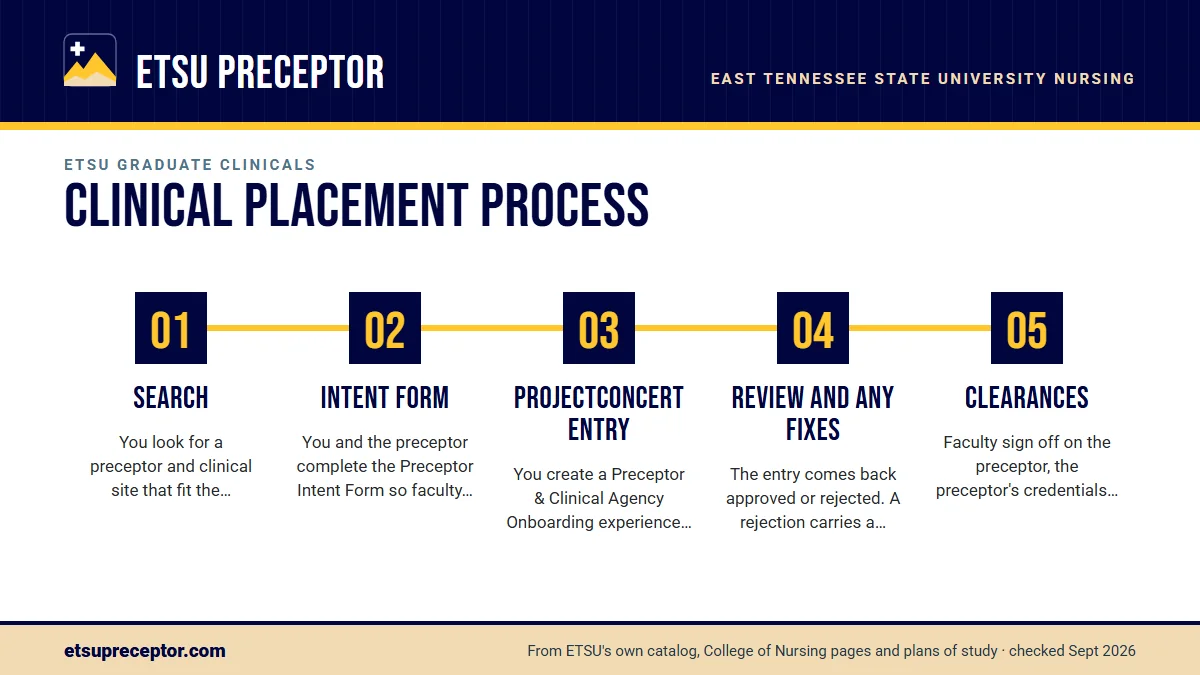
The path at a glance
ETSU's own documents give the order below. They come from the Preceptor Intent Form, the ETSU Online program FAQs and the College of Nursing's ProjectConcert guides dated 2024. Each stage depends on the one before it, so a gap early in the chain shows up later as a delayed first clinical day.
- SearchYou look for a preceptor and clinical site that fit the course. The graduate clinical coordinator can help with contacts and names of past preceptors.
- Intent FormYou and the preceptor complete the Preceptor Intent Form so faculty can judge whether the site matches the course's population focus.
- ProjectConcert entryYou create a Preceptor & Clinical Agency Onboarding experience, choose the coordinator from the dropdown and attach the form and the preceptor's CV.
- Review and any fixesThe entry comes back approved or rejected. A rejection carries a comment; you edit and resubmit.
- ClearancesFaculty sign off on the preceptor, the preceptor's credentials pass a check by the Office of Student Services, the site agreement is signed, and your compliance file is complete.
- Preceptor accessThe Graduate Clinical Placement Coordinator sends the preceptor a Preceptor Welcome Email with ProjectConcert login details.
- ScheduleYou build your clinical days in ProjectConcert's self-scheduler.
- Hours and patient journalYou record each shift and your cases under the Experience menu for review.
- EvaluationsYou schedule the preceptor's mid-term and final evaluations of you with Schedule User Evaluation.
Who acts at each stage, and where it happens
Several ETSU offices and roles touch one placement. Knowing who owns each stage tells you who to ask when something stalls, and keeps you from waiting on a step that is actually yours.
| Stage | Who acts | Where |
|---|---|---|
| Preceptor and site search | You, helped by the graduate clinical coordinator | Your community; the coordinator's contacts and past-preceptor lists |
| Preceptor Intent Form | You and your preceptor | The current version the coordinator provides |
| Onboarding entry | You | ProjectConcert: Experience, New, Preceptor & Clinical Agency Onboarding |
| Preceptor approval | Clinical faculty | Progress tracked in ProjectConcert |
| Credential verification | Office of Student Services | Progress tracked in ProjectConcert |
| Contract with the site | The College and the site | Must exist before clinicals start |
| Your clinical requirements | You | ProjectConcert Clinical Requirements tab |
| Preceptor login | Graduate Clinical Placement Coordinator | Preceptor Welcome Email |
| Schedule, hours, patient journal | You; preceptors and faculty review | ProjectConcert Schedule tab and Experience menu |
| Evaluations | You schedule them; the preceptor completes them | Course dashboard in ProjectConcert |
Your ETSU email is the official channel for all of it, so watch that inbox for ProjectConcert notices, rejection alerts and messages from faculty.
Phase one: from a name to a submitted entry
The first phase is the only one you drive almost alone. ETSU Online's FAQs place the search on the student, with the coordinator as a resource; our page on finding your own preceptor explains what that means program by program.
Once a preceptor agrees, the paperwork starts. The Preceptor Intent Form collects the preceptor's licenses, certifications, the planned hours and the site's patient mix. The ProjectConcert entry then carries that form to the College; the click-by-click version is on the ProjectConcert submission page.
Treat this phase as a single package. A form with a missing expiration date, or a course that does not match your plan of study, invites a rejection and a second round of review.
Phase two: clearances that all have to land before day one
The Intent Form names four conditions for starting clinicals, and none of them substitutes for another. Faculty approval of the preceptor, the Office of Student Services' review of credentials, a signed contract with the site, and your own complete compliance file all have to be finished.
The review side is covered on the preceptor approval page, including how to read a rejection. The agreement side, which deserves early attention at any site new to ETSU, has its own page on clinical contracts. Your immunizations, liability insurance and other items live in ProjectConcert's Clinical Requirements tab, each with a status and a due date.
An approved preceptor alone does not open your clinical days: the contract and your own requirements must also be complete.
Phase three: working the rotation in ProjectConcert
After approval, the Graduate Clinical Placement Coordinator emails your preceptor a username and login details for ProjectConcert. From that point the preceptor can see and review what you enter, so confirm with them that the welcome email arrived and did not land in a spam folder.
You then build your clinical days in the Schedule tab, which shows the course, term and times and links each day to the site, faculty member and preceptor. Each shift's hours, and the patient journal that goes with them, are entered from the Experience menu by choosing Utilize and then New; our guide to clinical hour logs walks through entries that hold up at review.
Near mid-term and again at the end, you schedule the preceptor's evaluation of you from the course dashboard, and the preceptor gets an emailed link. In the DNP residencies, ETSU's 2020 project guide adds a faculty evaluation and has the project chair verify hours each semester.
Timing: what ETSU publishes and what it leaves to you
ETSU publishes no deadline for submitting an outside preceptor and no lead time for setting up a contract. The placement guideline PDFs that may once have held dates now return "page not found," so your best source for a working date is the graduate clinical coordinator, asked about your specific course and term.
The one set of fixed dates belongs to the College's nurse-led clinics: a spring rotation request can go in from October 1, a summer one from March 1 and a fall one from May 1, and anything sent before those dates is not considered.
Plans of study also shape timing. Summer is a full clinical semester, full-time FNP students take their first 120-hour practicum in the first summer, and PMHNP students reach their first psychiatric practicum in spring of year one. Starting the search a full term before each practicum is the safest habit.
Why ETSU students choose us for this path
Our service is shaped around this exact sequence, stage by stage. Your placement advisor looks close to home for a clinician whose practice matches the course you are placing, then pulls together the details the first two stages depend on: the preceptor's degrees and credentials, each license and certification number along with its expiry, the practice's daily patient counts and a schedule that covers your hours.
We bring up the site agreement in the very first conversation with the practice, which buys the College the most time before your start date. ETSU's reviewers still make every decision, and they receive a file with nothing missing, laid out against ETSU's own form. Should a preceptor pull out mid-term, the search for a replacement begins the same day.
Our how it works page lists the steps; the form below is the quickest way to name the course you are placing next.
Questions ETSU students ask
What turnaround should I expect for ETSU preceptor approval?
ETSU does not publish a review time for preceptor approval, credential verification or contracts. The honest planning answer is to submit as early as you can and ask the graduate clinical coordinator what turnaround to expect for your course. Keep an eye on ProjectConcert and your ETSU email so a rejection comment gets answered the same day.
Can I begin clinical hours while my preceptor is still pending?
Four items on the Preceptor Intent Form have to be settled before any clinical day: faculty approval, credential verification, a contract, and your own clinical requirements. Plan your first clinical day for after all four are confirmed. If a start date is close and something is still open, ask your course faculty before you go to the site.
Is the process the same in the ETSU-TTU joint DNP?
The joint DNP describes placement as a shared effort between students and the two universities, and its catalog policies are written around a home school for each student. The ProjectConcert guides cited here are ETSU College of Nursing documents. Confirm with your joint DNP program which submission and approval steps apply to you before you enter a preceptor.
Do ETSU BSN students follow these steps?
No. Prelicensure students, whether in the traditional, accelerated or LPN to BSN track, are placed by the College of Nursing and never run a preceptor search. In the RN to BSN, a nurse in a full-time direct-care job can take NRSE 4026 at the job they already have, and anyone else sets up that practicum with the College. The steps on this page are for graduate students.
What should I do first if I have not started looking yet?
Open your plan of study and note the next practicum, its hours and its term. Then ask the graduate clinical coordinator for names from past placements and for the current Intent Form. With the course and population in hand, your search has a clear target, and our placement desk can start at the same point.
Related pages
Last checked 2026-09-25
We check these pages against ETSU's own catalog, College of Nursing pages, plans of study and ProjectConcert guides. Your plan of study, your syllabus, your course faculty and the graduate clinical coordinator have the final word.
ETSU asks you to lead the preceptor search. We make it the fastest part of your program.
Tell us your ETSU concentration, where you live and which semester your next practicum starts. We find preceptors who fit the course's patient population and prepare everything your Preceptor Intent Form and ProjectConcert entry need.
- Preceptors matched to the course: young and middle adults for
NRSE 5012, older adults forNRSE 5014, women forNRSE 5022, children forNRSE 5024, psychiatric care forNRSE 5405 - Credentials, license numbers, certification dates and the site's patient mix ready for faculty approval
- In your own community, in Northeast Tennessee or wherever ETSU approves your clinicals
Start your placement plan
Program, city and semester is all we need to begin.