Search alone, lean on ETSU, or bring in a placement service?
East Tennessee State University (ETSU) gives graduate nursing students a coordinator who can point to contacts and former preceptors, then expects them to drive the search. That leaves three practical routes: run the search yourself, lean on ETSU's own resources, or hand the legwork to a placement service. You can also mix them. Here is how each one works and how to pick.
Compare your options with us
Tell us your course and city; we will say what a search involves.
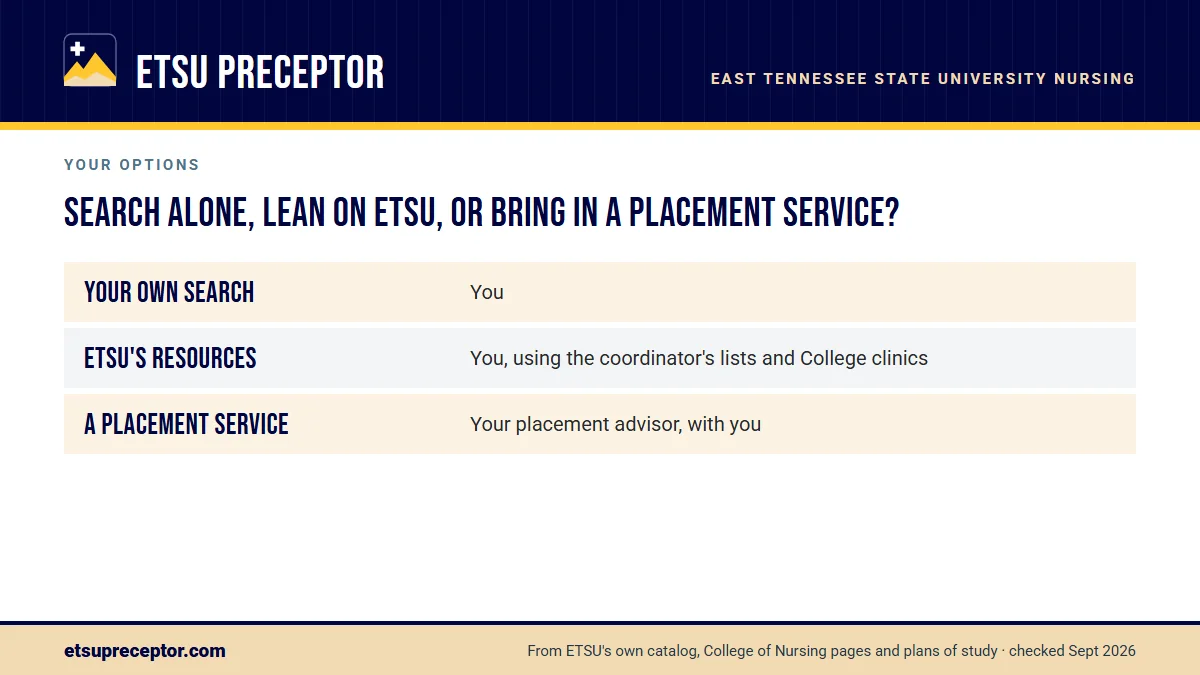
Three routes to the same approval
Whichever route you take, the finish line is identical. Faculty must accept the preceptor for the course, Student Services must confirm the preceptor's credentials, an agency contract must be signed, and your own compliance file must be complete before day one. No route skips those steps, so the real choice is about who does the searching and how much of your time it takes.
ETSU's wording frames the choice. The MSN, DNP and certificate FAQs describe the graduate clinical coordinator as a source of contacts and past preceptors, and place responsibility for an active search with the student. The ETSU-TTU joint DNP speaks of a shared effort instead. Our page on finding your own preceptor reads that wording program by program.
The options side by side
Each route has a setting where it shines. The comparison below is a starting point for your own situation.
| Route | Who does the searching | Where it shines | What to plan for |
|---|---|---|---|
| Your own search | You | Strong local network, a willing employer, an early start | Hours of calls and follow-up, checking each site's patient mix |
| ETSU's resources | You, using the coordinator's lists and College clinics | Names that have precepted ETSU students before | Shared lists, fixed clinic request windows, the search still led by you |
| A placement service | Your placement advisor, with you | Tight timing, narrow course focus, a thin local network | A quote to budget for, and your own ProjectConcert submission |
Across a whole program it often makes sense to use all three: your own network for one course, a College clinic for another, and a service for the practicum where local options run thin.
Searching on your own
Your own search works best when you already know people. A manager, a colleague who became an NP, a clinic where you did an earlier rotation: these contacts answer calls that cold outreach does not. The Intent Form even asks whether you have trained with this preceptor or agency before, so a familiar name is common.
The cost is time, and it arrives in the busiest part of the program. Each candidate has to see the right patients for the course, carry a license that matches or exceeds the role you are preparing for, and agree to your hours and dates. A new agency also needs a contract with ETSU, and ETSU states no timeline for that step.
If you choose this route, start with the course's population, keep a list of every call and its outcome, and gather credentials as you go. The Preceptor Intent Form page shows everything you will need to collect.
Leaning on ETSU's own resources
ETSU offers more than a single contact. The graduate clinical coordinator keeps contacts and lists of past preceptors, and a preceptor who has worked with ETSU before already knows the paperwork. Ask early in the term before your practicum, while there is time to follow up every name.
The College also runs nurse-led clinics where students can request precepted rotations: the Johnson City Community Health Center, the Johnson City Downtown Day Center, University Health Center, the Hancock County School Based Health Center and the Mountain City Extended Hours Health Center. Spring requests open on October 1, summer requests on March 1 and fall requests on May 1, and anything sent sooner is not considered; see the College's nurse-led clinics.
PMHNP students have a further option at Quillen College of Medicine, whose integrated behavioral health training has counted toward NRSE 5411 and NRSE 6950, although its status after the 2021-2025 funded years is unclear. Joint DNP students can ask which of ETSU's and Tennessee Tech's existing agreements sit near them.
Using a placement service
A service takes on the searching, checking and chasing. We are the most thorough way for ETSU students to do it: we look for preceptors near your home whose caseload matches your course, confirm dates and hours, and build a complete file for the Intent Form and the onboarding submission before you send anything.
We also raise the contract question on the day a preceptor says yes, stay on call through the semester, and start a replacement search at once if a preceptor steps away. ETSU's approvals work exactly as they would on any other route, and you still submit the ProjectConcert entry yourself; our part is to make sure what reaches the reviewers is complete the first time.
A service costs money where your own search costs time. What goes into a quote is on the cost page, and how it works walks through the steps.
Questions that settle the choice
A few honest answers usually make the right route obvious. Work through them for each practicum still ahead of you, not just the next one.
- How many practicums remain, and how many of them have a named preceptor today?
- Does your own network include clinicians who see the population your next course needs?
- How many weeks are left before the term starts, and would a new agency need a contract?
- Do you live near ETSU's clinics and the Tri-Cities, in a rural county, or in another state?
- How many hours a week can you give to calls and follow-up alongside work and courses?
If the answers point to a thin network and a close start date, a service will save you the most. If you are already out of options, read can't find a preceptor.
Questions ETSU students ask
Does ETSU approve a preceptor found by a placement service?
ETSU reviews every preceptor the same way, whoever found them. Clinical faculty weigh the preceptor against the course, the Office of Student Services confirms credentials, and a signed agency agreement is required. The route to the candidate does not change those steps, which is why a complete, accurate file matters most.
Will the graduate clinical coordinator place me if my own search fails?
ETSU's FAQs present the coordinator as a helper who can share contacts and names of earlier preceptors, while the active search stays with the student. They do not describe the coordinator taking over a search. Tell the coordinator early how your search is going, and ask what help is available for your course.
Can I use a service for just one hard-to-fill practicum?
Yes. You can run your own search for the courses where your network is strong and bring in a service for the one where it is not, such as a pediatric, women's health or psychiatric practicum. A quote can cover a single course or several.
Is a College nurse-led clinic rotation easier to get than an outside site?
It follows its own rules. The request windows are fixed and early submissions are set aside, and accepted students must show current items, among them a criminal background check no more than a year old, an annual TB test and CPR. Space is not published, so have a second option ready.
Do BSN students need to choose between these routes?
No. The College assigns clinicals for the Traditional BSN, the Accelerated BSN and the LPN to BSN. RN to BSN students use their employer if they work full time in direct patient care, or arrange a clinical with the College. The choice on this page begins with graduate study.
Related pages
Last checked 2026-09-25
We check these pages against ETSU's own catalog, College of Nursing pages, plans of study and ProjectConcert guides. Your plan of study, your syllabus, your course faculty and the graduate clinical coordinator have the final word.
ETSU asks you to lead the preceptor search. We make it the fastest part of your program.
Tell us your ETSU concentration, where you live and which semester your next practicum starts. We find preceptors who fit the course's patient population and prepare everything your Preceptor Intent Form and ProjectConcert entry need.
- Preceptors matched to the course: young and middle adults for
NRSE 5012, older adults forNRSE 5014, women forNRSE 5022, children forNRSE 5024, psychiatric care forNRSE 5405 - Credentials, license numbers, certification dates and the site's patient mix ready for faculty approval
- In your own community, in Northeast Tennessee or wherever ETSU approves your clinicals
Start your placement plan
Program, city and semester is all we need to begin.