The 40 interprofessional hours in every ETSU DNP
East Tennessee State University (ETSU) requires every DNP concentration to include an interprofessional experience of 40 practicum hours or more, counted inside the program's total rather than added to it. You can meet it inside an established interprofessional clinic, or through an experience you design yourself alongside faculty, your advisor and people at the host organization. ETSU publishes little beyond that, so settle the details early.
Planning your interprofessional hours?
Tell us your DNP concentration and term. We look for team-based sites near you that can host the experience.
The rule in ETSU's words
The College of Nursing's DNP page states that each concentration requires at least 40 hours of practicum in an interprofessional experience, and that those hours count within the program's total. That reaches every ETSU DNP concentration: FNP, PMHNP, AGPCNP and Nursing and Healthcare Leadership. ETSU ties the rule to concentrations rather than entry paths, so confirm with your advisor how it applies to your own plan.
Because the hours sit inside the total, they are not extra time on top of the 1,040 hours in ETSU's BSN-to-DNP plans or the 500 in its MSN-to-DNP plans. They have to come out of practicum time you are already scheduled for, which is why the question of which course carries them matters. The totals themselves, and ETSU's conflicting figures, are on DNP clinical hours.
Two routes ETSU names
Route one is a formal interprofessional clinic, where you join an experience that already exists. ETSU does not list which clinics qualify, so ask your course faculty whether one is available in your area or through the College.
Route two is arranged by you. The DNP page lets you design the experience on your own, in partnership with course faculty, your academic advisor and people at the host organization you pick. ETSU also names clinical faculty as helping design the DNP interprofessional experience, which makes a short written proposal a sensible opening move.
ETSU runs team-based training elsewhere too. The Institute for Integrated Behavioral Health at ETSU's Quillen College of Medicine has placed PMHNP master's students, in their second year, on integrated primary care teams, and those hours have counted toward NRSE 5411 and NRSE 6950. The funded slots its page describes ran from 2021 to 2025, and ETSU does not say whether it continues or whether its hours count toward the DNP's 40. The details are on the Institute page.
What ETSU leaves open
Questions to settle with faculty and your advisor
- Which practicum or residency the 40 hours belong to, and in which semester.
- Which professions must take part, and how many.
- Whether a given clinic counts as a formal interprofessional clinic, and who decides.
- What you record in ProjectConcert to show the hours were interprofessional.
- Who signs off on the hours: your preceptor, a partner at the organization or course faculty.
- Whether the requirement reads the same way in your catalog year.
None of these answers is on ETSU's website, and the 2023-24 DNP handbook and the preceptor materials that might once have covered them now return "page not found." Ask by email so the answers are on record, and keep them with your plan of study. If your faculty change, that email is what lets a new instructor see what was already agreed.
Planning a student-arranged experience
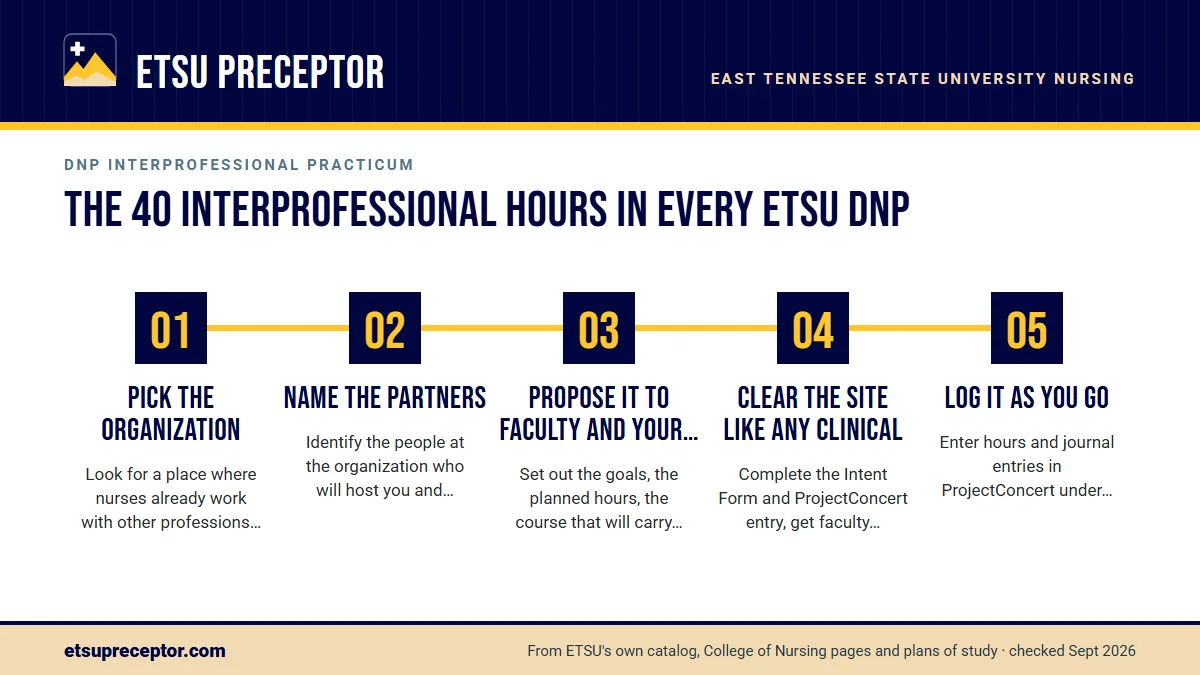
- Pick the organizationLook for a place where nurses already work with other professions, such as a primary care practice, a behavioral health program or a hospital team.
- Name the partnersIdentify the people at the organization who will host you and explain what each profession does in the work you will join.
- Propose it to faculty and your advisorSet out the goals, the planned hours, the course that will carry them and how you will show the interprofessional element.
- Clear the site like any clinicalComplete the Intent Form and ProjectConcert entry, get faculty approval and the credential check, and have a contract in place, as on the placement process page.
- Log it as you goEnter hours and journal entries in ProjectConcert under Experience, noting the interprofessional work the way faculty ask.
Where the hours can fit
Two places in ETSU's plans are natural candidates, subject to faculty approval. For NP students, a primary care or psychiatric rotation at a team-based site can carry interprofessional time alongside direct patient care. For every DNP student, the residencies, NRSE 6801 to NRSE 6804, put you inside one organization for four semesters, and the project guide allows a team member from the practice site: see the DNP residencies.
Leadership students can ask whether time in NRSE 5502 to NRSE 5504 with a nurse administrator, or in their residencies, qualifies. ETSU's DNP is built around rural primary care, and its admission review weighs interest in rural and underserved groups, so a rural clinic where several professions share patients fits the program's aims well.
ETSU's MSN plans also carry IPE 572E and IPE 672E, interprofessional seminars worth zero credits. They are seminars rather than practicum hours, and ETSU does not say they count toward the DNP's 40.
Why ETSU DNP students choose us
The interprofessional requirement is easy to leave until late and hard to arrange in a hurry, because it depends on several people at one organization agreeing to host you. We look for sites in your own community where nurses already share patients and decisions with other professions, confirm the organization will host the experience you and your faculty design, gather what the Intent Form and ProjectConcert entry need, and put the contract on the College's list early.
Faculty sign off on the design and the College checks credentials, and the paperwork we prepare is built to clear both on the first pass, with the interprofessional element spelled out. Tell us your concentration and the term you want to complete the hours with the contact form.
Questions ETSU students ask
How many interprofessional hours does ETSU's DNP require?
Forty practicum hours or more in an interprofessional setting, whatever your ETSU DNP concentration. The College of Nursing's DNP page states the minimum and says the hours count within the program's total. ETSU does not publish more detail, so confirm with course faculty and your academic advisor how the 40 hours fit your own plan.
Are the interprofessional hours in addition to my DNP clinical hours?
No. ETSU says the 40 hours count within the program's total, so they come out of practicum or residency time you already have, not on top of it. That is why it helps to decide early which course will carry them and how you will document them in ProjectConcert.
Can I arrange my own interprofessional experience at ETSU?
Yes. ETSU's DNP page allows a self-arranged experience, planned together with your course faculty, your advisor and contacts at the organization. Clinical faculty help shape the design. Treat it like any placement: the site still needs faculty approval and a contract before you start.
Do ETSU-TTU joint DNP students need 40 interprofessional hours?
The 40-hour statement appears on the ETSU DNP page. The ETSU-TTU joint DNP does not publish clinical-hour totals or course lists on the web, so joint DNP students should ask the ETSU-TTU DNP Program Director whether a similar requirement applies to their concentration.
Can ETSU's nurse-led clinics host interprofessional hours?
ETSU's Office of Practice opens requests for its nurse-led clinics on fixed dates, with spring rotations opening October 1, summer on March 1 and fall on May 1. ETSU does not say whether any of them counts as a formal interprofessional clinic, so ask course faculty before you apply for that purpose.
Related pages
Last checked 2026-09-25
We check these pages against ETSU's own catalog, College of Nursing pages, plans of study and ProjectConcert guides. Your plan of study, your syllabus, your course faculty and the graduate clinical coordinator have the final word.
ETSU asks you to lead the preceptor search. We make it the fastest part of your program.
Tell us your ETSU concentration, where you live and which semester your next practicum starts. We find preceptors who fit the course's patient population and prepare everything your Preceptor Intent Form and ProjectConcert entry need.
- Preceptors matched to the course: young and middle adults for
NRSE 5012, older adults forNRSE 5014, women forNRSE 5022, children forNRSE 5024, psychiatric care forNRSE 5405 - Credentials, license numbers, certification dates and the site's patient mix ready for faculty approval
- In your own community, in Northeast Tennessee or wherever ETSU approves your clinicals
Start your placement plan
Program, city and semester is all we need to begin.