Malpractice insurance for ETSU clinicals
East Tennessee State University (ETSU) requires graduate nurse practitioner students to carry professional malpractice insurance, at NP-student limits the College of Nursing sets, before clinical courses begin. The Preceptor Intent Form also lists liability insurance among the clinical requirements that every precepted placement has to meet before the first clinical day.
Get your placement plan
Tell us your ETSU program and where you live. A placement advisor replies with the preceptor and site options that fit your ETSU course.
What ETSU's pages say
Two ETSU sources carry the rule. The 2026-27 graduate catalog, in its DNP program requirements, requires proof of professional malpractice coverage, at limits the College chooses for NP students, before clinical courses begin, and mentions that a cost applies. On the Preceptor Intent Form, liability insurance then appears alongside immunizations as an example of the clinical requirements to satisfy before clinicals start.
Together they settle the timing: insurance is a gate, not a detail to finish during the term. A preceptor can be approved, credentials can clear the Office of Student Services check and a contract can be in place, and a student still cannot begin without proof of coverage. Our preceptor approval page shows where insurance sits among the other approvals, and the full compliance list is on our clinical health requirements page.
Who needs coverage
The catalog language is written for NP students in the DNP. The Intent Form, though, reaches well past NP courses: its course list includes the NP practicums, the nursing education practicums (NRSE 5045 and NRSE 5046), the executive leadership practicum and the DNP residencies. Since the form treats liability insurance as a clinical requirement, plan on coverage for any precepted ETSU graduate course.
Students who should plan for a policy
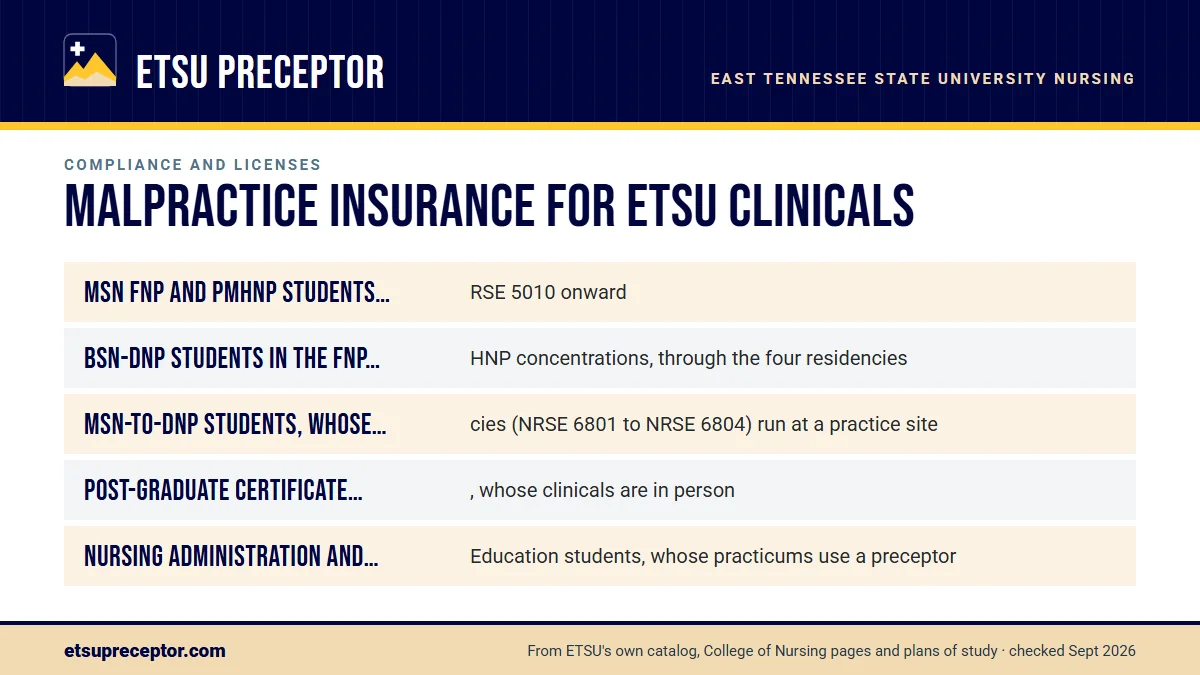
- MSN FNP and PMHNP students, from
NRSE 5010onward - BSN-DNP students in the FNP and PMHNP concentrations, through the four residencies
- MSN-to-DNP students, whose residencies (
NRSE 6801toNRSE 6804) run at a practice site - Post-graduate certificate students, whose clinicals are in person
- Nursing Administration and Nursing Education students, whose practicums use a preceptor
If your program is not an NP track, confirm the coverage type and limits with the Office of Student Services; ETSU's live pages describe the NP-student requirement only in general terms.
Coverage limits: the College sets them
ETSU's pages say the limits are set by the College but do not print the figures. Get them in writing from the Office of Student Services or your course faculty before you buy, and match the policy to them exactly. A policy written for a working RN is not automatically a policy for a nurse practitioner student.
When you compare policies, check three things. First, that the policy names you in your student role, as an NP student or whatever role your program uses. Second, that the per-claim and aggregate limits meet or exceed the College's figures. Third, that the policy period covers every clinical day you have planned, summer terms included.
The catalog notes that a cost applies, and premiums vary with the carrier and the limits you need. Our placement costs page explains how insurance fits with the other clinical expenses a student carries.
Timing coverage across a multi-semester plan
Buy before the requirement's due date in ProjectConcert, and pick a policy period that lines up with ETSU's calendar. ETSU's 2026-27 terms are August 24 to December 3 for fall and January 19 to April 29 for spring; the summer 2027 complete term, on the calendar ETSU approved in 2024, runs May 17 to August 13. A policy that renews in June can leave a summer practicum exposed if the renewal slips. Our academic calendar page lists the rest of the dates.
Many ETSU plans put clinical work in most terms. The full-time MSN FNP plan starts with NRSE 5010 in semester 1, then has a practicum in the first summer and in every term after it; the BSN-DNP then adds four 125-hour residencies. Keep one continuous policy rather than term-by-term patches, and upload each renewed certificate the day it arrives.
What sites and contracts ask
Insurance is part of how a site takes on a student. A contract must be in place between the College and the site before clinicals start, and that agreement, handled by the College, frames the placement; see our clinical contracts page. If a practice manager asks you directly for proof of coverage, send it together with a fresh Student Passport export from ProjectConcert, so the manager sees your whole record at once.
Working where you are employed raises its own question. Because the Intent Form records whether you are employed by the agency, the question of whose insurance applies comes up early, and coverage you hold as an employed RN belongs to that job. Your student hours are a different role, so ask the College whether employer coverage counts, and plan on your own student policy unless the College confirms otherwise. Our working where you work page covers the rest of that setup.
Why ETSU students start with us
Insurance is one of the few items that is entirely yours, and one of the easiest to forget while the preceptor search takes all your attention. When we place you, we ask the site what proof it wants and when, we prompt you to confirm the College's limits before your packet goes in, and we time the whole package so the preceptor details, the contract flag and your own clearance arrive together.
Approval of the preceptor stays with your clinical faculty, and the credential check stays with the Office of Student Services. We handle the legwork that feeds both, so the first submission is complete and on time. Tell us your program and start term through the contact form.
Questions ETSU students ask
Do ETSU MSN students need malpractice insurance, or only DNP students?
ETSU's catalog states the NP-student malpractice rule in its DNP requirements, but the Preceptor Intent Form, used for MSN, certificate and DNP placements, lists liability insurance among the clinical requirements for precepted courses. Plan on coverage for any ETSU graduate practicum and confirm the details with the Office of Student Services.
How much malpractice coverage does ETSU require?
The College of Nursing sets the limits for NP students, but its public pages do not print the figures. Ask the Office of Student Services or your course faculty for the current per-claim and aggregate amounts in writing, then buy a policy that matches or exceeds them for your student role.
Does my employer's insurance cover my ETSU clinical hours?
Not necessarily. Coverage you hold as an employed RN is tied to that job, while practicum hours are student work in a different role. Ask the College whether employer coverage satisfies its requirement. Unless it confirms that in writing, carry your own NP-student policy for every clinical day.
When do I need to show proof of malpractice insurance?
Before clinical courses start. The DNP catalog makes coverage a condition of beginning clinical courses, and the Intent Form puts liability insurance among the items settled before clinicals begin. The due date for your file appears in ProjectConcert; upload the certificate before it, and again at every renewal.
Does ETSU provide malpractice insurance for students?
ETSU's catalog says students must show proof of coverage and notes that a cost applies, which points to a policy the student buys. If you are unsure whether the College offers a group option, raise it with the Office of Student Services before you purchase a policy on your own.
Related pages
Last checked 2026-09-25
We check these pages against ETSU's own catalog, College of Nursing pages, plans of study and ProjectConcert guides. Your plan of study, your syllabus, your course faculty and the graduate clinical coordinator have the final word.
ETSU asks you to lead the preceptor search. We make it the fastest part of your program.
Tell us your ETSU concentration, where you live and which semester your next practicum starts. We find preceptors who fit the course's patient population and prepare everything your Preceptor Intent Form and ProjectConcert entry need.
- Preceptors matched to the course: young and middle adults for
NRSE 5012, older adults forNRSE 5014, women forNRSE 5022, children forNRSE 5024, psychiatric care forNRSE 5405 - Credentials, license numbers, certification dates and the site's patient mix ready for faculty approval
- In your own community, in Northeast Tennessee or wherever ETSU approves your clinicals
Start your placement plan
Program, city and semester is all we need to begin.