ETSU BSN-to-DNP PMHNP: psychiatric preceptors from your first spring
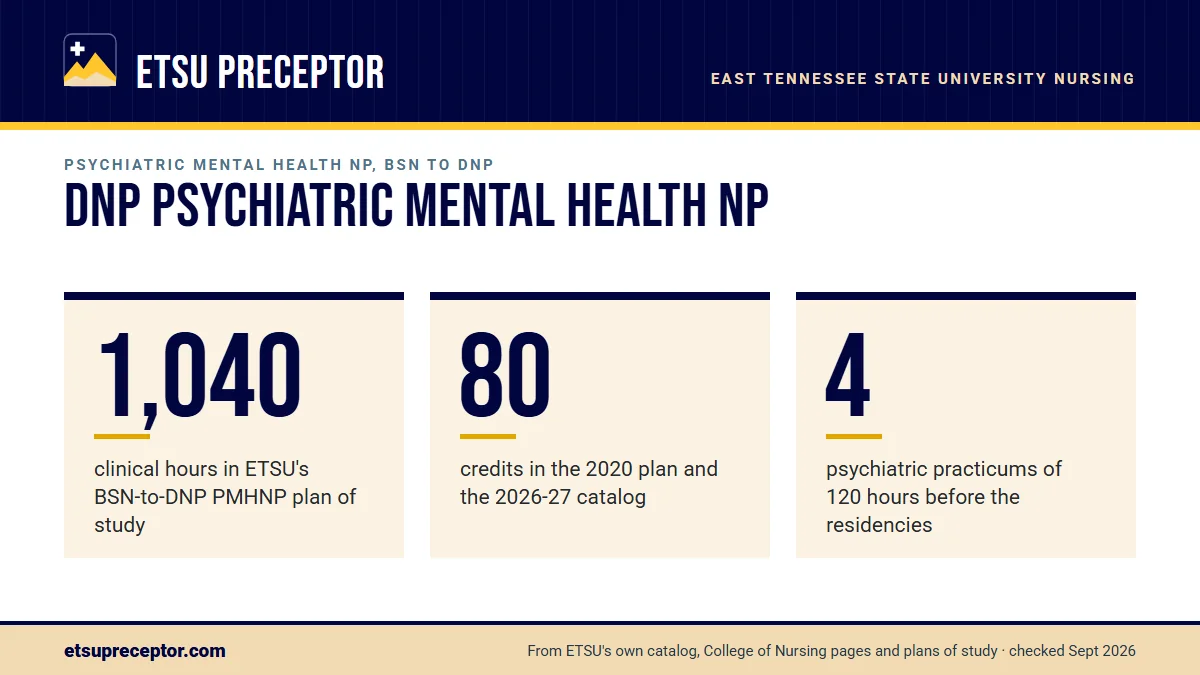
At East Tennessee State University (ETSU), the BSN-to-DNP Psychiatric Mental Health Nurse Practitioner concentration lists 80 credits and 1,040 clinical hours in its plan of study. Four psychiatric practicums come first, beginning in the spring of year one for full-time students, and four DNP residencies follow. That early start makes the psychiatric search the first thing to plan.
Plan your psychiatric placements
Tell us your start year, full-time or part-time pace, and where you live.
What the PMHNP doctorate prepares you for
ETSU's PMHNP concentration trains you to deliver psychiatric and mental health care to people of every age, and graduates are eligible for PMHNP national certification. Classes run online with required intensives, and your clinical work happens in person near home once each site is approved.
Admission to the BSN route happens each fall, and the application window closes May 1. A full-time student finishes in nine semesters and a part-time student in fifteen. The plan dated 2020 and the 2026-27 catalog agree on 80 credits, but the College's own DNP page quotes 82 to 86 credits for BSN entry, a gap ETSU does not explain. Follow the plan of study issued for the catalog year you entered under.
Semesters 1 through 5 track ETSU's master's PMHNP sequence, and semesters 6 through 9 add doctoral psychiatric courses beside the residencies. If you are weighing the shorter route, the MSN PMHNP page covers the master's version.
The full-time plan, term by term
Each clinical course below comes from ETSU's full-time BSN-to-DNP PMHNP plan, dated 2020. Hold it against the plan of study you received at admission.
| Term | Clinical course | Hours | Other courses that term |
|---|---|---|---|
| Fall 1 | NRSE 5010 Advanced Health Assessment Lifespan Practicum | 60 | NRSE 5016, NRSE 5018, NRSE 5009 |
| Spring 2 | NRSE 5405 Advanced Family Psychiatric Nursing Care I Practicum | 120 | NRSE 5303 Psychopharmacology, NRSE 5404 |
| Summer 3 | NRSE 5409, the Care II practicum | 120 | NRSE 5408, NRSE 6002 |
| Fall 4 | NRSE 5411 Interpersonal Treatment Modalities Practicum | 120 | NRSE 5000, NRSE 5410 |
| Spring 5 | NRSE 6950 Internship in Advanced Nursing Practice | 120 | NRSE 5001, NRSE 5006 |
| Summer 6 | NRSE 6801 Residency I | 125 | NRSE 5100, NRSE 5030 |
| Fall 7 | NRSE 6802 | 125 | NRSE 6050, NRSE 6414 Neurobiology of Psychiatric Disorders |
| Spring 8 | NRSE 6803 | 125 | NRSE 6713, NRSE 6415 Mental Health Care Delivery Systems |
| Summer 9 | NRSE 6804 | 125 | An elective |
Part-time students meet the psychiatric courses later: NRSE 5010 in Fall 1, NRSE 5405 in Spring 5, NRSE 5409 in Summer 6, NRSE 5411 in Fall 7 and NRSE 6950 in Spring 8, with the residencies filling Summer 12 through Summer 15. The four practicums themselves are described on our PMHNP practicums page.
Your first psychiatric preceptor, one term in
Full-time students reach NRSE 5405 in Spring 2, a single semester after starting. In practice the search for that spring site runs through your first fall, while you are also carrying health assessment and its lab-based practicum.
ETSU publishes no deadline for naming a preceptor and no lead time for contracts. What it does publish is that a contract with the site has to exist before clinicals begin, and that the preceptor must clear faculty approval and a credential check first. A psychiatric practice that has never hosted an ETSU student therefore needs to be identified early in the fall, not in December.
The Preceptor Intent Form asks for the preceptor's credentials, degrees, license and certification details, and how many students they already supervise. Its credential examples include NPs and physicians, and ETSU sets no published minimum for years of practice. The preceptor requirements page covers what ETSU and Tennessee rules do say about who may precept.
For full-time students, the psychiatric preceptor for NRSE 5405 has to be found during the first fall, while you are still in your first semester.
One practicum, two titles in ETSU's plans
ETSU's own plans disagree about NRSE 5411. In the doctoral plan it is the Interpersonal Treatment Modalities Practicum, paired with the NRSE 5410 course of the same name. The MSN PMHNP plan labels that course number Health Policy Leadership at 120 hours, and it calls NRSE 5408 a practicum even though the doctoral plan lists it as the didactic Advanced Family Psychiatric Nursing Care II.
For planning, the doctoral titles are the more consistent set: four psychiatric practicums at 120 hours each, starting with NRSE 5405 and NRSE 5409, then NRSE 5411 and the NRSE 6950 internship. Confirm the titles and hours in your syllabus before you describe the course to a preceptor, because the Intent Form asks which course the preceptor is for.
The internship closes the master's-level half of the program in Spring 5, one term before Residency I opens the doctoral years in Summer 6.
Tennessee practice rules your preceptor works under
If your preceptor is a Tennessee PMHNP who prescribes, Tennessee requires them to work with a collaborating physician. The two write their protocols together, and the physician reviews a fifth or more of the NP's charts every 30 days. Bills filed in 2024 to let experienced psychiatric NPs practice without that collaboration did not pass, so the requirement still stands.
That structure can help your search. A practice where psychiatric NPs and psychiatrists already work together gives you two kinds of clinician who may qualify, and the Intent Form's credential examples show ETSU expects both NPs and physicians as preceptors for NP courses. Your course faculty decide whether a given clinician fits the course. More on how collaboration shapes precepting is on the Tennessee APRN practice page.
Doctoral years: residencies with a psychiatric focus
From Summer 6 the plan shifts to the DNP project. Residency I pairs with population health and data analysis and a scholarly writing course, then Fall 7 and Spring 8 place NRSE 6414 Neurobiology of Psychiatric Disorders and NRSE 6415 Mental Health Care Delivery Systems beside the development and implementation residencies. Summer 9 finishes with NRSE 6804 and an elective.
The plan lists 125 hours for each residency, and BSN-entry students owe 40 supervised practicum hours within Residency I. A behavioral health organization that hosts your project needs to agree to it before faculty approve a site-based project, according to ETSU's 2020 project guide. Each of the four is explained on the DNP residencies page, and the catalog's 1,000-hour figure against the plans' 1,040 is compared on DNP clinical hours.
ETSU has also offered a training option for second-year PMHNP master's students through the Institute for Integrated Behavioral Health at Quillen College of Medicine, with hours that count toward both the NRSE 5411 practicum and the NRSE 6950 internship. The institute's page describes trainee funding for academic years 2021 through 2025, so ask whether it continues and whether DNP students qualify; the integrated behavioral health page has the details.
Why ETSU PMHNP doctoral students choose us
Psychiatric placements reward an early start, and we begin with your Spring 2 practicum while you are still in your first fall. We look for psychiatric NPs and physicians near you whose caseload fits each course, from the first psychiatric practicum through the internship, and we keep a residency site in view for the doctoral years.
Each candidate comes to you with the details ETSU asks for: what the clinician is licensed and board certified as, the numbers and expiry dates behind those credentials, their degrees, how many other students they are teaching, and who the practice treats by age group. That file drops straight into the Preceptor Intent Form and your ProjectConcert onboarding record, and we flag the contract need from the start so the College can prepare it.
Approval belongs to your course faculty and the credential check to the College, and the request that lands with them is whole and matches ETSU's rules. If a preceptor leaves mid-semester, we move straight to a replacement. Start your PMHNP plan with us.
Questions ETSU students ask
When does the first psychiatric practicum start in ETSU's BSN-to-DNP PMHNP?
In ETSU's full-time plan, NRSE 5405 falls in Spring 2, the second semester of the program. Part-time students reach it in Spring 5. Either way, NRSE 5010 health assessment comes first in Fall 1, so full-time students are searching for a psychiatric site while that first practicum is still underway.
Can a psychiatrist precept an ETSU PMHNP student?
ETSU publishes no written list of accepted preceptor types, but the Preceptor Intent Form gives MD alongside NP credentials as examples, which shows physicians are expected for NP courses. Tennessee's board rule sets the preceptor's license at your target level or higher. Your course faculty make the final call for each practicum.
Do NRSE 6414 and NRSE 6415 carry clinical hours?
ETSU's 2020 plan lists no clinical hours for either course. Neurobiology of Psychiatric Disorders sits in Fall 7 and Mental Health Care Delivery Systems in Spring 8, alongside the second and third residencies, which carry 125 hours each. Check your syllabus in case your catalog year differs.
Is there a part-time BSN-to-DNP PMHNP plan?
Yes. ETSU's part-time plan runs fifteen semesters. It moves the first psychiatric practicum to Spring 5 and the internship to Spring 8, and runs the four residencies from Summer 12 to Summer 15. A later change of pace needs a written request; the Office of Student Services decides, weighing open clinical slots.
Can I finish the PMHNP DNP from outside Tennessee?
Possibly, but check first. ETSU weighs each out-of-state graduate placement individually once you are admitted, and the relevant regulators have to approve it. ETSU's two published licensure lists for the DNP give different answers for a number of states, so compare them and ask your state board before you commit to an out-of-state psychiatric site.
Related pages
Last checked 2026-09-25
We check these pages against ETSU's own catalog, College of Nursing pages, plans of study and ProjectConcert guides. Your plan of study, your syllabus, your course faculty and the graduate clinical coordinator have the final word.
ETSU asks you to lead the preceptor search. We make it the fastest part of your program.
Tell us your ETSU concentration, where you live and which semester your next practicum starts. We find preceptors who fit the course's patient population and prepare everything your Preceptor Intent Form and ProjectConcert entry need.
- Preceptors matched to the course: young and middle adults for
NRSE 5012, older adults forNRSE 5014, women forNRSE 5022, children forNRSE 5024, psychiatric care forNRSE 5405 - Credentials, license numbers, certification dates and the site's patient mix ready for faculty approval
- In your own community, in Northeast Tennessee or wherever ETSU approves your clinicals
Start your placement plan
Program, city and semester is all we need to begin.