Who can precept an ETSU nursing student
East Tennessee State University (ETSU) publishes no written list of preceptor minimums, so the answer comes from two places: the credentials ETSU's own documents point to for each course, and Tennessee's Board of Nursing rule that anyone precepting you be licensed, without encumbrance, at your intended level or higher. Clinical faculty make the final call for each course.
Get your placement plan
Tell us your ETSU program and where you live. A placement advisor replies with the preceptor and site options that fit your ETSU course.
The short answer
A preceptor for an ETSU student needs to fit the course, hold the right license where they practice, and pass faculty review. Everything beyond that, such as years in practice or whether a physician assistant qualifies, is a question for your course faculty, because ETSU has not published a standard.
ETSU's preceptor page, preceptor handbook and program guideline PDFs now return "page not found," so there is no current document to quote on minimums. What remains is solid enough to plan with: the Preceptor Intent Form's credential examples, the catalog's course descriptions and the Tennessee rule text.
Preceptors who take an ETSU student also receive ProjectConcert access through a welcome email, so a willing preceptor should expect to review your hours and complete evaluations online. Once you have a candidate, the review itself is covered on our preceptor approval page.
What ETSU's documents point to, course by course
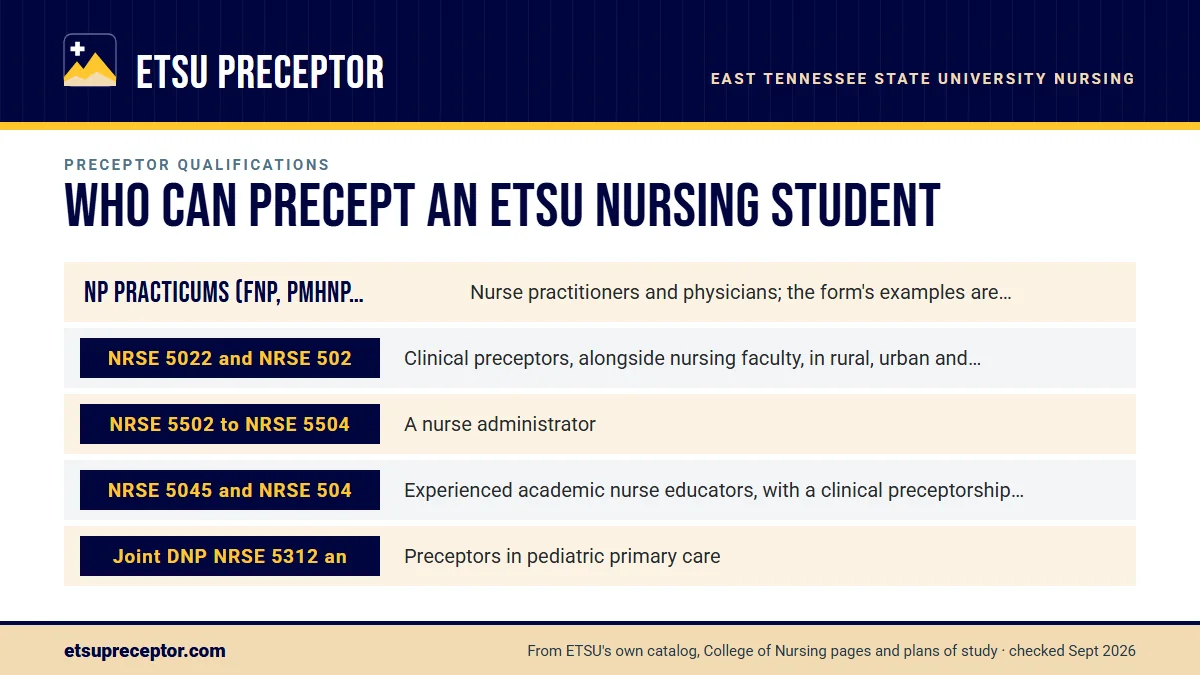
The pattern is simple: the preceptor's role mirrors the role you are preparing for. An FNP student learns from NPs and physicians, an administration student from a nurse administrator, an education student from an academic nurse educator.
| Course or program | Preceptor ETSU's documents point to | Where it comes from |
|---|---|---|
| NP practicums (FNP, PMHNP, AGPCNP) | Nurse practitioners and physicians; the form's examples are FNP, ANP and MD | Preceptor Intent Form |
| NRSE 5022 and NRSE 5024 | Clinical preceptors, alongside nursing faculty, in rural, urban and underserved settings | 2026-27 course descriptions |
| NRSE 5502 to NRSE 5504, Executive Leadership | A nurse administrator | 2026-27 description of NRSE 5502 |
| NRSE 5045 and NRSE 5046, Nursing Education | Experienced academic nurse educators, with a clinical preceptorship placement | 2026-27 course descriptions |
| Joint DNP NRSE 5312 and NRSE 5317 | Preceptors in pediatric primary care | 2026-27 course descriptions |
| DNP residencies | A practice site that agrees to host the project; a site team member may join the project team | 2020 DNP project guide |
Tennessee's rule: a license at or above your level
Tennessee's Board of Nursing defines a preceptor in Rule 1000-01-.01 as someone who teaches, mentors, models or supervises in a clinical setting and is licensed at or above the level the student seeks. The working detail sits in Rule 1000-01-.11, in force since October 8, 2024.
Under that rule, the preceptor's license has to be unencumbered, sit at the student's intended level or higher, and be valid in the state where the precepting happens; the preceptor's competencies must also fit the experience. All student clinical experiences, "including those with preceptors, shall be directed by nursing faculty," and preceptors may supplement faculty-directed learning but never replace clinical faculty. Schools must monitor preceptor licenses through Nursys e-Notify.
For APRN education, the same rule calls for clinical supervision consistent with national specialty and accreditor standards. Expect faculty to look at role, license and certification together rather than at any one of them.
What ETSU leaves unwritten
Several questions students ask most have no published ETSU answer. Treat each as a question for course faculty before you recruit, not after.
- Minimum years of experience for a preceptor
- Whether a physician assistant may precept an NP course
- Board certification as a formal rule, although the form collects certification numbers and expiration dates
- A numeric cap on students per preceptor, although the form asks how many the preceptor supervises at once
- Rules on relatives, friends or your own unit as preceptors
- Any benefits ETSU offers preceptors, since its preceptor page is no longer online
Asking early costs one email. Asking after a preceptor has said yes can cost you the preceptor, if faculty then decide the fit is wrong.
Preceptors outside Tennessee
Online graduate students often train where they live. Tennessee's rule ties the preceptor's license to the state where the precepting happens, so a preceptor in Virginia or Georgia would need that unencumbered, at-or-above license in Virginia or Georgia.
Your side has to line up too. ETSU's MSN rule calls for an unencumbered RN license from Tennessee or from your clinical state, and it reviews out-of-state graduate clinicals case by case after admission, subject to the relevant regulators. Our license rule page and our guide to clinicals outside Tennessee cover both.
If you plan to train in a state that one of ETSU's two licensure disclosures marks as not determined or not meeting requirements, raise it with the College before you recruit anyone there.
How Tennessee practice rules shape who says yes
Tennessee NPs who prescribe practice alongside a collaborating physician, following protocols the two write together, and Rule 0880-06-.02 has the physician review at least 20 percent of charts every 30 days. That arrangement does not change your eligibility, but it shapes how a practice runs and who in it has room to teach; see Tennessee APRN practice and preceptors.
There is also a reason for Tennessee NPs to say yes. The Tennessee Nurse Preceptor Incentive, a state-grant program the Tennessee Hospital Association operates with the Tennessee Center for Health Workforce Development, pays qualifying APRNs licensed in Tennessee one tiered amount per cycle when they teach APRN students from accredited Tennessee schools; a one-time UTHSC preceptor course comes first. The details are on our preceptor incentive page.
Why ETSU students trust us to vet preceptors
Every preceptor your placement advisor brings you is checked against the course first: the right role for the practicum, a current and unencumbered license in the state of the site, certification dates that run through your term, and a patient population that fits. That is the same set of questions your faculty will ask. A mid-term replacement, if you ever need one, is screened the same way.
ETSU's faculty still decide, and the candidate they review has already been screened against ETSU's documented expectations and Tennessee's rule. Preceptors curious about hosting an ETSU student can read our page for preceptors, and students can name the course and county they need in the form below, so the vetting starts right away.
Questions ETSU students ask
Can a physician assistant precept an ETSU NP student?
ETSU's pages do not address physician assistants as preceptors. ETSU's form lists FNP, ANP and MD as sample credentials, and Tennessee's rule requires a license at the student's intended level or higher. Ask your course faculty before you approach a PA, so you do not spend weeks on a candidate who may not be accepted.
How many years of experience does an ETSU preceptor need?
ETSU publishes no minimum. The program guideline PDFs that might once have set one now return page not found. Clinical faculty weigh experience when they review the preceptor, so include the preceptor's CV with the ProjectConcert entry and ask faculty early if your candidate is newly certified.
Does my preceptor have to be board certified?
No written ETSU rule says so, but the Preceptor Intent Form asks for certification numbers and their expiration dates, which feed the credential check. In practice, faculty will see whether the preceptor holds current national certification, so collect those details before you submit.
Can two preceptors share one ETSU practicum?
Yes, the Intent Form allows it. It asks whether another preceptor will share the rotation and how many hours are planned with each. Each preceptor still needs to meet the same license and role expectations, so give faculty complete details for both.
Does ETSU give preceptors anything for teaching?
ETSU's pages do not describe preceptor benefits; its preceptor page returns page not found. The published preceptor-facing item is ProjectConcert access through the welcome email. Separately, eligible Tennessee-licensed APRNs may join the state-funded Tennessee Nurse Preceptor Incentive, run through the Tennessee Hospital Association.
Related pages
Last checked 2026-09-25
We check these pages against ETSU's own catalog, College of Nursing pages, plans of study and ProjectConcert guides. Your plan of study, your syllabus, your course faculty and the graduate clinical coordinator have the final word.
ETSU asks you to lead the preceptor search. We make it the fastest part of your program.
Tell us your ETSU concentration, where you live and which semester your next practicum starts. We find preceptors who fit the course's patient population and prepare everything your Preceptor Intent Form and ProjectConcert entry need.
- Preceptors matched to the course: young and middle adults for
NRSE 5012, older adults forNRSE 5014, women forNRSE 5022, children forNRSE 5024, psychiatric care forNRSE 5405 - Credentials, license numbers, certification dates and the site's patient mix ready for faculty approval
- In your own community, in Northeast Tennessee or wherever ETSU approves your clinicals
Start your placement plan
Program, city and semester is all we need to begin.