Integrated behavioral health training for ETSU PMHNP students
East Tennessee State University (ETSU) has an in-house route for part of the psychiatric nurse practitioner hours: the Quillen College of Medicine's Institute for Integrated Behavioral Health prepares PMHNP master's students in their second year to work inside integrated primary care teams, and it says that time can be applied to NRSE 5411 and NRSE 6950. The funding it describes runs from academic year 2021 through 2025, which leaves its future unclear. Ask early, and keep an outside preceptor in view.
Get your placement plan
Tell us your ETSU program and where you live. A placement advisor replies with the preceptor and site options that fit your ETSU course.
What the Institute offers PMHNP students
The Institute for Integrated Behavioral Health belongs to ETSU's Quillen College of Medicine rather than the College of Nursing. Its nurse practitioner training page says it prepares second-year PMHNP master's students to work in integrated primary care teams, where behavioral health care is delivered inside a primary care practice instead of a separate specialty clinic.
The line that matters for planning: the Institute states that its training can be applied to the preceptor and clock-hour requirements of NRSE 5411 and NRSE 6950. Those are the last two psychiatric courses in the MSN PMHNP plan of study, worth 120 hours each, so a trainee slot could carry 240 of the program's 540 clinical hours.
Trainee funding on the page is described for the 2021 to 2025 academic years, with no word on cohorts after that. Treat the program as a possibility to ask about, not a placement to count on, until someone at ETSU confirms your year.
Where the two courses fall in your plan
Here is where each psychiatric practicum sits in the posted MSN plans, full time and part time.
| Course | Title | Full-time MSN | Part-time MSN | Hours |
|---|---|---|---|---|
NRSE 5010 | Advanced Health Assessment Lifespan Practicum | Fall 1 | Fall 1 | 60 |
NRSE 5405 | Advanced Family Psychiatric Nursing Care I Practicum | Spring 2 | Spring 5 | 120 |
NRSE 5409 | Care II Practicum (second psychiatric practicum) | Summer 3 | Summer 6 | 120 |
NRSE 5411 | Interpersonal Treatment Modalities Practicum | Fall 4 | Fall 7 | 120 |
NRSE 6950 | Internship in Advanced Nursing Practice | Spring 5 | Spring 8 | 120 |
In the full-time MSN, NRSE 5411 and NRSE 6950 land in semesters four and five, the second year the Institute describes. Part-time students reach them in semesters seven and eight, later than year two, so ask whether the Institute's schedule suits a part-time timeline. Summer is a full clinical term either way: NRSE 5409 falls in a summer at both paces.
The BSN-DNP PMHNP plan, dated 2020, runs the same five courses in its first five semesters before the DNP residencies. The MSN plan titles NRSE 5411 differently from the DNP plan; the PMHNP practicums page sets out that discrepancy.
Why team-based training fits the region
In integrated care, psychiatric problems are met where they first appear, in a primary care visit, and the psychiatric clinician works beside the primary care team rather than across town. ETSU's own curriculum reflects the link: the MSN FNP plan carries NRSE 6400, a course on better mental health outcomes within primary care.
The need is well documented. HRSA's shortage files list the ETSU FQHC facility in Washington County as a designated mental health shortage facility with a score of 20, and Sevier County carries a designated low-income mental health area. Many other mental health area designations across Northeast Tennessee carry a 'proposed for withdrawal' status, so they may not last.
Tennessee law also shapes the case for team training. Prescribing nurse practitioners still need a collaborating physician; in 2024 the legislature declined bills that would have freed experienced psychiatric NPs from that arrangement. Learning to work alongside physicians is part of how you will practice here; see Tennessee APRN practice and preceptors.
How to find out whether it is running
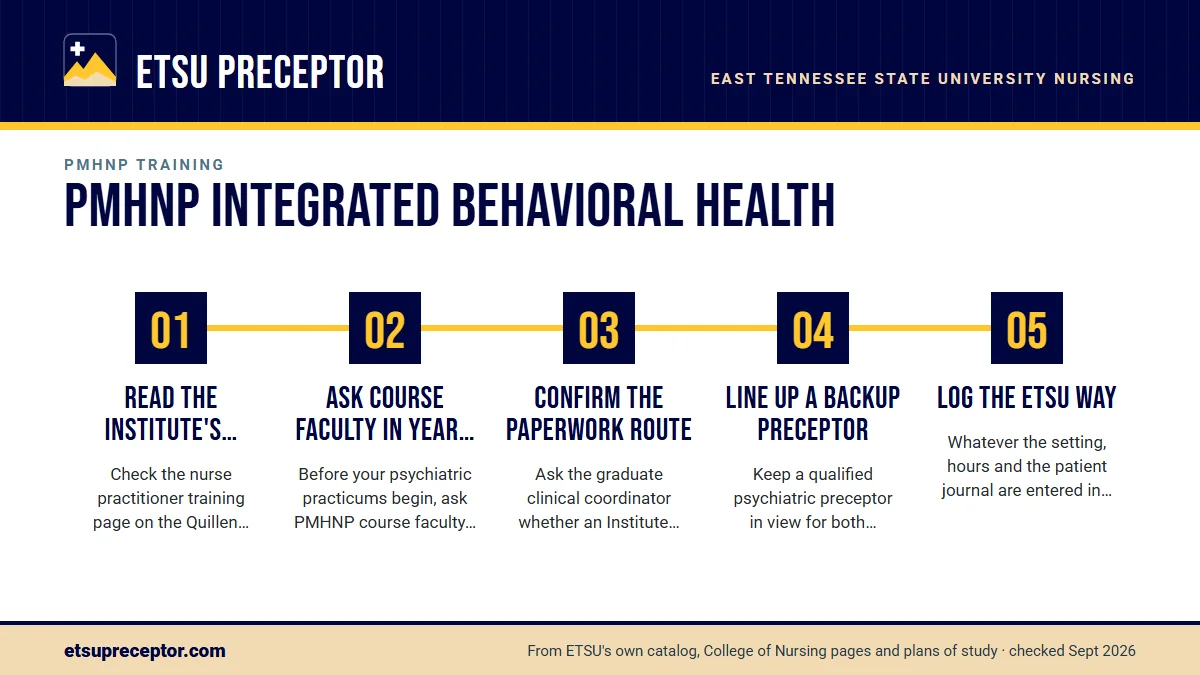
- Read the Institute's current pageCheck the nurse practitioner training page on the Quillen College of Medicine site for dates beyond academic year 2025 and any application steps.
- Ask course faculty in year oneBefore your psychiatric practicums begin, ask PMHNP course faculty whether Institute hours are expected to count toward
NRSE 5411andNRSE 6950for your cohort. - Confirm the paperwork routeAsk the graduate clinical coordinator whether an Institute placement still goes through the Intent Form and an onboarding submission in ProjectConcert, or has a process of its own.
- Line up a backup preceptorKeep a qualified psychiatric preceptor in view for both courses, so a closed cohort does not leave your final year without a site.
- Log the ETSU wayWhatever the setting, hours and the patient journal are entered in ProjectConcert under Experience, and that is also where you schedule the preceptor's mid-term and final evaluations.
Funding on the Institute's page stops at academic year 2025. Wait for someone at ETSU to confirm your cohort has a place before you build your final year around it.
An outside psychiatric preceptor for the same courses
If the Institute is not an option, NRSE 5411 and NRSE 6950 need a psychiatric preceptor, just as your earlier practicums did. ETSU publishes no written minimums for psychiatric preceptors. Its form records the preceptor's degrees, credentials and each license and certification number along with its expiration, and Tennessee's rule adds that the license must be unencumbered, valid where the preceptor practices and pitched at your target level or higher. Psychiatric NPs and psychiatrists are the natural candidates.
ETSU Online frames the specialty as psychiatric care for people of every age, delivered to individuals, families and groups in many kinds of setting. A practice that sees a range of ages and offers both individual and group work gives faculty an easy picture of fit. NRSE 5411 centers on interpersonal treatment modalities, so ask a prospective preceptor how much therapy you will see, not only medication management.
Psychiatric NPs licensed in Tennessee may also qualify for a state-funded preceptor payment when they teach APRN students from the state's accredited schools. Raising it can help when you approach a busy psychiatric NP; the preceptor incentive page explains who qualifies.
How we support ETSU PMHNP students
Psychiatric placements are a specialty of ours. We look for PMHNPs and psychiatrists in your own community whose practice fits NRSE 5405, NRSE 5409, NRSE 5411 or NRSE 6950, and we collect each detail ETSU's intent paperwork and onboarding upload call for before anything goes in. Even when an Institute slot is confirmed, NRSE 5405 and NRSE 5409 sit outside it, and we place those too.
If you are waiting on an Institute answer, we build the backup alongside it so your final year keeps its shape. ETSU's faculty and the Office of Student Services decide; our part is making sure every blank in what they receive is filled. See the MSN PMHNP program page or use the form below.
Questions ETSU students ask
Does the Institute for Integrated Behavioral Health still train ETSU PMHNP students?
The Institute's page ties its trainee funding to academic years 2021 through 2025 and is silent on later cohorts. To find out, check the Institute's current page, then ask your PMHNP course faculty and the graduate clinical coordinator whether Institute hours are expected to count for your cohort.
Which PMHNP courses can Institute hours count toward?
Only two courses are named on the Institute's page: NRSE 5411 and NRSE 6950, whose preceptor and clock-hour requirements its training can help meet. In ETSU's MSN PMHNP plan of study each carries 120 hours. No other course is named, so NRSE 5405 and NRSE 5409 still need their own preceptors.
Can FNP students join the integrated behavioral health training?
The Institute's nurse practitioner training page describes training for second-year PMHNP master's students and does not describe an FNP track. FNP students cover mental health in primary care through NRSE 6400 in their plan of study; ask course faculty about behavioral health exposure within a primary care practicum.
Are BSN-DNP PMHNP students eligible?
The Institute's page names PMHNP master's students. BSN-DNP PMHNP students take the same NRSE 5411 and NRSE 6950 in their first five semesters, so ask the Institute and your DNP course faculty whether you qualify. The page itself does not say either way.
Who approves a psychiatric preceptor outside the Institute?
The usual ETSU graduate route applies. Clinical faculty judge the psychiatric preceptor's fit, the Office of Student Services confirms credentials, and a site agreement plus your own cleared requirements are needed before the first day. The request itself goes in through ProjectConcert's onboarding format.
Related pages
Last checked 2026-09-25
We check these pages against ETSU's own catalog, College of Nursing pages, plans of study and ProjectConcert guides. Your plan of study, your syllabus, your course faculty and the graduate clinical coordinator have the final word.
ETSU asks you to lead the preceptor search. We make it the fastest part of your program.
Tell us your ETSU concentration, where you live and which semester your next practicum starts. We find preceptors who fit the course's patient population and prepare everything your Preceptor Intent Form and ProjectConcert entry need.
- Preceptors matched to the course: young and middle adults for
NRSE 5012, older adults forNRSE 5014, women forNRSE 5022, children forNRSE 5024, psychiatric care forNRSE 5405 - Credentials, license numbers, certification dates and the site's patient mix ready for faculty approval
- In your own community, in Northeast Tennessee or wherever ETSU approves your clinicals
Start your placement plan
Program, city and semester is all we need to begin.