How Tennessee's APRN rules shape who precepts you
In Tennessee, a nurse practitioner who prescribes works with a collaborating physician under protocols the two write together, and the Board of Nursing sets the license level every preceptor must hold. For East Tennessee State University (ETSU) students, those rules decide who can teach you and how a practice makes room for you.
Get your placement plan
Tell us your ETSU program and where you live. A placement advisor replies with the preceptor and site options that fit your ETSU course.
Collaboration in Tennessee, in plain terms
Tennessee issues APRN certificates in four roles: nurse practitioner, nurse anesthetist, nurse-midwife and clinical nurse specialist, each with or without a certificate of fitness to prescribe. That certificate of fitness, under Rule 1000-04-.04, is what allows an APRN to diagnose, set a medical plan of care and prescribe.
It comes with a partner. Before prescribing, the APRN files a notice naming a collaborating physician, with a formulary of drug categories, and opens records and practice sites to that physician. Any change is reported within 30 days, through a supervisory request in the state's LARS system that the physician approves or through a signed Notice and Formulary.
From 2026, the board also sends these NPs a yearly survey on the physician relationship each January, due December 1. This is the working world your preceptor lives in.
The physician's duties, and where you see them
These duties do not change whether you can train with an NP, but they explain how a Tennessee practice is built. Protocols are written for the site's own patients, which is the same population question ETSU's clinical faculty put to every site through the Preceptor Intent Form; our patient population page shows how they read it.
And because a prescribing NP always has a collaborating physician, a practice that hosts you may have a second clinician who could co-precept. The Intent Form already asks whether another preceptor will share the rotation.
| Duty | What Tennessee requires |
|---|---|
| Protocols | Written jointly with the NP, signed, dated, kept at the site, specific to the population served and reviewed every two years |
| Consultation | Available at all times for consultation, or a substitute arranged |
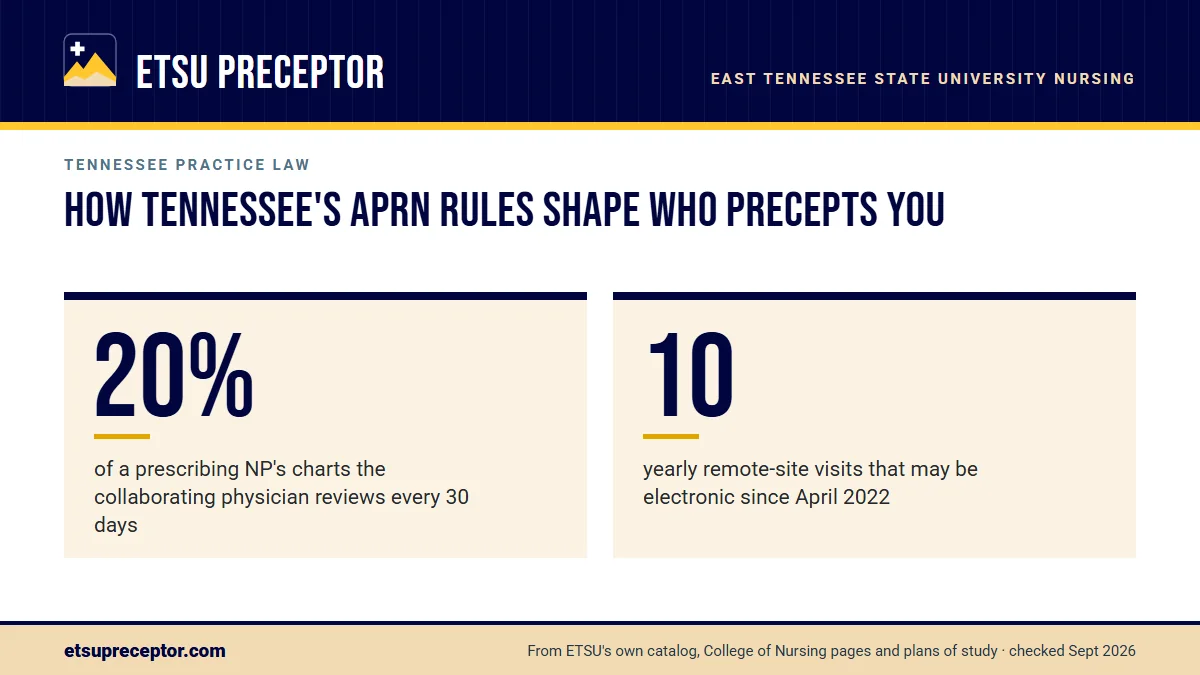
| Chart review | At least 20 percent of the NP's charts every 30 days, plus required reviews, such as controlled-drug prescriptions; since April 29, 2022, in person or by HIPAA-compliant electronic means |
| Remote sites | A physician visit every 30 days; since 2022, up to ten of each year's visits may be electronic and the rest in person |
The Board of Nursing's rule on preceptors
Chapter 1000-01 of the Board of Nursing's rules holds Tennessee's preceptor standards, in force in their current form since October 8, 2024. Its definitions cast the preceptor as someone teaching, mentoring, modeling or supervising students in clinical practice, and Rule 1000-01-.11 lists the conditions:
- The license carries no encumbrance and sits at the student's intended level or higher.
- It is valid in whichever state the teaching takes place.
- Competencies match the experience.
- Nursing faculty direct every clinical experience, the precepted ones included; a preceptor adds to faculty teaching and does not stand in for it.
- The school keeps watch on each preceptor's license through Nursys e-Notify.
For APRN programs, the rule also expects graduate courses in pathophysiology, health assessment and pharmacology, one of four APRN roles with one or more of six population foci, and clinical supervision that follows national specialty and accreditor standards. ETSU's course-by-course reading of these conditions is on our preceptor requirements page.
Psychiatric NPs still practice with a collaborating physician
PMHNP students sometimes hear that Tennessee is about to end collaboration for psychiatric NPs. The 2024 attempts failed. HB1876 would have required 60 months of practice first; HB2727 and SB2135 used three years or 6,240 hours. The General Assembly's record shows HB2727 taken off notice on March 20, 2024, and SB2135 sent to a general subcommittee the day before. The collaboration requirement stands.
The Board of Nursing's 2024 legislative update also lists acts on buprenorphine prescribing by NPs and physician assistants, covering patient caps and collaboration caps. A psychiatric practice that treats substance use may therefore work under added limits, which makes it a fair question to raise with any prospective preceptor before you commit. Our PMHNP practicums page covers ETSU's three psychiatric practicums.
What Tennessee leaves to ETSU
No Tennessee rule says who must find an APRN student's preceptor. Chapters 1000-01 and 1000-04, the board's FAQ and its education page were all checked, and none hands the search to the school or to the student. ETSU's own wording fills the gap: the graduate clinical coordinator can share contacts and past-preceptor lists, and the student is expected to drive the search; see finding your own preceptor.
The board does approve schools and set their minimum curriculum, online delivery included, and ETSU's College of Nursing states that its programs hold that approval. Tennessee is also a Nurse Licensure Compact state, one of 43 member jurisdictions in the board's 2025 count, and ETSU's DNP asks for an RN license from Tennessee or another compact state.
The same rules become yours after graduation
The collaboration you watch as a student is the arrangement you will enter as a new Tennessee NP. The APRN certificate under Rule 1000-04-.03 needs an unencumbered Tennessee RN license or multistate privilege, a master's or higher in a nursing specialty and current national certification. Before your first prescription, you and a collaborating physician agree on written protocols, then file either the Notice and Formulary or the LARS supervisory request.
Nobody may work as an APRN before the certificate is issued, and applications move in the order they arrive. That is one more reason to use your rotations well: ask your preceptor how the practice's protocols were written, how chart review works and what the physician looks for. You will need those answers in your first job.
Why ETSU students choose us to screen Tennessee preceptors
Our placement advisors check each Tennessee candidate against both rule sets before you see a name: license level, state and standing, certification dates that cover your term, and a patient population that fits your course. When a collaborating physician could co-precept, we collect that clinician's credentials as well, so the Intent Form can list a second preceptor from the start.
Tennessee APRNs who take you on may also qualify for the state's grant-funded preceptor incentive, and we raise it when we reach out. Everything reaches ETSU complete, so your clinical faculty and the Office of Student Services can do their review without chasing missing details, and you start the term with a preceptor who fits. Tell us your course and county in the form below.
Questions ETSU students ask
Do nurse practitioners in Tennessee need a collaborating physician?
Yes, to prescribe. An APRN holding a certificate of fitness must name a collaborating physician before prescribing and give that physician access to records and sites. The physician follows Rule 0880-06-.02, which calls for jointly written protocols and review of at least 20 percent of the NP's charts every 30 days.
Can a collaborating physician review charts remotely in Tennessee?
Since April 29, 2022, chart review may happen in person or by HIPAA-compliant electronic means. Visits to remote practice sites still come every 30 days, but up to ten of each year's visits may now be electronic, with the remainder in person.
Did Tennessee give psychiatric NPs full practice authority?
No. The 2024 bills that would have let experienced psychiatric NPs practice without a collaborating physician, HB1876 and HB2727 with its Senate companion SB2135, did not pass. HB2727 was taken off notice in March 2024 and SB2135 went to a general subcommittee. Psychiatric NPs in Tennessee still practice under collaboration.
Can a preceptor licensed only in another state teach me in Tennessee?
Under Tennessee's rule, the preceptor's license must be good in the state where the teaching happens, so someone precepting you in Tennessee needs a license valid in Tennessee at or above your level. ETSU checks this during approval, so confirm the license before you submit.
Is there a limit on how many NPs one Tennessee physician can collaborate with?
The Board of Medical Examiners' supervision FAQ, dated 2016, says there is no set cap. Separate 2024 acts on buprenorphine prescribing by NPs and physician assistants address patient caps and collaboration caps for that treatment. For your placement, the preceptor's license and the site's patients matter more.
Related pages
Last checked 2026-09-25
We check these pages against ETSU's own catalog, College of Nursing pages, plans of study and ProjectConcert guides. Your plan of study, your syllabus, your course faculty and the graduate clinical coordinator have the final word.
ETSU asks you to lead the preceptor search. We make it the fastest part of your program.
Tell us your ETSU concentration, where you live and which semester your next practicum starts. We find preceptors who fit the course's patient population and prepare everything your Preceptor Intent Form and ProjectConcert entry need.
- Preceptors matched to the course: young and middle adults for
NRSE 5012, older adults forNRSE 5014, women forNRSE 5022, children forNRSE 5024, psychiatric care forNRSE 5405 - Credentials, license numbers, certification dates and the site's patient mix ready for faculty approval
- In your own community, in Northeast Tennessee or wherever ETSU approves your clinicals
Start your placement plan
Program, city and semester is all we need to begin.