ETSU nursing clinicals in Tennessee
Tennessee is home to East Tennessee State University (ETSU), and every licensure list ETSU publishes agrees that its nursing programs meet Tennessee's requirements. What shapes your clinicals here is Tennessee law and practice: nurse practitioners work with a collaborating physician, a preceptor must be licensed at or above the level you are seeking, and the big health systems take NP students only through school agreements.
Training in Tennessee?
Tell us your county, ETSU program and next practicum. We search close to home for a preceptor who fits Tennessee's rules and your course.
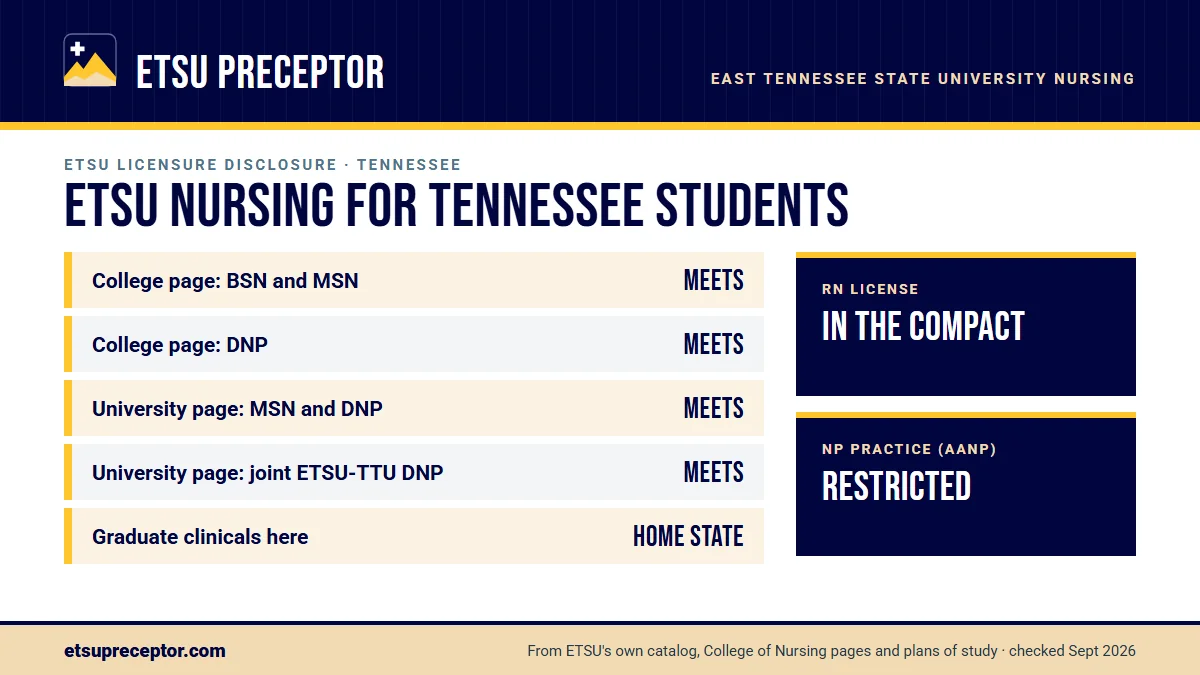
What ETSU says about Tennessee
| ETSU page | Program | Result for Tennessee |
|---|---|---|
| College of Nursing MSN page (updated September 2025) | BSN and MSN | Meets |
| College of Nursing DNP page (updated April 2026) | ETSU DNP and ETSU-TTU joint DNP | Meets |
| University consumer information pages (tables updated June 2025) | MSN and DNP | Meets |
| University consumer information page (updated July 2024) | ETSU-TTU joint DNP | Meets |
| University consumer information page | BSN | Meets |
Every column lines up, which is not true for many states. The College of Nursing also states that its programs hold Tennessee Board of Nursing approval, so a student who lives and trains in Tennessee has no disclosure question to settle. The questions left are practical: which preceptor, which site and which contract.
Tennessee matters to students elsewhere too. The LPN to BSN runs every clinical inside Tennessee, across Northeast, East and Middle Tennessee regions, and ETSU's RN to BSN page cautions that out-of-state residents might be required to train at a Tennessee institution or agency instead. Other states are compared on ETSU's licensure disclosures.
Collaboration: how Tennessee nurse practitioners practice
AANP classes Tennessee as a restricted practice state. An NP who prescribes holds a certificate of fitness and must work with a collaborating physician who follows Board of Medical Examiners Rule 0880-06-.02. Together they write protocols that are signed, dated, kept at the practice site, specific to the population served and reviewed every two years.
Under that rule the physician is reachable for consultation at all times, reviews at least 20% of the NP's charts every 30 days, and adds required reviews for controlled-drug prescriptions and anything prescribed outside protocol. Remote sites get a physician visit every 30 days. A 2022 statute change lets chart review happen by secure electronic means and allows up to ten of the yearly site visits to be electronic. The medical board sets no cap on how many APRNs one physician may work with.
The rule has held. Two 2024 bills aimed at releasing experienced psychiatric NPs from collaboration failed in the General Assembly, so PMHNPs work under the same arrangement. For your search, it means a collaborating physician is part of every prescribing NP's practice, and the Intent Form's credential examples put MD next to FNP and ANP. The full picture is on Tennessee APRN practice and preceptors.
Tennessee's preceptor rule
The Tennessee Board of Nursing rewrote its rules effective October 8, 2024. Rule 1000-01-.01 describes the preceptor's job as teaching, mentoring, role modeling or supervising students in clinical settings, and it sets the license floor at the level the student is working toward or higher. For an NP student, that means an NP or a physician, not a staff RN. Rule 1000-01-.11 adds the rest:
- Every clinical experience, with or without a preceptor, runs under nursing faculty direction.
- A preceptor adds to faculty-directed learning and never stands in for clinical faculty.
- The preceptor's license carries no encumbrance, sits at your target level or above, and covers practice in the state where you train together.
- Their competencies fit the experience you need.
- The school watches each preceptor's license status using Nursys e-Notify.
No Tennessee rule says whether the school or the student finds APRN preceptors. ETSU answers that for itself: its graduate clinical coordinator can draw on contacts and a record of past preceptors, while the search itself is the student's to lead. How ETSU applies all this is on preceptor requirements. One pending change points the other way: a 2026 bill, SB 2013/HB 1905, would pause Board approvals for nursing programs based outside Tennessee that want to place students here. Its enactment could not be confirmed, and it targets out-of-state schools rather than Tennessee-based ones like ETSU.
What Tennessee health systems ask of schools
The large systems each publish their own route for NP students, and every route runs through the school. These notes come from each system's own pages and describe its process, not an arrangement with any particular school.
- Ballad Health has 20 hospitals serving 29 counties spread over four states: Northeast Tennessee plus parts of Southwest Virginia, Southeast Kentucky and Northwest North Carolina. Ballad says any advanced practice provider (APP) student may ask for an elective rotation, and more than 400 rotate there yearly, yet each must come from a program with an active Ballad agreement and apply via that program's clinical coordinator. Its online student orientation is finished before an approved placement begins.
- Covenant Health in Knoxville places students from partner schools through its Total Clinical Placement System (TCPS); other schools request facility access through its Student Portal, starting at least two weeks ahead.
- Erlanger in Chattanooga has paused new affiliation agreements for APP students. Its own staff studying in programs without an agreement can request an exception, subject to preceptor availability and manager approval.
- Vanderbilt Health in Nashville keeps affiliation agreements covering NP, MSN and DNP students, and a school without one starts the process through its clinical coordinator.
Because each request goes school to system, a hospital-based site brings ETSU's contract step with it. Ask the graduate clinical coordinator what exists for your course before you contact a system, and read Tennessee NP preceptors for more on each.
Northeast Tennessee: shortage areas and ETSU's own clinics
ETSU's home region carries a dense set of federal shortage designations. HRSA's September 2026 files show low-income primary care shortage areas reaching Sevier, Greene, Hawkins, Sullivan, Washington, Carter and Unicoi, whole-county geographic designations for Johnson and Hancock, and facility designations for ETSU's own health center and the Rural Health Services Consortium in Hawkins County. Many mental health area designations here carry a proposed-for-withdrawal status, so they may not last.
Appalachian Regional Commission economic status for fiscal 2027 puts Johnson and Hancock at distressed and Carter and Greene at at-risk. Hawkins, Sevier, Sullivan, Unicoi and Washington are transitional, and Knox is competitive.
ETSU runs nurse-led clinics inside that landscape through its Office of Practice: the Johnson City Community Health Center and the Johnson City Downtown Day Center Clinic, which ETSU calls Federally Qualified Health Centers, school-based health centers in Sneedville for Hancock County, and a Mountain City extended hours clinic named on the practice page. Each term has a fixed opening date for requests: October 1 covers spring, March 1 covers summer, May 1 covers fall, and anything sent before a window opens is not considered. See ETSU's nurse-led clinics and Northeast Tennessee preceptors.
The Tennessee Nurse Preceptor Incentive
Tennessee rewards preceptors through a state grant-funded Nurse Preceptor Incentive run by the Tennessee Hospital Association and the Tennessee Center for Health Workforce Development. It began as a 2024 pilot and makes one tiered payment per cycle, based on approved hours, first come first served while funds last. Listed cycles include Summer and Fall 2026.
An APRN preceptor qualifies when licensed in Tennessee, holding an unrestricted Tennessee or compact license, a U.S. citizen or permanent resident, precepting APRN students from an approved, accredited Tennessee school, and finished with a one-time UTHSC preceptor course. Hours count at sites approved by a Tennessee program with a current clinical affiliation agreement. Since January 14, 2026, enrollment and hour logs run through the Whitecoat platform, and each preceptor's employer policy decides whether they can join.
ETSU is an accredited Tennessee school, so a Tennessee NP who precepts you may be able to take part, which is worth mentioning when you ask. Tennessee has no preceptor tax credit: the 2024 mental health preceptor tax bill did not pass. Details are on the preceptor incentive page.
Your RN license now, your APRN certificate later
For Tennessee clinicals, a Tennessee RN license or a multistate license from another compact state does the job. Tennessee belongs to the Nurse Licensure Compact but has not enacted the APRN Compact. ETSU's rules on keeping every license unencumbered are on the RN license page. After graduation, the Tennessee board's APRN path runs like this:
- Pass national certificationYour certifying body sends verification to the board, and the certification number goes on the application.
- Hold a Tennessee or multistate RN licenseUpload a copy with the application.
- Have ETSU send your transcriptThe official transcript showing the conferred degree must come directly from the school after the degree posts.
- Apply in LARSUse the APRN Initial Certificate Application for your license type, with a notarized Declaration of Citizenship, any criminal history disclosure and the Mandatory Practitioner Profile. Applications are handled in the order received, and you do not practice as an APRN until the certificate issues.
- Set up collaboration before prescribingThe certificate of fitness comes with the APRN certificate when Rule 1000-04-.04 is met. Before prescribing, write joint protocols and file the Notice and Formulary or a LARS supervisory request, and keep a DEA registration and CSMD registration for controlled substances.
The certificate renews every two years with your RN license, and the board surveys certificate-of-fitness NPs each year about the physician relationship; from 2026 the survey arrives in January and is due December 1.
Why Tennessee ETSU students choose us
Tennessee is where our knowledge of ETSU's process runs deepest. We search your own county and the counties around it for an NP or physician preceptor whose license clears Tennessee's at-or-above rule and whose patient mix fits your ETSU course, then collect everything ETSU's Intent Form and ProjectConcert's Preceptor & Clinical Agency Onboarding entry require. If the site is new to ETSU, we flag the contract on the first day so the College has time to set it up.
The decision on your preceptor belongs to ETSU's clinical faculty, and the Office of Student Services handles verification; our part is making sure the file they receive is complete and matches ETSU's rules at first submission. If a preceptor steps away mid-semester, we start on a replacement at once. See how it works or send your details through the contact form.
Questions ETSU students ask
Can a physician precept an ETSU nurse practitioner student in Tennessee?
Yes, as long as the physician meets Tennessee's preceptor rule: licensed at your target level or higher, with no encumbrance, for the state where you train. ETSU's Preceptor Intent Form gives MD as an example credential next to FNP and ANP. Your clinical faculty still approve each preceptor for the specific course and its patient population.
Does Ballad Health accept ETSU nurse practitioner students?
Ballad's academics page admits APP students whose school holds an active affiliation with Ballad, and the school's clinical coordinator is the one who sends the request; orientation comes first. ETSU's pages do not describe an NP placement agreement with Ballad, so ask the graduate clinical coordinator whether one covers your course before you approach a Ballad hospital.
Is Tennessee a full practice state for nurse practitioners?
No. AANP lists Tennessee as restricted: a prescribing NP needs a collaborating physician, jointly written protocols and regular chart review. Bills in 2024 to exempt experienced psychiatric NPs from collaboration did not pass. For students, this mostly affects who is in the practice, since collaborating physicians work alongside the NPs you may ask to precept you.
Where do ETSU LPN to BSN students do clinicals in Tennessee?
ETSU's LPN to BSN page lists three clinical regions. In the northeast that means places like Johnson City; in East Tennessee, Knoxville, Sevierville or Crossville; in Middle Tennessee, Nashville, Columbia or Manchester. Placement close to home is something ETSU aims for without promising, so plan for long drives, possible overnight stays and twelve-hour clinical days on weekends.
Does my Tennessee preceptor need to hold a Tennessee license?
Tennessee's rule looks for an unencumbered license, at your level or higher, that is good for the state where the two of you work. A Tennessee license or a multistate license from another compact state covers the RN side; APRN authority is issued state by state. ETSU's Office of Student Services verifies the credentials listed on your Intent Form.
Related pages
Last checked 2026-09-25
We check these pages against ETSU's own catalog, College of Nursing pages, plans of study and ProjectConcert guides. Your plan of study, your syllabus, your course faculty and the graduate clinical coordinator have the final word.
ETSU asks you to lead the preceptor search. We make it the fastest part of your program.
Tell us your ETSU concentration, where you live and which semester your next practicum starts. We find preceptors who fit the course's patient population and prepare everything your Preceptor Intent Form and ProjectConcert entry need.
- Preceptors matched to the course: young and middle adults for
NRSE 5012, older adults forNRSE 5014, women forNRSE 5022, children forNRSE 5024, psychiatric care forNRSE 5405 - Credentials, license numbers, certification dates and the site's patient mix ready for faculty approval
- In your own community, in Northeast Tennessee or wherever ETSU approves your clinicals
Start your placement plan
Program, city and semester is all we need to begin.