The right RN license for your ETSU clinicals
East Tennessee State University (ETSU) ties clinical eligibility to your RN license. MSN students need a clean, unencumbered RN license either in Tennessee or in whichever state hosts their clinicals, DNP students need a license or authorization in Tennessee or a compact state, and every graduate student must report any encumbrance at once.
Get your placement plan
Tell us your ETSU program and where you live. A placement advisor replies with the preceptor and site options that fit your ETSU course.
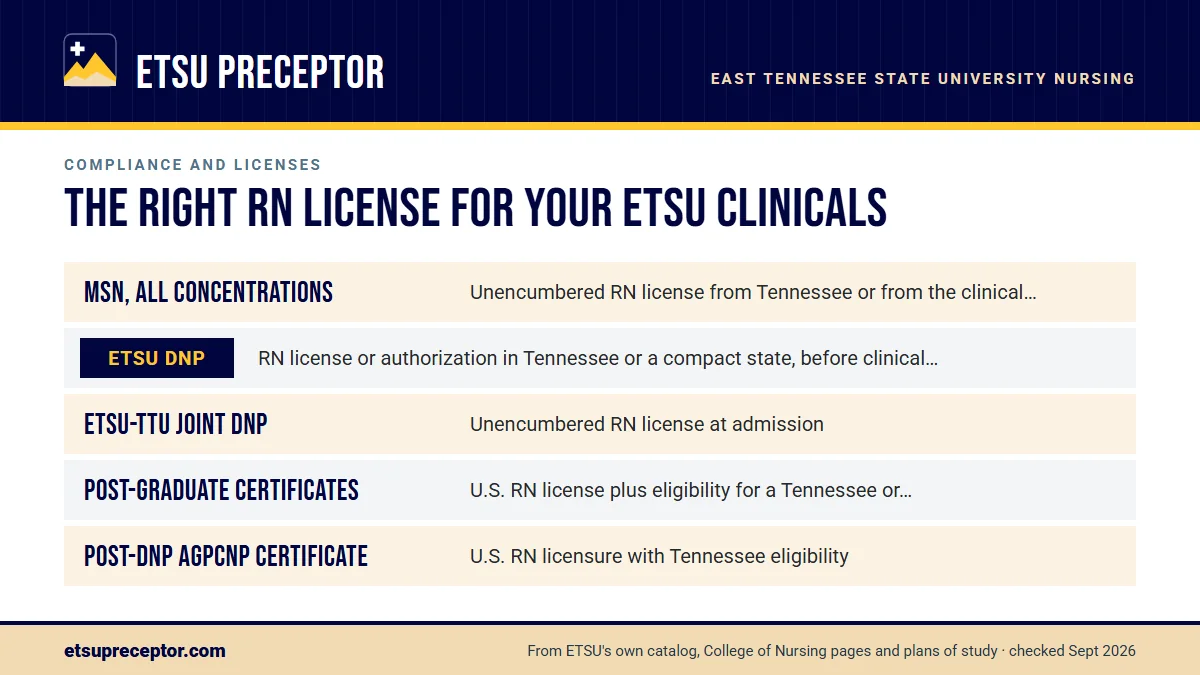
The rule by program
Each ETSU program words its license rule a little differently, and the differences matter most when you plan clinicals outside Tennessee.
| Program | License ETSU asks for | Where ETSU states it |
|---|---|---|
| MSN, all concentrations | Unencumbered RN license from Tennessee or from the clinical state | Graduate catalog, MSN |
| ETSU DNP | RN license or authorization in Tennessee or a compact state, before clinical courses | Graduate catalog, DNP |
| ETSU-TTU joint DNP | Unencumbered RN license at admission | ETSU Online joint DNP page |
| Post-graduate certificates | U.S. RN license plus eligibility for a Tennessee or compact-state license | Graduate catalog, certificates |
| Post-DNP AGPCNP certificate | U.S. RN licensure with Tennessee eligibility | ETSU Online certificates page |
| RN to BSN and LPN to BSN | Current license, reviewed under the Clinical Health Requirements Policy | Undergraduate catalog |
One rule sits over every graduate program: keep an unencumbered license in each state where you hold one and in each state where you do clinicals.
Tennessee, the compact and your clinical state
Tennessee belongs to the Nurse Licensure Compact, and the Board of Nursing's 2025 report counts 43 member jurisdictions. A multistate license from your home compact state carries a privilege to practice as an RN in the other member states, which fits the DNP rule's wording of Tennessee or any compact state.
The MSN wording is narrower on paper: Tennessee or the state where clinicals happen. Read with the every-state rule, the working test becomes simple. Is your license valid in the state where you will stand beside a preceptor? A Tennessee multistate license generally answers that for another compact state, while a clinical in a state outside the compact means holding that state's own license. Confirm your exact case with the graduate clinical coordinator before you commit to a site.
License is only half of the out-of-state question. ETSU also says graduate clinicals outside Tennessee need a green light from the relevant regulators, with each request weighed individually once a student is admitted. Our page on clinicals outside Tennessee covers that side, and ETSU's licensure disclosures show how ETSU rates each state.
Report any encumbrance at once
ETSU's graduate catalog requires every graduate student to keep each license unencumbered and to report any encumbrance immediately to the Associate Dean of Graduate Programs. The consequences are spelled out: a suspended or revoked license, or a change you fail to report, leads to administrative withdrawal.
An encumbrance can be more than a revocation. If a board opens an action, adds conditions or restricts a license you hold in any state, raise it with the Associate Dean before a site or a preceptor learns of it some other way. If you are unsure whether something counts, ask right away rather than after the fact. The duty does not pause between practicums or during a term with no clinical course.
Under ETSU's graduate catalog, an unreported license change leads to administrative withdrawal, just as a suspension or revocation does.
Bachelor's students: RN to BSN and LPN to BSN
Licensed students entering a BSN track show their license, and the undergraduate catalog reviews it under the College's Clinical Health Requirements Policy. An encumbered or revoked license means withdrawal from the program.
New associate degree graduates get one short window in the RN to BSN: they may take one semester of BSN courses before licensure, but they must pass the NCLEX-RN within that first semester. The final practicum, NRSE 4026, can run at your current employer if you work full time in direct patient care; our R.N. Practicum page explains the options for everyone else.
LPN to BSN clinicals stay inside Tennessee. ETSU's program page rules out LPN to BSN placements beyond the state line and sorts its clinicals into Northeast, East and Middle Tennessee regions.
Your preceptor's license counts too
The license question runs through both sides of a placement. Tennessee Board of Nursing Rule 1000-01-.11 (in force since October 8, 2024) requires a preceptor's license to be unencumbered, to sit at the student's target level or higher, and to be held in the state where the precepting happens; it also requires schools to monitor preceptor licenses through Nursys e-Notify.
That is why the Preceptor Intent Form asks for each preceptor's license numbers with state and expiration date, and why the Office of Student Services verifies credentials before you start. If a preceptor holds licenses in more than one state, give the one for the state where you will train. A preceptor license that expires in the middle of your term is as much of a problem as your own. Our preceptor requirements page covers who can precept an ETSU student.
Looking ahead to your APRN certificate
The license you keep clean now is the one your first APRN application rests on. Tennessee's APRN certificate rule (1000-04-.03) requires an unencumbered Tennessee RN license or a multistate privilege, a graduate nursing degree at master's level or above in a specialty, and national certification that is current. The Board's application in LARS asks you to upload a copy of your RN license, so keep it current through graduation and that step stays simple. The Board processes APRN applications in the order received, with only military members and spouses expedited, so there is no fast lane for a file that needs fixing.
If you move during the program, the rules shift with you. ETSU says a student who relocates may continue only if the new state's board of nursing allows it, and has to notify both the College and the records office; see moving during your program.
How we plan placements around your license
We start every placement with a location check: where you hold a license, where you want to train, and whether that state fits ETSU's rules and disclosures for your program. Then we search for preceptors licensed in that state at your target level or higher, and we collect their license numbers and expiry dates for the Intent Form so the credential check finds nothing missing. If you are moving mid-program or weighing a site across a state line, we raise the license question before the search begins.
Approval of the preceptor belongs to your clinical faculty and verification to the Office of Student Services. We bring them an accurate, complete file on the first pass. Start with the contact form.
Questions ETSU students ask
Does ETSU's online MSN require a Tennessee RN license?
Not necessarily. For MSN students, ETSU's graduate catalog accepts an unencumbered RN license from Tennessee or from the state that hosts their clinicals. You must also keep every license you hold unencumbered, and hold a valid license in each state where you do clinicals.
Can I use a multistate compact license for the ETSU DNP?
Yes. The DNP catalog asks for an RN license or authorization in Tennessee or a compact state before clinical courses, and Tennessee is a Nurse Licensure Compact member. Check that your clinical state is also a member, or hold that state's own license, before you choose a site.
What happens if my RN license is disciplined during the program?
Tell the Associate Dean of Graduate Programs straight away. ETSU's catalog says a suspended or revoked license, or a change you fail to report, leads to administrative withdrawal. Early reporting lets the College advise you on clinical timing before a site or preceptor is affected.
Can I start ETSU's RN to BSN before I pass the NCLEX?
New associate degree graduates may take one semester of BSN courses before licensure, according to ETSU's RN to BSN page, but they must pass the NCLEX-RN within that first semester. The final practicum, NRSE 4026, comes later, in the last semester of the three-semester track.
Does my preceptor need a license in my clinical state?
Yes. Tennessee Rule 1000-01-.11 wants the preceptor's license to be unencumbered, at the student's target level or higher, and issued for the state where the teaching takes place. The Intent Form collects license numbers, states and expiry dates, and those details are verified by the Office of Student Services before your first day.
Related pages
Last checked 2026-09-25
We check these pages against ETSU's own catalog, College of Nursing pages, plans of study and ProjectConcert guides. Your plan of study, your syllabus, your course faculty and the graduate clinical coordinator have the final word.
ETSU asks you to lead the preceptor search. We make it the fastest part of your program.
Tell us your ETSU concentration, where you live and which semester your next practicum starts. We find preceptors who fit the course's patient population and prepare everything your Preceptor Intent Form and ProjectConcert entry need.
- Preceptors matched to the course: young and middle adults for
NRSE 5012, older adults forNRSE 5014, women forNRSE 5022, children forNRSE 5024, psychiatric care forNRSE 5405 - Credentials, license numbers, certification dates and the site's patient mix ready for faculty approval
- In your own community, in Northeast Tennessee or wherever ETSU approves your clinicals
Start your placement plan
Program, city and semester is all we need to begin.