ETSU nursing from Mississippi: clinicals and approvals
Every licensure disclosure East Tennessee State University (ETSU) publishes says its nursing programs meet Mississippi's educational requirements. What slows a Mississippi rotation is something else: a university governing board, not the nursing board, vets out-of-state nursing programs before their students set foot in a Mississippi clinic, and it wants months of notice.
Training in Mississippi?
Tell us your town, program and next practicum. We plan around IHL's timeline from the start.
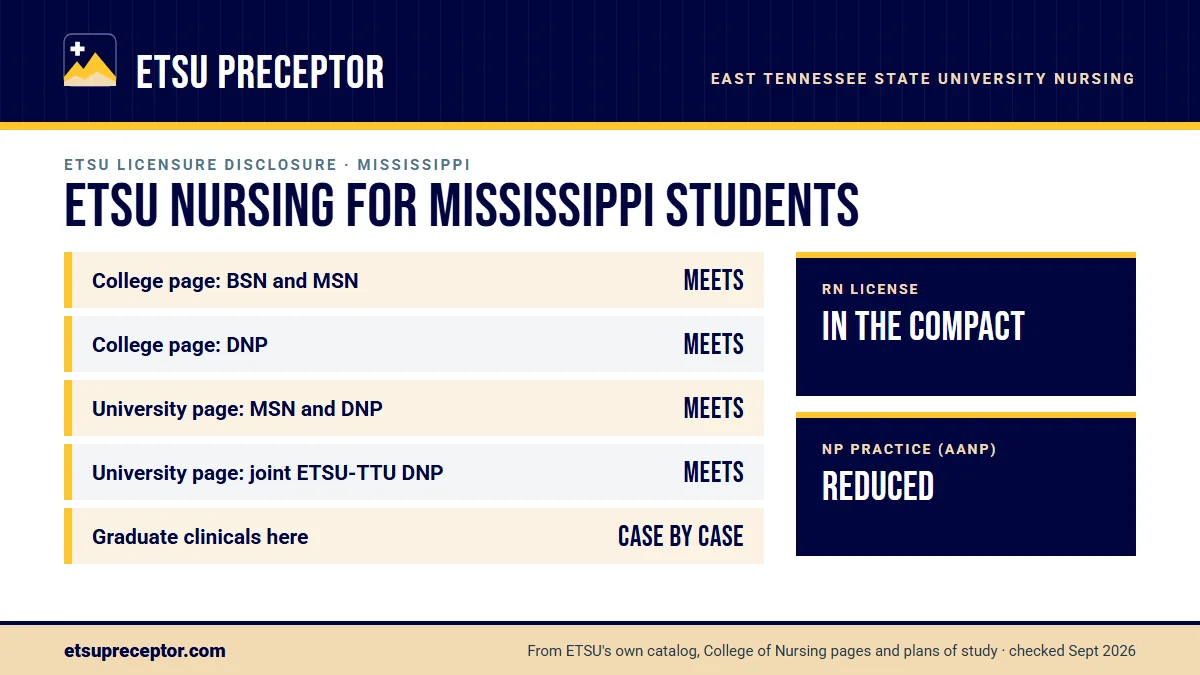
What ETSU says about Mississippi
| ETSU page | Program | Result for Mississippi |
|---|---|---|
| College of Nursing MSN page (updated September 2025) | BSN and MSN | Meets |
| College of Nursing DNP page (updated April 2026) | ETSU DNP and ETSU-TTU joint DNP | Meets |
| University consumer information pages (tables updated June 2025) | MSN and DNP | Meets |
| University consumer information page (updated July 2024) | ETSU-TTU joint DNP | Meets |
| University consumer information page | BSN | Meets |
No ETSU page hedges on Mississippi: the College of Nursing counts it among the 25 states where the BSN and MSN meet requirements and the 24 for the DNP, and the university tables agree. A clean disclosure speaks to the curriculum, not to a particular clinical site, and ETSU still weighs each placement outside Tennessee on its own after admission. The full comparison is on ETSU's licensure disclosures.
Mississippi's review runs through IHL, not the nursing board
Mississippi hands this job to an unexpected office. Its nursing board approves practical nursing programs, while RN degree programs fall under Mississippi's Institutions of Higher Learning board, known as IHL. An out-of-state school that wants its students training in Mississippi therefore talks to IHL, which holds those graduate and undergraduate programs to Mississippi's own standards.
In IHL's view, a clinical practicum in the state amounts to physical presence, which calls for IHL Nursing Education to look over the program. IHL puts that process at up to three months. Appendix S of its procedures manual, dated August 2024, is stricter on timing: programs run from outside Mississippi should file a full four months or more ahead of the start date. The school also needs SARA participation or a non-SARA authorization from MCCA, and NC-SARA lists ETSU as a Participant.
ETSU, for its part, makes out-of-state placement contingent on the appropriate regulators' approval, so mention a Mississippi site to the graduate clinical coordinator the moment it looks likely. Broader rules are on clinicals outside Tennessee.
IHL reviews ETSU's program, not your preceptor, and wants four months' notice before clinicals.
Who practices and precepts in Mississippi
AANP classes Mississippi as reduced practice. To practice, a Mississippi NP needs a collaborative relationship the board has approved, with a physician or dentist holding a Mississippi license. Physician preceptors are familiar in ETSU NP courses anyway; MD sits among the Intent Form's credential examples.
Population centers are Jackson, Gulfport-Biloxi and Hattiesburg, along with the Mississippi side of the Memphis metro, home to roughly 278,000 Mississippians. Among the systems Mississippi NP students look at are Forrest Health, UMMC, North Mississippi Health Services, the Singing River system, and Memphis-based Baptist Memorial Health Care, whose hospitals include Mississippi Baptist Medical Center in Jackson. None is a committed ETSU site; each would first need a contract with ETSU.
Tennessee's Nurse Preceptor Incentive names Mississippi in its neighbor clause, but only so Tennessee-licensed APRNs can count Mississippi schools' students training in Tennessee. An ETSU rotation on Mississippi soil is outside that clause; how the incentive works has the rest.
Licenses for a Mississippi rotation
IHL's program standards tie the license to the clinical's location: graduate students in clinical courses, APRN tracks included, must be licensed as RNs, without encumbrance, for the state they train in, and IHL expects visiting programs to enforce the same. Mississippi's compact participation dates from January 19, 2018, and its board adds that no employer can demand a remote-state license from a nurse in good standing whose home state is a compact member.
A multistate license issued by Mississippi satisfies ETSU's catalog on both tracks: MSN students need an unencumbered license from Tennessee or from wherever they train, and doctoral students need one from Tennessee or another compact state. Mississippi has not passed the APRN Compact. Details are on the license ETSU expects.
Why ETSU students in Mississippi choose us
A Mississippi rotation runs on two clocks, ETSU's review and IHL's, and we start both on day one. Our search stays close to where you live, aimed at a preceptor whose patients line up with your ETSU course. We gather the credential and site details the Preceptor Intent Form and ProjectConcert call for, and raise the contract question with you straight away.
The yes or no on your preceptor comes from ETSU's clinical faculty; the Office of Student Services confirms the credentials behind it. What reaches them from us is whole and in step with ETSU's process on the first try. Should a preceptor pull out mid-semester, finding a replacement becomes our next job. Your first step is the contact form.
Questions ETSU students ask
Does ETSU's online FNP meet Mississippi licensure requirements?
Yes, on every page ETSU publishes. Both the College of Nursing's September 2025 MSN page and the university's June 2025 consumer tables list Mississippi as meeting requirements. Clinicals there are a separate matter: ETSU reviews each out-of-state placement, and IHL reviews the program.
Can I do my ETSU clinicals across the line in Memphis?
Memphis is in Tennessee, so a site there is not an out-of-state placement for ETSU and Mississippi's IHL review does not apply to it. Tennessee's rules do: your preceptor needs an unencumbered license at or above the level you are seeking. A Mississippi multistate RN license covers you in Tennessee, and the site still needs a contract with ETSU.
Does the Tennessee Nurse Preceptor Incentive pay a Mississippi preceptor?
Its neighbor clause lets Tennessee-licensed APRNs precept students from Mississippi schools for Tennessee hours only, and it does not fund an ETSU rotation inside Mississippi. A Tennessee-licensed APRN precepting you at a Tennessee site falls under the program's ordinary terms.
What happens if I move to Mississippi during my ETSU program?
ETSU allows a mid-program move only with the consent of the new state's nursing board, and both the College and the records office need to hear about it. A Mississippi clinical then brings IHL's review into play. See moving mid-program.
Related pages
Last checked 2026-09-25
We check these pages against ETSU's own catalog, College of Nursing pages, plans of study and ProjectConcert guides. Your plan of study, your syllabus, your course faculty and the graduate clinical coordinator have the final word.
ETSU asks you to lead the preceptor search. We make it the fastest part of your program.
Tell us your ETSU concentration, where you live and which semester your next practicum starts. We find preceptors who fit the course's patient population and prepare everything your Preceptor Intent Form and ProjectConcert entry need.
- Preceptors matched to the course: young and middle adults for
NRSE 5012, older adults forNRSE 5014, women forNRSE 5022, children forNRSE 5024, psychiatric care forNRSE 5405 - Credentials, license numbers, certification dates and the site's patient mix ready for faculty approval
- In your own community, in Northeast Tennessee or wherever ETSU approves your clinicals
Start your placement plan
Program, city and semester is all we need to begin.