Who pays for what in an ETSU clinical placement
East Tennessee State University (ETSU) places most clinical costs on the student. Its graduate catalog has you paying for your own background check, buying malpractice coverage for nurse practitioner students at a level the College fixes, and getting yourself to every clinical site. BSN students meet their clinical health requirements at their own expense, and LPN to BSN students may face long travel and overnight stays. This page names who pays for each item; it gives no figures, because ETSU publishes none.
Get your placement plan
Tell us your ETSU program and where you live. A placement advisor replies with the preceptor and site options that fit your ETSU course.
The short answer, item by item
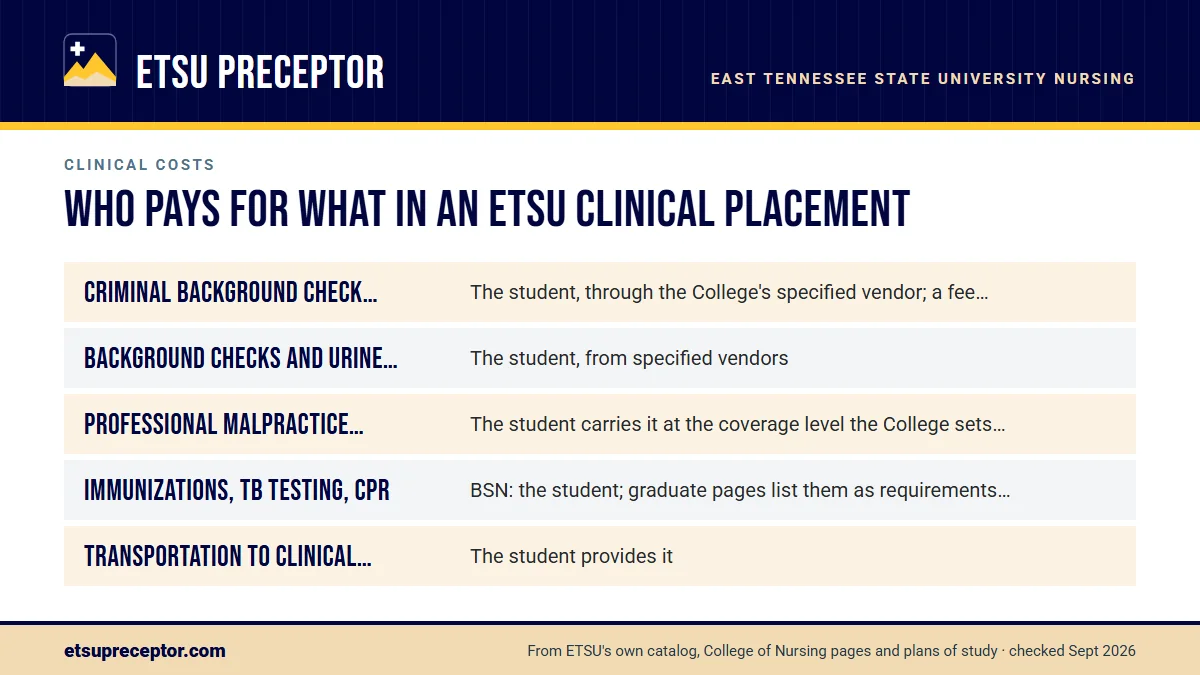
Each row below is drawn from ETSU's own catalog or College pages. Where ETSU names no payer, the table says so rather than guessing.
| Item | Who pays, per ETSU | Where ETSU says it |
|---|---|---|
| Criminal background check (graduate) | The student, through the College's specified vendor; a fee applies | Graduate catalog, DNP program |
| Background checks and urine drug screens (BSN) | The student, from specified vendors | Undergraduate catalog |
| Professional malpractice insurance (NP students) | The student carries it at the coverage level the College sets; a cost applies | Graduate catalog, DNP program |
| Immunizations, TB testing, CPR | BSN: the student; graduate pages list them as requirements without naming a payer | Catalogs; Office of Practice list |
| Transportation to clinical sites | The student provides it | Graduate catalog |
| Long travel and overnight stays (LPN to BSN) | The student | LPN to BSN page |
| Travel or waiting when repeating a BSN clinical | The student | Undergraduate catalog |
| Clinical agency contracts | Not published | Not found on ETSU's pages |
| Preceptor pay or benefits | Not published by ETSU; a state-funded incentive pays some Tennessee APRN preceptors | Tennessee Hospital Association program page |
Background checks and drug screens
Graduate students buy their own criminal background check, from a vendor the College names, under College policy. The agencies that host clinicals read the results and make the call on whether you may train with them. ETSU itself never sees the report; all it files is a record that the check happened, kept with your clinical health requirements.
Nursing pages do not name the vendor. A 2023 Graduate School instruction sheet sends ETSU students to Truescreen's Application Station, but it is university-wide rather than nursing-specific, so get the vendor's name from the Office of Student Services first.
Timing can mean paying twice. The College's nurse-led clinics ask for a check from the past 12 months, so an admission-year check may need repeating before a clinic rotation. BSN students also pay for urine drug screens; ETSU's graduate pages mention no drug screen. More detail is on the background checks page.
Malpractice insurance
The DNP catalog makes professional malpractice coverage a condition of starting clinical courses, pitched at whatever level the College chooses for NP students, and it flags that this costs money. The Preceptor Intent Form names liability insurance among the clinical requirements every graduate student must meet before clinicals start, so MSN and certificate students should expect the same question.
ETSU's pages publish neither the coverage limits nor a carrier. Ask the Office of Student Services which limits your program requires and what proof ProjectConcert expects, then buy a policy that matches exactly. A policy with the wrong limits, or one that lapses mid-term, can hold up an otherwise approved placement. The malpractice insurance page walks through what to check.
Ask the Office of Student Services to name the check vendor and the insurance limits, and only then spend money on either: a wrong purchase has to be bought again.
Immunizations, TB tests, CPR and trainings
ETSU's fullest requirement list belongs to its nurse-led clinics: annual flu and TB testing, MMR, hepatitis B, varicella, Tdap or Td in the last decade, CPR, plus several ETSU trainings. The DNP catalog separately asks for current CPR and an understanding of universal precautions before clinical coursework.
Only the BSN catalog names a payer, saying students meet their clinical health requirements at their own expense. Graduate pages list the same kinds of items as requirements without saying who covers them. Plan for them as your responsibility, keep receipts and dates together, and ask the Office of Student Services whether ETSU provides any of them.
The ETSU trainings, in HIPAA, bloodborne pathogens, fire extinguishers, hazard communication and emergency preparedness, come from ETSU itself; the Office of Practice points students to its training resources page. The immunizations and TB page maps each item to ProjectConcert.
Travel, overnight stays and time
The graduate catalog says students provide their own transportation to clinical sites. ETSU's graduate programs are online with in-person clinicals near home, so the distance to your preceptor is the cost you control most directly. Over a 120-hour practicum, a preceptor twenty minutes away and one two hours away add up very differently.
LPN to BSN students get the bluntest warning. ETSU aims to place them close to their permanent home, says it cannot promise that, and cautions that long drives, nights away and 12-hour weekend clinical days may be part of the program, all paid for by the student. Pre-licensure BSN students who repeat a clinical course may also have to travel or wait for an opening, at their own cost.
DNP students choose whether to attend semester intensives in person or by Zoom, which ETSU Online allows; the ETSU-TTU joint DNP currently holds its intensives on Zoom. The largest hidden cost is time. A practicum that cannot start on schedule can push your plan of study back a term while ETSU's time limits, six years for a master's and seven for a doctorate, keep running. See delayed graduation.
Preceptors, contracts and what ETSU leaves unsaid
ETSU's pages say nothing about paying preceptors or about what preceptors receive, such as continuing education credit or recognition, and the College's preceptor page returns 'page not found'. The only preceptor-facing item ETSU publishes is ProjectConcert access through the welcome email.
Tennessee has its own lever. A state grant funds the Tennessee Nurse Preceptor Incentive, which the Tennessee Hospital Association administers together with the Tennessee Center for Health Workforce Development. Qualifying APRNs licensed in Tennessee who teach APRN students from the state's accredited schools can claim a single payment each cycle, tiered by approved hours, while the money lasts. The program pays the preceptor directly, and students play no part in funding it. More on the incentive page.
Who bears any cost of an agency contract is not published either, and Tennessee offers no preceptor tax credit: the 2024 bill for mental health preceptor rotations did not pass.
Our service and what you get
Some ETSU students add one more line to the budget: a placement service. Ours is the most thorough way to get a preceptor matched to an ETSU course, and the cost page explains what shapes a quote.
In return you get a preceptor close to where you live whose patients suit the course, a documented file covering each credential ETSU's paperwork requests, a contract question raised on day one while there is still time to act, and a fresh search if a preceptor pulls out. ETSU's faculty and the Office of Student Services make the decisions; our work is to hand them a file with nothing missing. Ask for a quote through the form at the foot of this page.
Questions ETSU students ask
Does ETSU pay for nursing students' background checks?
ETSU's graduate catalog says the student pays for the criminal background check, which comes from a vendor the College specifies, and the BSN catalog puts background checks and urine drug screens at the student's expense. Host agencies judge the results, and ETSU's file holds only evidence that you completed the check.
Do ETSU NP students need their own malpractice insurance?
Yes. The catalog requires professional malpractice insurance for nurse practitioner students, at a coverage level the College sets, before DNP clinical courses, and the Preceptor Intent Form lists liability insurance among the requirements for graduate clinicals. ETSU does not publish the limits, so confirm them with the Office of Student Services.
Will ETSU reimburse clinical travel?
ETSU's pages publish no travel reimbursement for clinicals. The graduate catalog says students provide their own transportation to clinical sites, and the LPN to BSN page warns that long travel and overnight stays may be needed at the student's expense. A preceptor close to home is the simplest way to keep travel down.
Do ETSU students pay their preceptors?
ETSU's published pages say nothing about paying preceptors or about what they receive. Separately, Tennessee's grant-funded preceptor incentive can reward qualifying APRN preceptors in the state. That money flows from the program to the preceptor, and none of it comes from you.
Does a rotation at a College nurse-led clinic cost anything?
ETSU's pages list no charge tied to requesting a clinic rotation. The clinics do insist on a criminal background check dated within the last year, so an older one may need replacing at your own expense, along with current immunizations, a yearly TB test and CPR.
Related pages
Last checked 2026-09-25
We check these pages against ETSU's own catalog, College of Nursing pages, plans of study and ProjectConcert guides. Your plan of study, your syllabus, your course faculty and the graduate clinical coordinator have the final word.
ETSU asks you to lead the preceptor search. We make it the fastest part of your program.
Tell us your ETSU concentration, where you live and which semester your next practicum starts. We find preceptors who fit the course's patient population and prepare everything your Preceptor Intent Form and ProjectConcert entry need.
- Preceptors matched to the course: young and middle adults for
NRSE 5012, older adults forNRSE 5014, women forNRSE 5022, children forNRSE 5024, psychiatric care forNRSE 5405 - Credentials, license numbers, certification dates and the site's patient mix ready for faculty approval
- In your own community, in Northeast Tennessee or wherever ETSU approves your clinicals
Start your placement plan
Program, city and semester is all we need to begin.