Background checks for ETSU nursing clinicals
At East Tennessee State University (ETSU), nursing students pay for a criminal background check from a vendor the College specifies, and it must be done before clinical courses begin. The College keeps only proof that you completed it. Clinical agencies read the results and decide, site by site, whether you can train with them.
Get your placement plan
Tell us your ETSU program and where you live. A placement advisor replies with the preceptor and site options that fit your ETSU course.
What ETSU's catalog requires
The DNP requirements in ETSU's 2026-27 graduate catalog list a criminal background check among the items to finish before clinical courses, next to licensure, malpractice insurance, CPR and the College's other clinical requirements. The check follows College policy, comes from a "specified vendor," and is paid for by the student.
The Preceptor Intent Form carries the same logic into every precepted graduate course, whether you are in the MSN, a post-graduate certificate or the DNP: clinical requirements are settled before the first clinical day. Plan on a completed, current check before your first practicum. The other items that sit beside it are on our clinical health requirements page, and who pays for what is on our placement costs page.
Which vendor does ETSU nursing use?
The College of Nursing's pages name no company. The catalog says only "specified vendor," so take the vendor from the College's own instructions, or put the question to the Office of Student Services before paying anyone.
You may come across a 2023 instruction sheet from ETSU's Graduate School that sends students to Truescreen's Application Station: Student Edition. That sheet is university-wide, not a College of Nursing document, so do not treat it as the nursing vendor without the College's confirmation. The sheet also says results usually arrive in three to five business days and can be sent electronically to a clinical facility's education director, a useful sense of the turnaround whichever vendor the College names.
Confirm the vendor with the College before you order: ETSU's nursing pages say only "specified vendor."
Who reads your results: the agencies
This is the part of ETSU's rule that shapes everything else. The graduate catalog says the affiliated clinical agencies, not the College, look at background results and rule on whether a student can train on their premises. The College does not see the report at all. All it files is proof that the check was completed, kept in your Clinical Course Health Requirement file.
The same catalog passage warns that unfavorable results can end clinical progress. Each agency applies its own standard, so the practical question is always what the site you want will accept, and the answer can differ from one health system to the next.
The general Graduate School sheet describes the facility side as well: a Clinical Education Director may review a flagged check and decide whether the student is cleared. Knowing who makes that call tells you who to talk to if your report shows anything at all.
Getting the check done, step by step
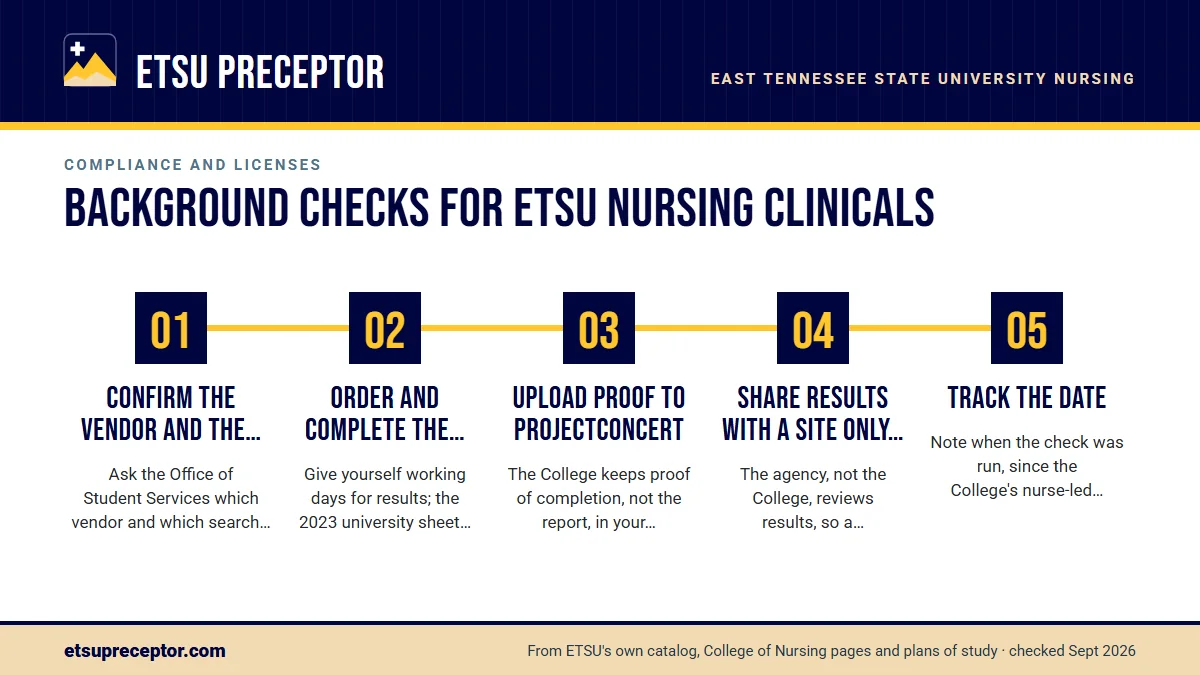
- Confirm the vendor and the packageAsk the Office of Student Services which vendor and which search the College specifies for your program.
- Order and complete the checkGive yourself working days for results; the 2023 university sheet cites three to five business days as usual.
- Upload proof to ProjectConcertThe College keeps proof of completion, not the report, in your clinical requirements file, where the item carries its own due date.
- Share results with a site only if it asksThe agency, not the College, reviews results, so a facility's education office may ask the vendor to send them directly.
- Track the dateNote when the check was run, since the College's nurse-led clinics accept one only from the past 12 months.
Timing a check around your practicums
ETSU publishes no calendar deadline for the check; like other requirements, its due date sits in ProjectConcert. The one fixed window ETSU does publish comes from the Office of Practice: students accepted for a rotation in the College's nurse-led clinics need a criminal background check run within the previous 12 months.
That window is a useful planning rule even outside the clinics. A check run at admission can be well over a year old by the time a DNP residency or the final PMHNP internship begins, and a site may want something newer than what is in your file. Ask each site early whether it accepts your existing report, and leave time for results if you need a new one. Our guide to the Office of Practice clinics covers their request windows.
BSN students: background checks and urine drug screens
Students on the three prelicensure tracks (Traditional, Accelerated and LPN to BSN) meet the College's Clinical Health Requirements, which the undergraduate catalog says include background checks and urine drug screens from specified vendors, at the student's own expense.
The catalog is plain about who decides: "clinical partners have authority to determine if students meet the clinical health requirements." A student the College has cleared can still be refused by a facility. ETSU says a refused student will not be moved to another clinical group or given another experience, and may have to withdraw.
Graduate students will not find a drug screen on ETSU's graduate pages; only the undergraduate catalog mentions one. A site with its own onboarding can still ask for a screen, so put the question to each site before your start date. Our BSN clinicals page explains how the College assigns prelicensure placements.
If something is on your record
Talk to the College before you apply to sites, not after a site says no. Because agencies make the decision, the useful questions are how a given site reviews flagged reports and whether its education office will look at yours before you commit a term to that placement. The graduate clinical coordinator and the Office of Student Services are the right first contacts. Keep copies of any court or board documents that explain an entry, since a reviewer weighing a flagged report may ask for context.
Think past graduation too. The Tennessee Board of Nursing's LARS application for an APRN certificate asks applicants to disclose any criminal history, with records. Clear, documented answers now make that later step simpler.
How we keep this step off your critical path
We treat the background check as part of the placement from the start. Before we propose a preceptor and site, we learn what that site's onboarding asks of students, background and drug screen steps included, and we tell you what to have ready so the check is never the last item holding your start date. When a site runs its own portal or orientation, we map the order of its steps against your term dates, so no step waits on another.
The agency still reviews your results and your clinical faculty still approve the preceptor; our work is the rest of the packet, from the Intent Form details to an early flag on the contract, done right the first time. Read how it works or send your course and term through the contact form.
Questions ETSU students ask
Which background check company does ETSU nursing use?
ETSU's nursing pages do not name one. The graduate catalog says only that the check comes from a specified vendor, at the student's expense. A 2023 university-wide Graduate School sheet names a vendor, but it is not a nursing document, so confirm the company with the College of Nursing's Office of Student Services before you order.
Does ETSU see my background check report?
No. The catalog says the College does not see the report and files only proof of completion, in your Clinical Course Health Requirement file. Each affiliated clinical agency reviews the results and makes its own decision about you, which is why the conversation about any finding happens with the site.
How recent does my background check need to be?
ETSU publishes one window: rotations in the College's nurse-led clinics need a check from the past 12 months. Other sites set their own standard, and ProjectConcert shows the due date for your file. If your check is close to a year old before a new practicum, ask the site whether it needs a fresh one.
Do ETSU graduate nursing students take a drug screen?
ETSU's graduate pages do not list one; only the undergraduate catalog mentions urine drug screens, for BSN students. Individual clinical sites can still require a screen as part of their own onboarding, so ask each site what it runs well before your start date and keep the result with your compliance records.
What if a site turns me down after my background check?
The agency's decision stands for that site, and ETSU's catalog warns that unfavorable results can end clinical progress. Tell your course faculty and the graduate clinical coordinator right away. For BSN students, the undergraduate catalog says a refused student will not be moved to another group and may have to withdraw.
Related pages
Last checked 2026-09-25
We check these pages against ETSU's own catalog, College of Nursing pages, plans of study and ProjectConcert guides. Your plan of study, your syllabus, your course faculty and the graduate clinical coordinator have the final word.
ETSU asks you to lead the preceptor search. We make it the fastest part of your program.
Tell us your ETSU concentration, where you live and which semester your next practicum starts. We find preceptors who fit the course's patient population and prepare everything your Preceptor Intent Form and ProjectConcert entry need.
- Preceptors matched to the course: young and middle adults for
NRSE 5012, older adults forNRSE 5014, women forNRSE 5022, children forNRSE 5024, psychiatric care forNRSE 5405 - Credentials, license numbers, certification dates and the site's patient mix ready for faculty approval
- In your own community, in Northeast Tennessee or wherever ETSU approves your clinicals
Start your placement plan
Program, city and semester is all we need to begin.