ETSU LPN to BSN: clinical intensives in Tennessee, planned around your life
East Tennessee State University (ETSU) lets licensed practical nurses earn a BSN in four accelerated semesters of nursing courses, taught by Zoom and online, with clinical work run as intensives. The College assigns those clinicals in Northeast, East or Middle Tennessee, and ETSU states plainly that placements outside Tennessee are not possible. Planning the travel and the weekends is the real work.
Thinking past the BSN?
Tell us the graduate program you have in mind.
How the LPN to BSN is put together
The program starts after the university core. From there, the nursing core runs four accelerated semesters and 52 credits, mixing 7-week and 15-week courses inside each term. Lectures come by Zoom and online modules; clinical courses are run as clinical intensives rather than weekly shifts spread across the term.
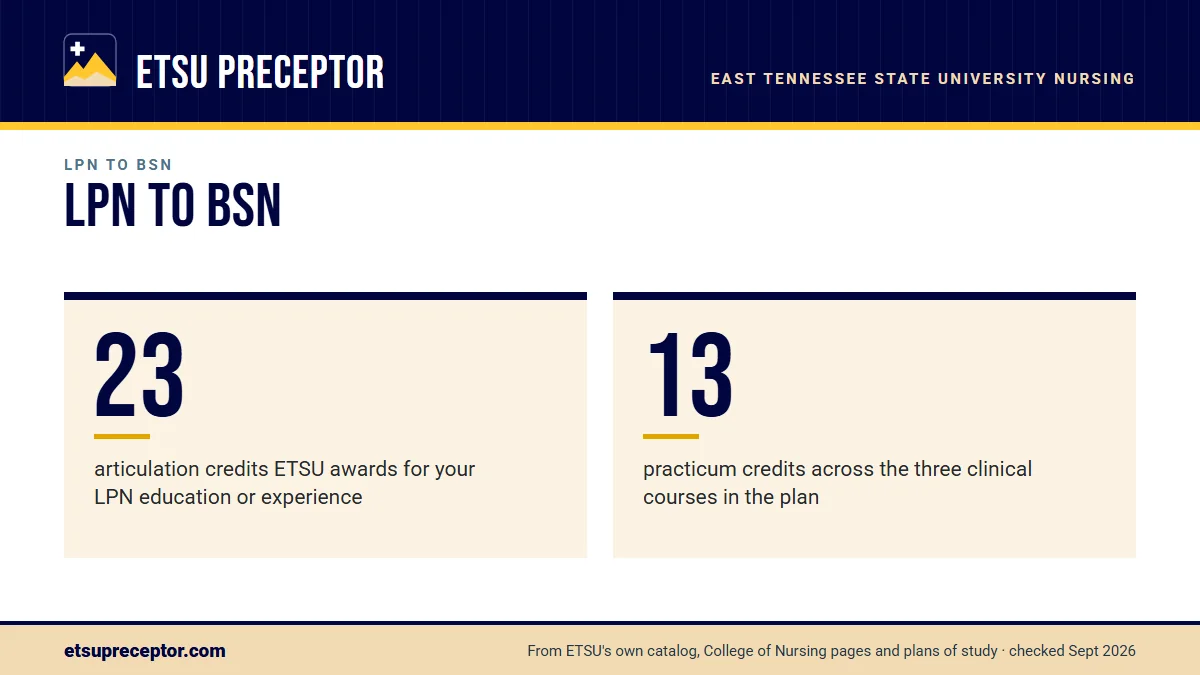
Your LPN background counts. Once you finish the BSN nursing core, ETSU awards 23 articulation credits for your LPN education or LPN work experience, which is how the plan reaches the full degree without repeating what you already know.
The plan image ETSU posts is dated 2024, and the 2026-27 catalog pages for the program were not readable at our last check. The College also approved a substantive BSN curriculum revision for fall 2026, so confirm the sequence below against your own plan of study and catalog year before you plan your work schedule around it.
Semester by semester
ETSU's full-time plan lays the four semesters out like this. The first two are all theory, and the practicum courses arrive together in the second half of the program.
| Semester | Courses (credits) | Clinical work |
|---|---|---|
| I (13 credits) | NRSE 2016 Pathophysiology (4), NRSE 2030 Health Assessment (4), NRSE 3400 Concepts of Professional Nursing Practice (2), NRSE 3170 Transition to Professional Practice for Licensed Practical Nurses (3) | None |
| II (10 credits) | NRSE 3020 Pharmacology for the Transitioning Licensed Practical Nurse (2), NRSE 3350 Nursing Informatics and Healthcare Systems (2), NRSE 3525 Health Promotion and Research (3), NRSE 3510 Population, Community, and Public Health Nursing (3) | One on-site weekend intensive |
| III (15 credits) | NRSE 3900 Care of Childbearing Families, Children, and Persons with Mental Illness (9), NRSE 3901 practicum (6) | First clinical course, as intensives |
| IV (14 credits) | NRSE 4612 Adult Care for the Transitioning Licensed Practical Nurse (4), NRSE 4613 Adult Care Practicum (3), NRSE 4620 Leadership and Professional Practice (3), NRSE 4621 Professional Practice Practicum (4) | Two clinical courses, as intensives |
That puts 13 practicum credits in three courses. ETSU's pages give no clock hours for any of them, so take the hour figures from each syllabus and your clinical faculty.
The weekend intensive and the clinical intensives
Before any patient care, semester II brings you to campus once, for an on-site weekend intensive. ETSU describes it as skills validation, simulation and hands-on practice, meant to get you ready for the in-person clinicals that begin in semester III. Treat it as fixed: arrange coverage at work and any childcare as soon as the date appears.
From semester III, clinical learning comes in concentrated blocks. NRSE 3901 pairs with the nine-credit theory course on childbearing families, children and mental illness, which means one practicum spans several populations. Semester IV then carries two practicums, adult care and professional practice, beside the matching theory courses.
ETSU expects many of those clinical days to fall on weekends, including 12-hour days running Friday through Sunday. For nurses who work weekday shifts that can help, but it also means long stretches without a day off. Build the plan with your manager before the semester, not after the schedule posts.
Three Tennessee regions, and nothing across the state line
The College assigns LPN to BSN clinicals within three regions of the state, and ETSU names example cities for each:
| Region | Example cities ETSU names |
|---|---|
| Northeast Tennessee | Johnson City |
| East Tennessee | Knoxville, Sevierville, Crossville |
| Middle Tennessee | Nashville, Columbia, Manchester |
| Vanderbilt University Medical Center | Open to VUMC employees only |
ETSU's program page is blunt about the boundary: "Clinical placements outside the state of Tennessee are not possible." If you live in Bristol, Virginia, in western North Carolina or in southern Kentucky, your clinicals will still be in Tennessee, however close a hospital across the line may be.
The College tries to place each student near a permanent home address but does not promise it. Our campuses and sites page shows how the LPN to BSN fits beside ETSU's other nursing locations.
Do not plan on a clinical site in Virginia, North Carolina or Kentucky. ETSU rules out LPN to BSN placements outside Tennessee.
Budgeting the travel and the nights away
Because the region you are assigned may not be the one you live in, the LPN to BSN carries real travel risk. ETSU says students may have to drive long distances and stay overnight, and that those costs are the student's own. A Johnson City student placed toward Knoxville, or a Middle Tennessee student sent some distance from home, feels that quickly across a string of 12-hour days.
Put three things in your plan before semester III: a vehicle you can rely on for long drives, a budget line for lodging on consecutive clinical days, and a work arrangement that frees whole weekends. The who pays for what page lists ETSU's other student-paid items, from background checks to insurance.
If your assignment creates a hardship, raise it with the College as soon as you know. ETSU's page does not describe an appeal or swap process, so early, specific conversations are your best tool.
Your LPN license and clinical health requirements
The undergraduate catalog asks LPN to BSN students to show their license for review under the College's Clinical Health Requirements Policy. An encumbered or revoked license means withdrawal from the program, so keep yours clear throughout.
Like every BSN student, you must meet and maintain Clinical Health Requirements, which cover a background check and urine drug screening through vendors the College chooses, paid by you. Host facilities also get to judge for themselves whether you meet those requirements, which means a facility's judgment can count as much as the College's.
ETSU nursing keeps these items in ProjectConcert with a status and due date for each. See clinical health requirements and background checks for the list and how to keep it current.
Getting in
You apply to ETSU as a Health Professions-Nursing Interest (HPNU) major and then to nursing through NursingCAS, where one application covers every track and campus. The admission bar matches the other prelicensure tracks: 3.0 overall, 2.75 across prerequisites, and prerequisites no older than five years.
The TEAS is required, at 65% or higher within two years, but LPN to BSN applicants may reuse a qualifying score from their LPN admission if it is still inside that two-year window. Spring entry closes on July 15, summer and fall entry on February 15, and the tracks taking students change from cycle to cycle, so check the current cycle on ETSU's prospective students page.
ETSU at Sevierville, a regional site for junior- and senior-level programs, lists the LPN to BSN among its offerings, alongside the Accelerated BSN and the RN to BSN. If you live in Sevier County or nearby, ask the College whether that campus plays a part in your cohort's intensives.
After the BSN: where our service fits
Your LPN to BSN clinicals come from the College, so this program asks for no preceptor search. The search arrives later, if you go on to graduate study. ETSU's MSN and DNP expect the student to lead it, with the graduate clinical coordinator's contacts to help, and the MSN asks for an unencumbered RN license and a BSN from a nationally accredited program.
That is where we do our best work. We track down preceptors close to home whose caseload suits each graduate course, prepare what the Preceptor Intent Form and ProjectConcert entry ask for, and keep a replacement search ready if a preceptor steps away. Graduates who start planning in their first RN year arrive at the first practicum with the search already underway. Read finding your own preceptor, or share your timeline using the form below.
Questions ETSU students ask
How many clinical hours is ETSU's LPN to BSN?
ETSU's pages do not publish clock hours for the LPN to BSN. The full-time plan shows three practicum courses, NRSE 3901, NRSE 4613 and NRSE 4621, worth 13 credits between them, all run as clinical intensives. Each syllabus and your clinical faculty give the hours that apply to your cohort and catalog year.
Is ETSU's LPN to BSN fully online?
Mostly, but not entirely. Theory courses run by Zoom and online, while semester II includes one on-site weekend intensive for skills validation and simulation, and the practicum courses in semesters III and IV are in person at assigned Tennessee sites. Expect to travel for all of those.
Will ETSU place me close to home for LPN to BSN clinicals?
ETSU says it tries to place LPN to BSN students near their permanent home but cannot promise it. Assignments come from three Tennessee regions, and students may face long drives and overnight stays at their own expense. Tell the College early about any constraint that affects where you can train.
Can I keep working during ETSU's LPN to BSN?
ETSU's pages do not set a rule on outside work. The plan's theory courses are online and flexible, but clinical intensives are likely to land on weekends, including 12-hour days from Friday to Sunday, with travel on top. Settle a schedule with your employer before semester III begins.
Can I use my old TEAS score for ETSU's LPN to BSN?
Yes, if it still qualifies. LPN to BSN applicants may reuse the TEAS score from their LPN admission when it was taken within the past two years and meets ETSU's 65% minimum. Older scores mean retesting, and ETSU allows only two attempts, spaced 30 or more days apart.
Related pages
Last checked 2026-09-25
We check these pages against ETSU's own catalog, College of Nursing pages, plans of study and ProjectConcert guides. Your plan of study, your syllabus, your course faculty and the graduate clinical coordinator have the final word.
ETSU asks you to lead the preceptor search. We make it the fastest part of your program.
Tell us your ETSU concentration, where you live and which semester your next practicum starts. We find preceptors who fit the course's patient population and prepare everything your Preceptor Intent Form and ProjectConcert entry need.
- Preceptors matched to the course: young and middle adults for
NRSE 5012, older adults forNRSE 5014, women forNRSE 5022, children forNRSE 5024, psychiatric care forNRSE 5405 - Credentials, license numbers, certification dates and the site's patient mix ready for faculty approval
- In your own community, in Northeast Tennessee or wherever ETSU approves your clinicals
Start your placement plan
Program, city and semester is all we need to begin.