Grades and progression in ETSU graduate nursing
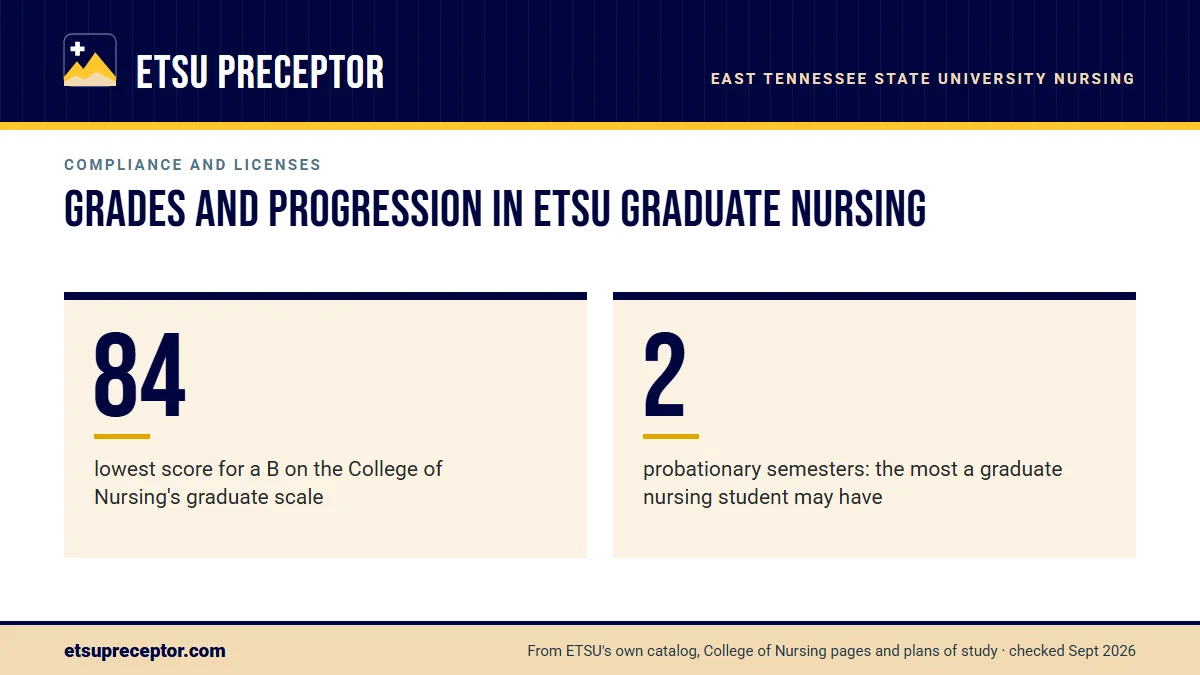
East Tennessee State University (ETSU) College of Nursing sets a floor of B for every graduate nursing course, and a student who falls below it gets one chance to repeat the course. On the College's scale a B starts at 84, so a practicum that is slipping needs a plan quickly, before withdrawal dates, probation or a second attempt come into play.
Get your placement plan
Tell us your ETSU program and where you live. A placement advisor replies with the preceptor and site options that fit your ETSU course.
The grade you need
Across the university, the Graduate School treats a B as satisfactory and a C as the minimum passing grade. The College of Nursing sets a higher bar for its own students: the 2026-27 catalog, for both the MSN and the DNP, expects at least a B in each graduate nursing course.
| Grade | Course score |
|---|---|
| A | 93 to 100 |
| B | 84 to 92 |
| C | 75 to 83 |
| F | Below 75 |
The catalog description of an NP practicum such as NRSE 5012 states no separate pass or fail mode, and ETSU's pages do not say how a practicum grade is weighted. Your course syllabus answers that, so read it in the first week, before your first clinical shift.
What a practicum grade rests on
Much of the evidence your course faculty see in a clinical course lives in ProjectConcert. Your hour logs and patient journal sit under the Experience menu, and the mid-term and final evaluations your preceptor fills in are ones you trigger yourself with "Schedule User Evaluation." An evaluation that never went out, or hours logged late, leaves a gap in the record faculty grade from.
In the DNP residencies, a 2020 ETSU project guide describes three layers: the preceptor's evaluation and a separate faculty evaluation both go into ProjectConcert, and the DNP project chair signs off on hours as each semester closes. Our pages on preceptor evaluations and hour logs cover the steps in detail.
Keep your own copies as the term goes: approved logs, both evaluations and any written feedback. If a grade is ever disputed, that record is what you will point to.
One repeat, and how it counts
Falling short of a B earns you one more attempt at the course. Under the Graduate School's retention standards, every attempt counts in your graduate GPA; the repeat does not replace the first grade, so a C followed by an A still averages in.
For a practicum, a repeat is also a scheduling problem. ETSU's plans of study run practicums in a set order, and some later courses list earlier ones as prerequisites; the 2026-27 catalog, for example, names NRSE 5010 among the prerequisites for NRSE 5011, which is taken alongside NRSE 5012. A repeated practicum may also mean a new placement, and with it a new Intent Form and ProjectConcert entry. Settle the revised plan with your advisor before you register.
BSN students face a similar squeeze. The undergraduate catalog warns that a given clinical course may not run every term at every location, and a student repeating a clinical course may have to travel or sit out until a space opens, at their own cost.
Withdrawing: W, WF and the one-semester limit
A course withdrawal after the census date earns a W. Once the last day to withdraw without the dean's permission has passed, you receive a W if you were passing at that point and a WF if you were not. For 2026-27 that date is October 12 in fall and March 9 in spring; our academic calendar page lists the rest.
Nursing adds a limit of its own: a student may carry WF grades in one semester of an academic year at most. Late withdrawals go to the Graduate Dean, and a retroactive withdrawal for serious circumstances may be requested up to one year after the term.
Withdrawing from a failing practicum after the dean-permission date can leave a WF, and nursing allows WF grades in only one semester per academic year.
Probation and dismissal
A cumulative or program GPA below 3.0 places you on probation. After one probationary term, the Graduate Dean decides between dismissal and continued probation. The limit is two probationary semesters, and nursing counts them whether they come back to back or years apart.
A student whose GPA cannot mathematically recover can be dismissed at once, though the decision waits while an Incomplete is pending. Programs may also recommend dismissal for failing a program requirement or for professional or ethical breaches, after written notice and at least five business days to respond. A reinstatement request is allowed once, a second dismissal is final, and a one-time Academic Fresh Start exists.
Incompletes carry their own rules, including a one-year deadline and a nursing rule that more than one blocks progression; see incompletes, leave and time limits.
Appealing a grade
ETSU's grade appeal policy has two levels. Level One is a meeting with the instructor within 10 business days of the start of the next fall or spring term. Level Two is a written appeal to the department chair within 10 business days after that meeting. The student carries the burden of proof, and the Graduate Dean's decision is final.
Because the first meeting waits for the next fall or spring term, a summer practicum grade can sit for weeks before Level One opens. Use that time to assemble the record: approved hour logs, the mid-term and final evaluations, and any messages with course faculty about expectations. An appeal built on dated documents is far stronger than one built on memory.
When a practicum is going badly
Act while the term is still running. Tell your course faculty as soon as a preceptor relationship or a site stops working, because a replacement preceptor needs the same approvals as the first one, and every week of delay shrinks the hours you can still log. Our guides cover a preceptor who drops out and falling behind on hours.
This is where we are strongest. When a placement collapses mid-term, we search for a replacement preceptor whose patients match the course, collect what the Intent Form and the College's credential check need, and raise the contract question on day one, so your faculty can review a complete packet fast. Reach us through the contact form.
Questions ETSU students ask
What is the minimum passing grade in ETSU graduate nursing courses?
A B. The Graduate School treats C as its minimum pass, but the College of Nursing's 2026-27 catalog sets the bar at B for each of its graduate courses. On the College's scale a B runs from 84 to 92, so a course score of 83 is a C.
Can I retake a practicum I failed at ETSU?
Yes, once: anything under a B lets you take the course a second time. Both attempts count in your graduate GPA, since a repeat does not replace the first grade. A practicum repeat may also need a new placement, so talk with your advisor and course faculty about the revised plan of study early.
What is the difference between a W and a WF?
A withdrawal after the census date earns a W. After the last day to withdraw without the dean's permission (October 12 in fall 2026, March 9 in spring 2027), the grade is W or WF depending on whether you were passing. Nursing allows WF grades in only one semester per academic year.
How many probation semesters are allowed in ETSU nursing?
Two. A GPA below 3.0 means probation, and after one probationary term the Graduate Dean decides between dismissal and continued probation. The College of Nursing counts probationary semesters whether they are consecutive or spread across the program, so an early probation still counts later.
Does a failed practicum delay graduation?
It can. ETSU's plans run practicums in sequence, and a repeat takes a later term and often a new preceptor. The graduation application is due September 1 for a spring finish and March 1 for summer or fall, so tell your advisor if the plan changes. Our delayed graduation guide covers the options.
Related pages
Last checked 2026-09-25
We check these pages against ETSU's own catalog, College of Nursing pages, plans of study and ProjectConcert guides. Your plan of study, your syllabus, your course faculty and the graduate clinical coordinator have the final word.
ETSU asks you to lead the preceptor search. We make it the fastest part of your program.
Tell us your ETSU concentration, where you live and which semester your next practicum starts. We find preceptors who fit the course's patient population and prepare everything your Preceptor Intent Form and ProjectConcert entry need.
- Preceptors matched to the course: young and middle adults for
NRSE 5012, older adults forNRSE 5014, women forNRSE 5022, children forNRSE 5024, psychiatric care forNRSE 5405 - Credentials, license numbers, certification dates and the site's patient mix ready for faculty approval
- In your own community, in Northeast Tennessee or wherever ETSU approves your clinicals
Start your placement plan
Program, city and semester is all we need to begin.