Patient population mix: matching an ETSU practicum to the right site
East Tennessee State University (ETSU) asks nurse practitioner students to describe who a proposed site actually sees: its mix of children, adolescents, women, adults and older adults, both as percentages and as a typical day's count. Clinical faculty read those figures against the population focus of the practicum you are requesting. Getting the mix right before you submit spares you a rejection and a second round in ProjectConcert.
Get your placement plan
Tell us your ETSU program and where you live. A placement advisor replies with the preceptor and site options that fit your ETSU course.
What the Intent Form asks about a site's patients
The Preceptor Intent Form closes with a short block about the agency. After the agency's name and address comes a grid with five rows: children, adolescents, women, adults and older adults. For each row you give two figures, the percentage of the site's patients in that group and roughly how many of them the site sees in a day.
ETSU describes the form as a tool that helps faculty judge whether a preceptor can meet a course's population focus and learning outcomes. The patient grid is the part that answers the population question head on. The credentials section tells faculty who will teach you; the grid tells them who you will actually be examining, diagnosing and treating.
The copy of the form on etsu.edu is old. Its year choices stop at 2021 and it still carries retired course numbers, so request the latest copy from the graduate clinical coordinator before you fill anything in. The field-by-field guide to the Preceptor Intent Form covers every other box.
The population behind each ETSU practicum
Each nurse practitioner practicum in ETSU's plans of study is built around one population, and the form's own course labels spell it out. Match the site to that label rather than to the preceptor's specialty title alone.
| Course | Label or focus | Patients to show in the grid | Hours |
|---|---|---|---|
NRSE 5010 | Advanced Health Assessment Lifespan Practicum | A lifespan mix; the course pairs lab practice with clinical placement | 60 |
NRSE 5012 | Young & Middle Adults Practicum | Young and middle-aged adults | 120 |
NRSE 5022 | Women's Health Practicum | Women | 120 |
NRSE 5014 | Older Adults Practicum | Older adults | 120 |
NRSE 5024 | Children & Adolescents Practicum | Children and adolescents | 120 |
NRSE 5032 | Older Adult Chronic Health Practicum (AGPCNP, on the older form) | Older adults with chronic conditions | Not published |
NRSE 5405, 5409, 5411, 6950 | PMHNP practicums and internship | Psychiatric and mental health patients across the lifespan | 120 each |
These hours come from the MSN FNP and PMHNP plans of study. The 2026-27 catalog is the official record, so check each figure against the plan of study that goes with your catalog year. The FNP clinical hours page shows which term each practicum lands in for full-time and part-time students.
How faculty read the percentages and the daily counts
The two figures do different jobs. A percentage shows how central a group is to the practice. A daily count shows how many of those patients could realistically cross your path in a shift. A busy clinic where children are a small slice of the day can still give you a steady run of pediatric visits, while a quiet office with a high percentage may give you only a handful.
ETSU publishes no minimum percentage and no minimum daily count for any course. The judgment belongs to the clinical faculty member who approves the preceptor, alongside the Office of Student Services' check of the preceptor's credentials. If your site looks borderline, ask course faculty what they need to see before you submit, not after a rejection lands in the Comment column.
The grid and the credentials should tell one story. A site full of teenagers paired with a preceptor certified only in adult care invites questions, and Tennessee adds its own layer, requiring that a preceptor's license match or exceed the role you are preparing for. Our preceptor requirements page covers that rule.
Where the right populations tend to be
Catalog descriptions for NRSE 5022 and NRSE 5024 place the clinical work in rural, urban and underserved settings, alongside nursing faculty and clinical preceptors. ETSU Online describes its FNP as primary care from infancy through adulthood with a focus on underserved rural and urban groups. Community clinics, health departments and family practices are as relevant to that brief as specialty offices.
The College's own nurse-led clinics are one example. Its clinics page lists two school-based centers at the Hancock County schools in Sneedville, one elementary and one middle/high, next to two Johnson City clinics that ETSU describes as Federally Qualified Health Centers. Requests there open on fixed dates, explained on the Office of Practice clinics page.
The ETSU-TTU joint DNP brings further population foci: children of all ages for Pediatric NP-Primary Care, women in varied settings for Women's Health Care NP, and adolescents through older adults in hospitals and clinics for Adult-Gerontology Acute Care NP. The same test applies to each: show that the site sees the people the concentration names.
Getting honest numbers from a site
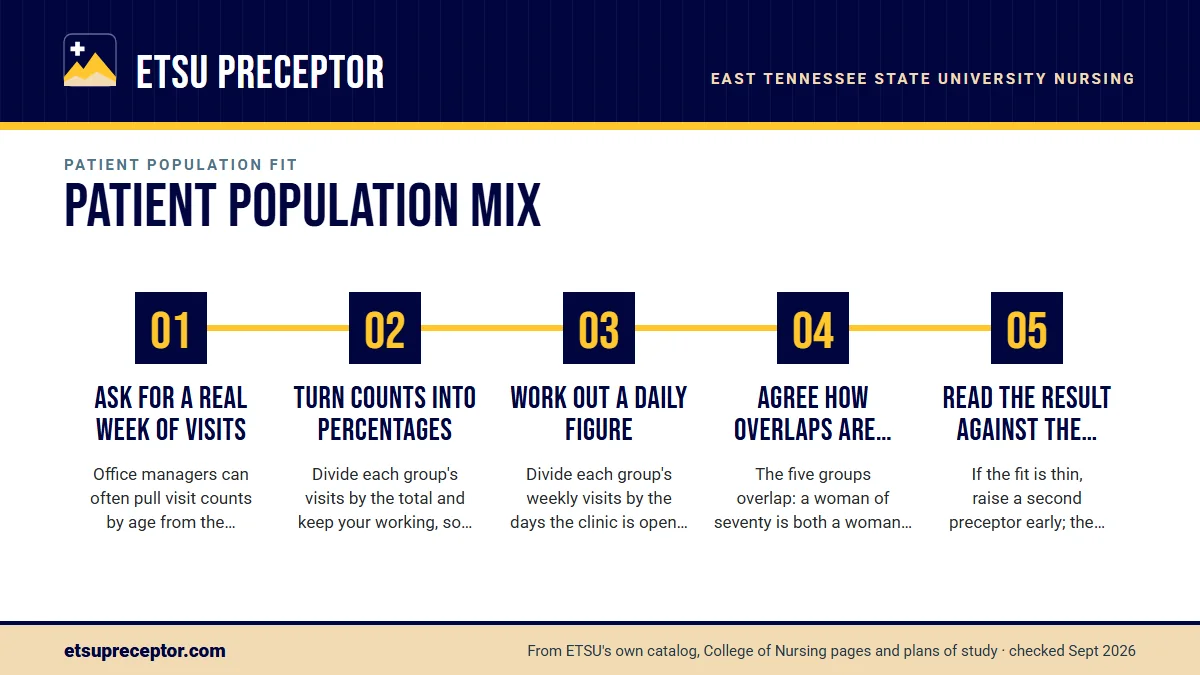
- Ask for a real week of visitsOffice managers can often pull visit counts by age from the scheduling system. A recent week or month of actual counts beats a preceptor's impression.
- Turn counts into percentagesDivide each group's visits by the total and keep your working, so you can explain the figure if faculty ask.
- Work out a daily figureDivide each group's weekly visits by the days the clinic is open and round sensibly.
- Agree how overlaps are countedThe five groups overlap: a woman of seventy is both a woman and an older adult. Ask the coordinator how your course wants overlaps handled before you total the grid.
- Read the result against the course labelIf the fit is thin, raise a second preceptor early; the form has a line for one.
Fill the grid for the course you are requesting, not for the practice in general: the same family practice can be a strong fit for NRSE 5012 and a weak one for NRSE 5024.
When one site cannot cover the whole population
The form asks how many hours you plan with the preceptor and whether another preceptor will share the rotation. That second question is how many population gaps get solved. A women's health practicum split between a family practice and a gynecology office, for instance, can show faculty a fuller picture than one site stretched thin.
Every preceptor in a split goes through the same checks: faculty approval, credential verification, a contract with the agency and your own clinical requirements. A second agency means a second contract, and ETSU publishes no lead time for one, so the clinical contracts page is worth reading before you commit to a split.
The form also asks about any earlier training with the same preceptor or agency. ETSU's pages do not forbid returning to a site for a later course, but the grid has to describe the new course's population, not be copied from the last submission.
How we build a population-matched placement
We start from your course number, not from whoever happens to be available. For each practicum we look for a preceptor in your own community whose daily panel is built around the population the course names, and we collect the site's five-group figures before anything is submitted.
You receive everything the form and the ProjectConcert upload will ask about: the preceptor's degrees and credentials, each license and certification with its expiration, the planned hours, and a patient grid the site has signed off. Faculty still judge the fit and Student Services still checks credentials, but they judge a submission built around the right population from the start. Our how it works page shows the sequence, and the form at the bottom takes your course and term.
Questions ETSU students ask
Is there a minimum share of children for ETSU's pediatric practicum?
ETSU's published pages set no minimum percentage or daily count for NRSE 5024 or any other course. Clinical faculty decide whether the children and adolescents a site sees are enough for the course outcomes. If your site is mostly adults with some pediatric visits, ask course faculty before you submit, and consider adding a second, pediatric-focused preceptor.
Can one family practice cover several ETSU FNP practicums?
ETSU's pages do not limit a site to one course. Each preceptor request names a single course, so the grid should reflect that course's population each time. A busy family practice might suit adults one term and older adults another, but faculty decide separately. The form also asks whether you trained there before, so answer it plainly.
Do PMHNP students fill in the patient mix?
Yes. The form lists PMHNP among its concentrations and names NRSE 5405, NRSE 5409, NRSE 5411 and NRSE 6950 among its courses, so the agency block applies. ETSU Online describes PMHNP care as spanning the lifespan, so show the full age range the psychiatric practice serves, including children and adolescents if it sees them.
What if the site can only estimate its patient numbers?
Faculty rely on what the form says, so an accurate estimate matters more than a precise-looking one. Ask the office for real visit counts from a recent week or month where it can, and note which figures are estimates. A modest figure that holds up in week one serves you better than an optimistic one that does not.
Does the patient grid matter for leadership or education practicums?
The older form lists the education practicums and the retired NRSE 5500 leadership course, but its concentration choices are AGPCNP, FNP and PMHNP and the grid fits NP courses best. Leadership practicums pair you with a nurse administrator and education practicums with experienced academic nurse educators. Ask the coordinator what the current form expects for those courses.
Related pages
Last checked 2026-09-25
We check these pages against ETSU's own catalog, College of Nursing pages, plans of study and ProjectConcert guides. Your plan of study, your syllabus, your course faculty and the graduate clinical coordinator have the final word.
ETSU asks you to lead the preceptor search. We make it the fastest part of your program.
Tell us your ETSU concentration, where you live and which semester your next practicum starts. We find preceptors who fit the course's patient population and prepare everything your Preceptor Intent Form and ProjectConcert entry need.
- Preceptors matched to the course: young and middle adults for
NRSE 5012, older adults forNRSE 5014, women forNRSE 5022, children forNRSE 5024, psychiatric care forNRSE 5405 - Credentials, license numbers, certification dates and the site's patient mix ready for faculty approval
- In your own community, in Northeast Tennessee or wherever ETSU approves your clinicals
Start your placement plan
Program, city and semester is all we need to begin.