ETSU BSN clinicals: how the College assigns them and what you control
East Tennessee State University (ETSU) assigns clinical placements for its prelicensure BSN students, whether they study in the Traditional BSN in Johnson City or the Accelerated BSN in Johnson City, Kingsport or Sevierville. You do not hunt for a site. What you control is your campus preference, your clinical health file and your plans for graduate study, where the search does become yours.
Planning past the BSN?
Tell us the graduate program you have in mind and when.
Five routes to an ETSU BSN, and who arranges clinicals
The College of Nursing offers five ways into the BSN. Three lead to a first RN license and two serve nurses who are already licensed, and the answer to who arranges clinicals changes with the route.
| Route | Where it runs | Who arranges clinicals |
|---|---|---|
| Traditional BSN | In person, Johnson City | The College assigns |
| Accelerated BSN (Continuous Enrolled BSN) | Johnson City, Kingsport, Sevierville | The College assigns |
| LPN to BSN | Zoom and online, with clinical intensives | The College assigns, inside Tennessee only |
| RN to BSN | Online | Your employer (full-time direct care) or the College |
| Dual Degree (ADN plus RN to BSN) | Online, with partner colleges | Same as the RN to BSN |
ETSU also lists a Direct Entry Freshman Pathway into the BSN starting fall 2026, and an EMS to BSN Pathway for EMTs and paramedics in seven Northeast Tennessee counties. The licensed routes have their own pages: RN to BSN and LPN to BSN.
One NursingCAS application covers every track
Applicants first join ETSU as Health Professions-Nursing Interest (HPNU) majors, then apply to nursing through NursingCAS. A single NursingCAS application covers every track and campus, and you mark your preferences inside it, which is the first real choice you make about where your clinicals will happen.
The College looks for a cumulative college GPA of 3.0, a prerequisite GPA of 2.75 with prerequisites finished within five years, and a TEAS score of at least 65% from the past two years, with no more than two attempts at least 30 days apart. Applications close on July 15 for spring entry and on February 15 for summer or fall entry, and the tracks and campuses admitting each term vary.
In the Accelerated BSN, each campus admits in one term only, with a summer intake in Johnson City, a spring intake in Kingsport and a fall intake in Sevierville. Your start term and your campus therefore come as a pair.
The Accelerated BSN clinical sequence
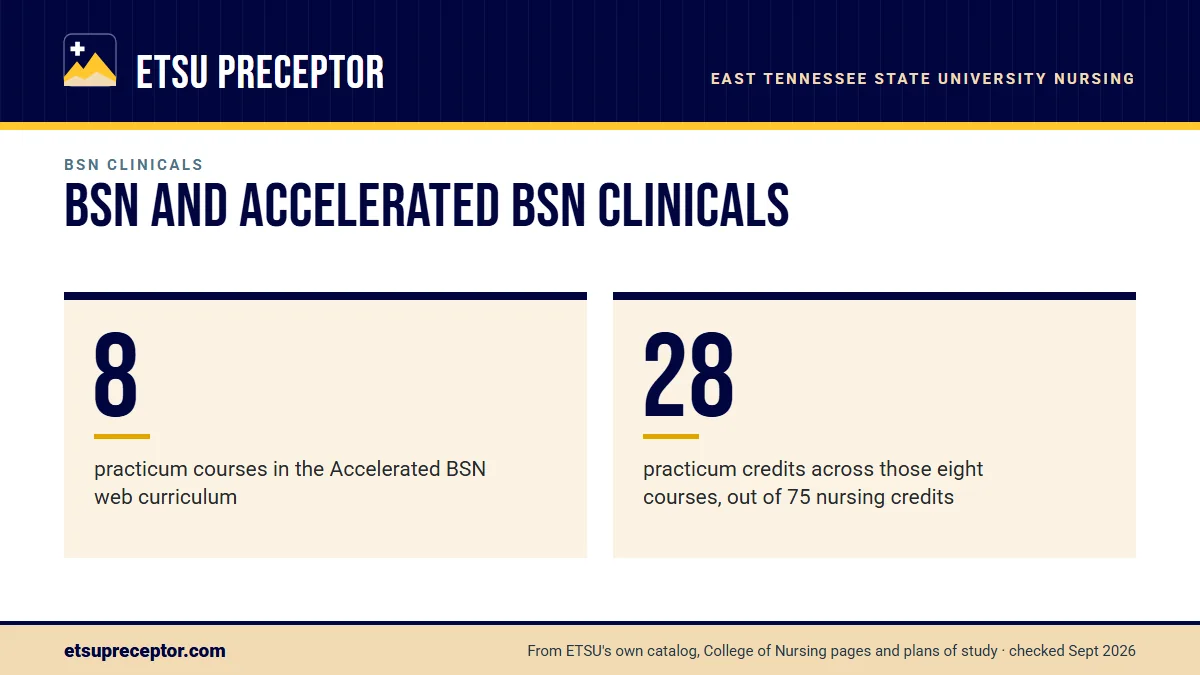
The Accelerated BSN web curriculum runs five semesters and 75 nursing credits, and clinical work starts in the very first semester. These are its practicum courses:
| Semester | Practicum course | Credits |
|---|---|---|
| 1 | NRSE 2351 Patient Centered Care 1 Practicum | 3 |
| 2 | NRSE 3501 Patient Centered Care 2 Practicum | 4 |
| 3 | NRSE 3091 Care of Persons with Mental Illness Practicum | 2 |
| 3 | NRSE 3541 Adult Care 1 Practicum | 4 |
| 4 | NRSE 4551 Adult Care 2 Practicum | 3 |
| 4 | NRSE 4561 Clinical Care for Women, Childbearing Families, and Children | 4 |
| 5 | NRSE 4611 Adult Care 3 Practicum | 4 |
| 5 | NRSE 4621 Professional Practice Practicum | 4 |
The page gives no clock hours for any of these courses and does not explain the asterisks printed beside NRSE 2351 and NRSE 3501. Your syllabus and clinical faculty have the hour figures for your cohort.
The Traditional BSN and the fall 2026 curriculum change
The Traditional BSN runs in person on the Johnson City campus. ETSU points to simulation facilities in Bishop Hall, its nurse-managed clinics and its partnership with Ballad Health as the backbone of hands-on learning, and every prelicensure track prepares graduates to sit the NCLEX-RN.
The track's old web page now redirects to a general page with no semester plan, so the only full curriculum is the catalog entry, "Nursing Major, B.S.N.", so ask the College for the curriculum that matches your admission term. Treat any course list you find on the web with care for a second reason too.
ETSU's curriculum office lists a substantive BSN curriculum revision and a BSN admission-policy revision, both effective fall 2026, and the 2026-27 undergraduate catalog adds NRSE 2070 Fundamental Concepts of Nursing Practice with its corequisite NRSE 2071. Neither course appears in the web curricula, so students entering from fall 2026 should take the practicum sequence from their advisor and their catalog year, not from older plans.
The Accelerated BSN course list above comes from ETSU's web curriculum, which predates the fall 2026 revision. Confirm your own sequence with your advisor.
How assignment works, and its limits
Because the College assigns BSN clinicals, the practical questions are about availability rather than searching. The undergraduate catalog cautions that a given course will not run in every term at every campus or facility. Repeating a clinical can therefore mean driving farther or waiting out a term until a seat opens, and the student bears that cost.
Which facilities the Kingsport and Sevierville cohorts train in is not listed anywhere on ETSU's site, and the Johnson City material names Ballad Health as a partner without listing units. If where you train matters to you, for a commute, childcare or a hoped-for first job, raise it with your campus advisor rather than assuming the nearest hospital.
Our campuses and sites page compares the three campuses and their skills labs.
Clinical health requirements decide who walks in the door
Every BSN student must meet and keep up the College's Clinical Health Requirements and Core Performance Standards. Among them are background checks and urine drug screens, bought by the student from vendors the College names, and ETSU nursing tracks each item in ProjectConcert with its own status and due date.
The catalog adds a rule worth reading twice: the facilities themselves hold the final say on whether a student meets the health requirements. A facility can turn away a student the College has already cleared. When that happens, the student is not moved to another group or given a different experience, and may have to withdraw.
Keep your file complete well ahead of each semester and answer any question from a facility quickly. The clinical health requirements and background checks pages list what goes in.
Licensure after graduation
Graduates of the prelicensure tracks are eligible for the NCLEX-RN. For graduates staying in Tennessee the picture is simple: the College says its programs are approved by the Tennessee Board of Nursing, and the Commission on Collegiate Nursing Education (CCNE) accredits its baccalaureate program. If you plan to work outside Tennessee, check ETSU's state disclosures, because the university publishes two that disagree about the BSN.
On the College of Nursing's own pages, the BSN curriculum meets educational requirements in 25 states, with the other 25 still undetermined. The university's consumer information pages say the BSN meets requirements everywhere except California, Hawaii, Louisiana and some U.S. territories. Hawaii is the sharpest conflict: "meets" on one list, "does not meet" on the other.
Our licensure disclosures page sets the lists side by side. Your target state's board of nursing has the final word.
Where we help BSN students
Your BSN clinicals come from the College, so there is no preceptor search in this part of your education. Our work begins at the point where ETSU hands the search to you: graduate study.
In ETSU's MSN, DNP and post-graduate certificate FAQs, a coordinator offers contacts and names of former preceptors, but the search itself is the student's to drive. A full-time MSN Family Nurse Practitioner student meets a 120-hour practicum in the first summer, and the plan of study lists 540 hours in all, each practicum tied to one patient population.
Graduates heading that way get the most from us by starting early. We map preceptors for your first practicums while you build RN experience, so the search is already moving when the program asks for it. Read the MSN FNP page or send us your plans with the form below.
Questions ETSU students ask
Can I choose where my ETSU BSN clinicals are?
Not the individual site. The College assigns BSN clinicals, and the choice you do make is your track and campus preference inside the NursingCAS application. In the Accelerated BSN that also fixes your start term. Tell your advisor early about any constraint, such as a long commute, since the facilities each cohort uses are not published.
How many clinical hours are in ETSU's Accelerated BSN?
No clock hours for BSN practicum courses appear on ETSU's web pages. The Accelerated BSN curriculum shows eight practicum courses worth 28 credits in total, from NRSE 2351 in the first semester to NRSE 4621 in the last. Your syllabus and clinical faculty have the hours for your cohort and catalog year.
Does ETSU's BSN require a drug test?
Yes. The undergraduate catalog includes urine drug screens, along with background checks, among the Clinical Health Requirements every BSN student must meet, using vendors the College specifies and at the student's own expense. Clinical partners can decide for themselves whether a student meets those requirements, so a clear result matters at every facility.
What if I fail a BSN clinical course at ETSU?
Retaking a clinical can be slow. Because each course does not run in every term at every campus, the catalog says a repeating student may face a longer drive or a wait for an open seat, and pays any added cost. Talk to your advisor right away about the next available section.
Is a placement service useful for BSN students?
Its value comes later, since the College assigns the BSN clinicals themselves. A service becomes useful when you move into graduate study at ETSU, where the MSN, DNP and certificate FAQs place the preceptor search with the student. Planning that search while you finish the BSN puts you months ahead.
Related pages
Last checked 2026-09-25
We check these pages against ETSU's own catalog, College of Nursing pages, plans of study and ProjectConcert guides. Your plan of study, your syllabus, your course faculty and the graduate clinical coordinator have the final word.
ETSU asks you to lead the preceptor search. We make it the fastest part of your program.
Tell us your ETSU concentration, where you live and which semester your next practicum starts. We find preceptors who fit the course's patient population and prepare everything your Preceptor Intent Form and ProjectConcert entry need.
- Preceptors matched to the course: young and middle adults for
NRSE 5012, older adults forNRSE 5014, women forNRSE 5022, children forNRSE 5024, psychiatric care forNRSE 5405 - Credentials, license numbers, certification dates and the site's patient mix ready for faculty approval
- In your own community, in Northeast Tennessee or wherever ETSU approves your clinicals
Start your placement plan
Program, city and semester is all we need to begin.