Clinicals where you work: what ETSU asks and how to make it count
East Tennessee State University (ETSU) lets RN to BSN students who work full time in direct patient care take their final practicum at their current employer. For graduate students, the Preceptor Intent Form just includes a question on whether the agency employs you, and nothing ETSU publishes either permits or bars the arrangement. Your own workplace can be a strong option; the details that decide it are the course population, a qualified preceptor, a contract and a clear line between your job and your student hours.
Get your placement plan
Tell us your ETSU program and where you live. A placement advisor replies with the preceptor and site options that fit your ETSU course.
What ETSU says about employer placements
The clearest rule belongs to the online RN to BSN. If you hold a full-time job in direct patient care, ETSU Online says the last-semester course, NRSE 4026 R.N. Practicum, can happen where you already work. Nurses in other kinds of roles arrange their clinical through the College of Nursing. The R.N. Practicum page covers that course in detail.
The RN to BSN page adds a caution for anyone near a state line: state regulations may require anyone living outside Tennessee to log their clinical hours with an institution or agency located in Tennessee. If your hospital is across the border in Virginia or North Carolina, raise this with the College before you plan around it.
For the MSN, the DNP and the certificates, ETSU's published pages neither allow nor forbid a practicum at your employer. The Intent Form has two related lines: one asks if the agency employs you, the other if you have already trained under this preceptor or at this agency. Answer both plainly. Faculty read the whole form when they judge fit, and a clear answer now heads off awkward questions once the rotation is underway.
What an employer site offers, and where it trips students up
A workplace placement starts with real advantages. You know the building, the charting system and many of the clinicians, and a manager who knows your work can open doors a cold email cannot. Travel is already part of your week.
The friction comes from overlap. A practicum is a student role: you are there to learn a new scope under a preceptor, not to cover your usual duties. Colleagues who know you as a staff nurse can slide back into treating you as one, and the hours you log in ProjectConcert should reflect time spent learning at the level your course targets.
Four things that make an employer placement work
- Separate time: practicum hours on days you are not rostered, or in a different department from your usual unit.
- A preceptor at the right level: for NP courses, an NP or physician licensed at your target role or higher.
- The right patients: the unit or clinic must see the population your course names; an adult medical floor will not carry a pediatric practicum.
- A signed agreement: being on the payroll does not replace the contract between ETSU and the agency.
The contract and the health system's own rules still apply
Employment does not turn a workplace into an ETSU clinical site. The Intent Form lists a contract among the things that must be in place before clinicals start, together with clinical faculty approval, the Office of Student Services' credential check and your own clinical requirements. ETSU publishes no lead time for new agreements, so raise the contract question with the graduate clinical coordinator as soon as your employer says yes.
Large systems set student rules that a staff badge does not change. Ballad Health's academics page says APP students must come from a program with a current Ballad affiliation agreement, go through their program's clinical coordinator and finish Ballad's student orientation before an approved placement begins. Erlanger says it is not entering new APP affiliation agreements, though employees enrolled in unaffiliated programs may ask for an exception, subject to preceptor availability and manager approval.
Neither page says anything about ETSU in particular. Read your employer's own student page and ask the coordinator where ETSU stands; our Tennessee NP preceptors page compares what the region's systems publish.
Being on the payroll does not make your workplace an approved ETSU site: the contract, faculty approval and credential check apply exactly as they would anywhere else.
How employer sites line up with ETSU's graduate courses
Nursing Administration is the most natural match. The three Executive Leadership practicums (NRSE 5502 through NRSE 5504) carry 180 hours apiece in the plan of study, the catalog puts a nurse administrator beside you as preceptor, and ETSU Online pitches the concentration at leaders in hospitals and large providers. Your own organization's nursing leadership is an obvious first call. Whether a leader in your own reporting line is acceptable is not answered on ETSU's pages, so ask course faculty.
The four DNP residencies (NRSE 6801 through NRSE 6804, listed at 125 hours apiece) can revolve around a project inside a practice. ETSU's 2020 DNP project guide makes the practice's agreement a condition of faculty approval for any site-based project, and it allows a member of the project team to come from that site. An employer that wants the project done is a strong home for it; see DNP residencies.
For FNP and PMHNP practicums, check the preceptor's credentials and the patient population before anything else. Your own unit may have neither, while an outpatient clinic elsewhere in the same organization might. The education practicums call for experienced academic nurse educators, so ask faculty whether a staff development role at your employer qualifies.
Proposing your own workplace, step by step
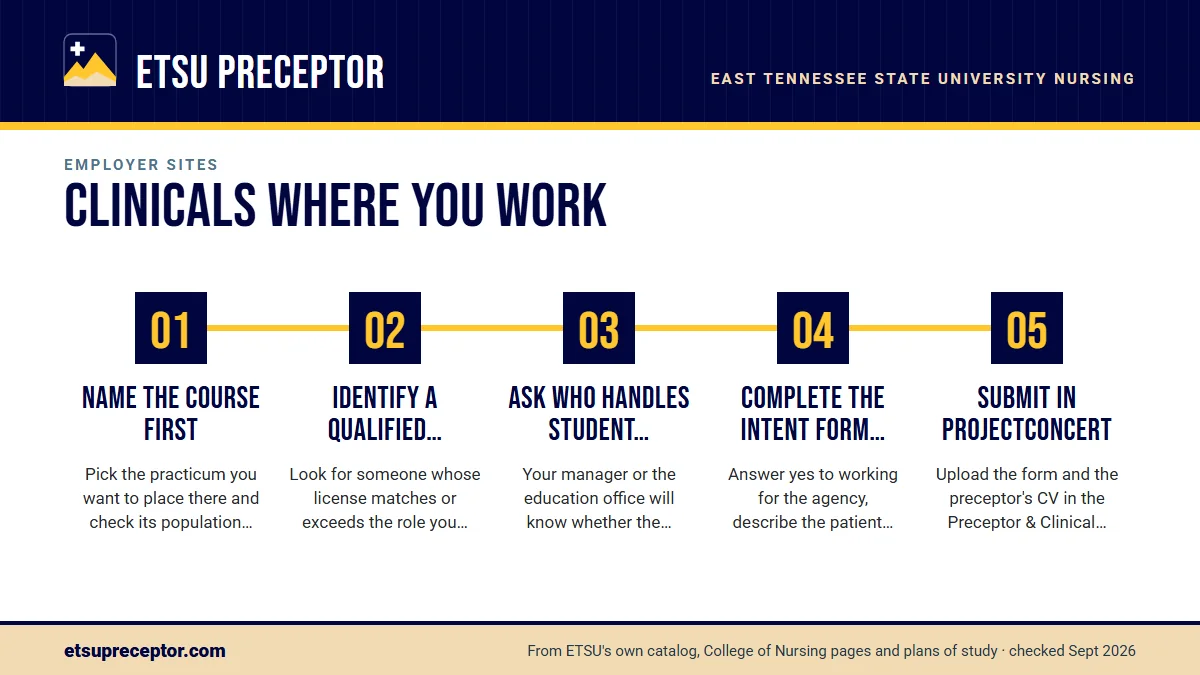
- Name the course firstPick the practicum you want to place there and check its population and hours in your plan of study.
- Identify a qualified preceptorLook for someone whose license matches or exceeds the role you are preparing for, ideally outside your direct chain of supervision.
- Ask who handles student agreementsYour manager or the education office will know whether the organization takes graduate students and who signs agreements. Pass that contact to the graduate clinical coordinator.
- Complete the Intent Form honestlyAnswer yes to working for the agency, describe the patient mix of the unit you will train in, and list the planned hours.
- Submit in ProjectConcertUpload the form and the preceptor's CV in the Preceptor & Clinical Agency Onboarding entry and pick the coordinator from the dropdown. The submission guide shows each screen.
- Keep the two roles apartAgree a schedule with your preceptor that stays separate from paid shifts, and log only practicum time.
How we help, whether your employer is the plan or the backup
Some ETSU students want their employer and need the paperwork assembled cleanly; others find their employer cannot take them and need a new site quickly. We handle both. For an employer placement we pull together what faculty need about the preceptor (degrees, credentials, license and board certification numbers and when each expires), plus the unit's patient mix and your planned hours, and we raise the contract on day one, leaving the College time to get it signed.
When the employer route closes, we look near your home for a clinician whose patients match the course, and the Intent Form details come ready to file. Faculty and Student Services keep the decision; what we add is a submission that answers every question they will ask. Tell us your course and term.
Questions ETSU students ask
Can ETSU graduate students do clinicals at their own job?
Nothing ETSU publishes rules it out. The Intent Form even carries a question about being employed by the agency, a sign that faculty see it regularly enough to ask. Approval still depends on a qualified preceptor, the site's patient population, a contract with the agency and your clinical requirements. Talk to the graduate clinical coordinator and course faculty early.
Can my manager be my preceptor?
ETSU publishes no rule on managers, relatives or friends as preceptors. What does exist is Tennessee's rule that a preceptor's license sit at least at the level you are pursuing, plus faculty judgment of fit. For NP courses an RN manager would not meet that level; for Nursing Administration, ask faculty whether someone in your own reporting line is acceptable.
Does the RN to BSN employer rule cover MSN students?
No. ETSU Online's employer rule covers the RN to BSN's final practicum, NRSE 4026, for nurses employed full time in direct patient care. Graduate students go through the full preceptor route instead: form, onboarding upload, faculty sign-off, credential verification and a site agreement, all before the first clinical day.
Can hours from my regular shifts count toward a practicum?
ETSU's pages do not address counting work shifts. Treat practicum hours as separate student time spent with your preceptor, logged in ProjectConcert under Experience and reviewed by that preceptor. If your situation is unusual, for example a new role at the same employer, confirm with course faculty before you log anything.
What if my employer is Ballad Health?
Ballad's own academics page says any enrolled APP student may request elective rotations, but only from programs with a current Ballad affiliation agreement, through the program's clinical coordinator, and after Ballad's student orientation. Being an employee does not skip those steps. Ask ETSU's graduate clinical coordinator how your request should be routed.
Related pages
Last checked 2026-09-25
We check these pages against ETSU's own catalog, College of Nursing pages, plans of study and ProjectConcert guides. Your plan of study, your syllabus, your course faculty and the graduate clinical coordinator have the final word.
ETSU asks you to lead the preceptor search. We make it the fastest part of your program.
Tell us your ETSU concentration, where you live and which semester your next practicum starts. We find preceptors who fit the course's patient population and prepare everything your Preceptor Intent Form and ProjectConcert entry need.
- Preceptors matched to the course: young and middle adults for
NRSE 5012, older adults forNRSE 5014, women forNRSE 5022, children forNRSE 5024, psychiatric care forNRSE 5405 - Credentials, license numbers, certification dates and the site's patient mix ready for faculty approval
- In your own community, in Northeast Tennessee or wherever ETSU approves your clinicals
Start your placement plan
Program, city and semester is all we need to begin.