ETSU RN to MSN: use the bridge to get ahead of your practicums
East Tennessee State University (ETSU) opens its MSN to registered nurses whose bachelor's degree is in another field. You first earn a B or better in a 12-credit bridge that carries no clinical hours, then move into an MSN concentration whose practicums need preceptors near where you live.
Plan ahead from the bridge
Tell us the concentration you are bridging into.
Who the bridge is for
ETSU's RN to MSN serves registered nurses who hold a BA or BS outside nursing. MSN admission asks for an unencumbered RN license, a bachelor's GPA of 3.0 and the other criteria in the catalog, with no GRE. Your application deadline and first term follow the concentration you choose.
The application itself goes to the Graduate School: an application, all transcripts and an essay. The College of Nursing Graduate Admissions Committee admits competitively and gives decisions four to six weeks after the deadline, which is worth remembering if you hope to start a preceptor search the moment you are admitted.
The bridge does not award a BSN along the way. ETSU's RN to MSN page says graduates do not receive the BSN; the bridge exists to prepare you for graduate study, and the credential you finish with is the MSN.
ETSU's RN to MSN page also speaks to where you live. If your home is in another state, ETSU wants you to check with that state's nursing board, ahead of your application, that this online program satisfies its rules. Moving away from Tennessee partway through is allowed only when your new state's board permits it, and you report the new address to both the College of Nursing and the records office.
The four bridge courses
The bridge is four undergraduate courses, 12 credits in all, and you need a B or better before graduate courses begin:
NRSE 3525Health Promotion and ResearchNRSE 4620Leadership and Professional PracticeNRSE 3200Advancing to Professional PracticeNRSE 3510Population, Community, and Public Health Nursing
ETSU lists no practicum hours inside the bridge, which makes it the quiet stretch of the program: no preceptor to find, no hours to log. The grade bar does not relax afterward. In the MSN itself, each graduate nursing course demands at least a B, and you get a single retake of a course that falls short.
Where clinical hours begin after the bridge
When the bridge is done you follow your concentration's plan of study, and the first practicum can come quickly. ETSU's plans, dated 2023, place it as follows:
| Concentration | First practicum | When in the plan | Total practicum hours |
|---|---|---|---|
| Family Nurse Practitioner | NRSE 5010 health assessment, 60 hours | Semester 1 | 540 |
| Psychiatric Mental Health NP | NRSE 5010, then NRSE 5405, the first psychiatric practicum | Semester 1; NRSE 5405 in spring of year one full time | 540 |
| Nursing Administration | NRSE 5502 Executive Leadership Practicum I, 180 hours | First summer (semester 3) | 540 |
| Nursing Education | NRSE 5115 Clinical Specialization Practicum, 60 hours | Semester 3 | 429 stated; courses add to 420 |
Each concentration has its own guide: FNP, PMHNP, Nursing Administration and Nursing Education. These figures rest on ETSU's older web plans, so hold them up against the plan you receive.
What to do during the bridge semesters
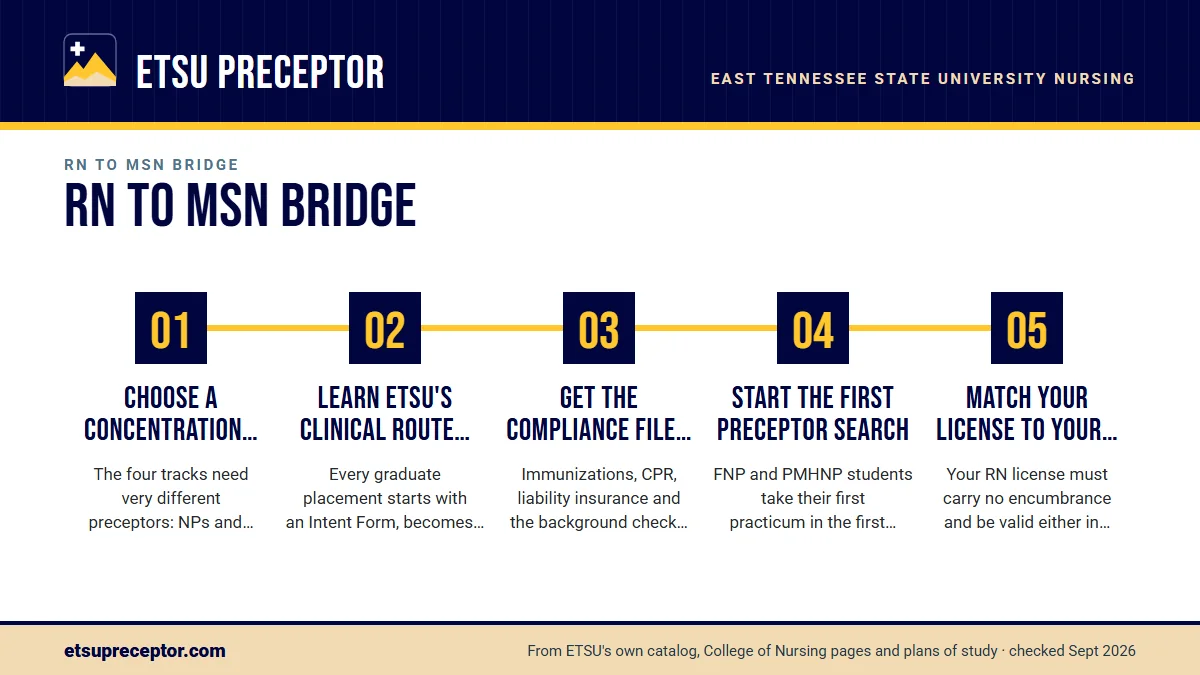
- Choose a concentration with clinicals in mindThe four tracks need very different preceptors: NPs and physicians for the NP tracks (the Intent Form's own examples are FNP, ANP and MD), a nurse administrator for administration, and experienced academic nurse educators for education. Think about who you can realistically reach where you live.
- Learn ETSU's clinical route before you need itEvery graduate placement starts with an Intent Form, becomes an onboarding submission in ProjectConcert, then needs a faculty sign-off, a credentials review and a site contract. Knowing the order now saves weeks later; the placement process guide walks through it.
- Get the compliance file movingImmunizations, CPR, liability insurance and the background check are tracked in ProjectConcert, where every item shows whether it is complete and when it falls due. Your access begins once the Office of Student Services emails new students about clinical health requirements.
- Start the first preceptor searchFNP and PMHNP students take their first practicum in the first graduate semester, so the search belongs in the final bridge term. Since ETSU names no filing date and no contract turnaround, starting early is the only safe plan.
- Match your license to your clinical stateYour RN license must carry no encumbrance and be valid either in Tennessee or in whichever state hosts your clinicals. As a compact member, Tennessee honors multistate licenses; the license rules page covers encumbrances and reporting.
Clinicals outside Tennessee
Online coursework lets you live almost anywhere, but a clinical site beyond the Tennessee line has to be cleared with the regulators involved, and ETSU looks at each request individually after you are admitted. That review happens on top of the preceptor approval every student goes through, so it adds time to your first placement. For complaints, out-of-state distance students use ETSU's own process first, and the NC-SARA directory lists ETSU as a participating institution.
On top of that, ETSU's two published lists of states where its nursing programs meet licensure requirements conflict for a number of states, with Hawaii and Maryland the sharpest conflicts. Read both before you settle on where your clinicals will happen; ETSU's licensure disclosures sets them side by side. If your state is marked "not determined" in one list, ask the College what that means for your concentration before you commit.
Why bridge students bring us in early
The bridge is the ideal moment to start with us, because we can plan every practicum in your concentration before the first one arrives. We match preceptors to each course's population or role, in your own community, and put together the preceptor details faculty ask for: credentials, license numbers, certification dates and the hours you plan to spend there.
We point out right away when a site will need a contract, which gives the College a head start, and we remain your placement partner until the last practicum ends. Faculty at ETSU make the approval decision and the College confirms each credential; we hand them a complete, rule-ready package from the first submission. Use the form below and tell us which concentration you are bridging into.
Questions ETSU students ask
Do I earn a BSN in ETSU's RN to MSN program?
No. ETSU's RN to MSN page states that graduates do not receive the BSN. The 12-credit bridge prepares you for graduate study, and the credential you earn is the MSN in your chosen concentration. If the BSN itself is your goal, ETSU runs a separate online RN to BSN track that admits once a year, in summer.
Can I start the RN to MSN in spring?
Only if you are bridging into the FNP concentration, which is the one ETSU MSN track with a spring intake, due November 1. Nursing Administration, Nursing Education and PMHNP start in fall, with applications due May 1. Because deadlines follow the concentration, choose your track before you apply.
Does NRSE 3510 in the bridge include clinical work?
ETSU's RN to MSN materials list no practicum hours for any bridge course, including NRSE 3510 Population, Community, and Public Health Nursing. In ETSU's BSN tracks the same course number appears as a classroom course beside separately numbered practicum courses. Your syllabus is the final word, so check it when you register.
How long does ETSU's RN to MSN take?
ETSU does not publish a separate length for the bridge. After it, the MSN takes five semesters full time and usually seven to eight part time. ETSU's graduate policy allows six years for a master's degree, so ask your advisor whether the bridge courses start that clock or whether it begins with your first graduate course.
Do I need a Tennessee RN license for the RN to MSN?
Not necessarily. A clean license from the state where your clinicals happen also satisfies the MSN rule, and Tennessee's compact membership matters if you hold a multistate license. The stakes are high after admission: any encumbrance on a license you hold must be reported to the Associate Dean of Graduate Programs immediately, and a suspension, revocation or unreported change means administrative withdrawal.
Related pages
Last checked 2026-09-25
We check these pages against ETSU's own catalog, College of Nursing pages, plans of study and ProjectConcert guides. Your plan of study, your syllabus, your course faculty and the graduate clinical coordinator have the final word.
ETSU asks you to lead the preceptor search. We make it the fastest part of your program.
Tell us your ETSU concentration, where you live and which semester your next practicum starts. We find preceptors who fit the course's patient population and prepare everything your Preceptor Intent Form and ProjectConcert entry need.
- Preceptors matched to the course: young and middle adults for
NRSE 5012, older adults forNRSE 5014, women forNRSE 5022, children forNRSE 5024, psychiatric care forNRSE 5405 - Credentials, license numbers, certification dates and the site's patient mix ready for faculty approval
- In your own community, in Northeast Tennessee or wherever ETSU approves your clinicals
Start your placement plan
Program, city and semester is all we need to begin.