The ETSU graduate clinical coordinator: what the role covers and how to use it well
At East Tennessee State University (ETSU), the graduate clinical coordinator is the College of Nursing role that supports graduate students' placements. ETSU documents three things the role does: it keeps contacts and lists of past preceptors, it appears in the ProjectConcert dropdown when you submit a preceptor, and it sends approved preceptors their welcome email and login. Knowing those limits helps you ask for the right help at the right time.
Get your placement plan
Tell us your ETSU program and where you live. A placement advisor replies with the preceptor and site options that fit your ETSU course.
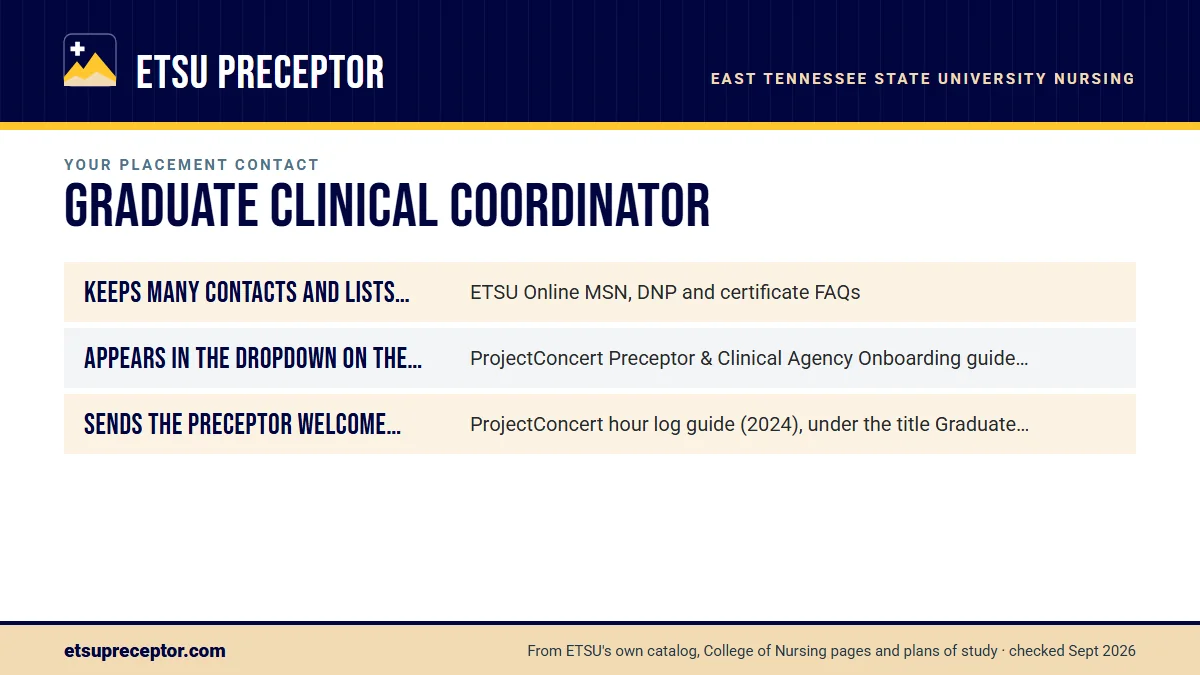
What the coordinator does, in ETSU's own documents
ETSU publishes no job description for the role, but its FAQs and ProjectConcert guides show where the coordinator enters your placement. Each function sits at a different point in the timeline.
| Function | Where ETSU says it | When it matters to you |
|---|---|---|
| Keeps many contacts and lists of past preceptors | ETSU Online MSN, DNP and certificate FAQs | Early in your search, before you have a candidate |
| Appears in the dropdown on the onboarding entry | ProjectConcert Preceptor & Clinical Agency Onboarding guide (2024) | When you submit a preceptor and site |
| Sends the Preceptor Welcome Email with ProjectConcert login details | ProjectConcert hour log guide (2024), under the title Graduate Clinical Placement Coordinator | After the preceptor is approved, before your first logged shift |
ETSU's guide shows a dropdown rather than one fixed name, a hint that ETSU has several coordinators. That detail matters when you choose who receives your entry.
The coordinator supports the search; faculty approve
It is easy to assume the person who helps you find a preceptor also signs off on that preceptor. ETSU's Preceptor Intent Form gives those jobs to other people: course approval of the preceptor belongs to clinical faculty, and checking the preceptor's credentials belongs to the Office of Student Services.
So a coordinator's suggestion is a lead, not an approval. A preceptor from a past-preceptor list still has to fit your current course, show current licenses and certifications, and practice at a site with a contract in place. Our preceptor approval page explains each of those checks.
For a full list of who handles what, including the Office of Practice, the Associate Dean of Graduate Programs and the DNP project chair, see who does what at ETSU.
Choosing the right name in the ProjectConcert dropdown
When you create the Preceptor & Clinical Agency Onboarding experience, the General tab asks you to pick the graduate clinical coordinator from a list. ETSU's guide does not say how names map to programs or courses.
If you are not sure which coordinator covers your concentration, ask before you submit rather than guessing. A short email naming your program, course number and term settles it. The full entry, including the Documents tab and the Save and Submit steps, is covered on our ProjectConcert submission page.
Keep a note of which coordinator you chose. If the entry is rejected or a question comes up later, that is the person to follow up with first.
The welcome email and your preceptor's login
After approval comes through, a Preceptor Welcome Email goes out from the Graduate Clinical Placement Coordinator containing a ProjectConcert username and login details. ETSU's ProjectConcert page describes it as the platform faculty and preceptors use to check, sign off and run reports on what students submit, so this email is what lets your preceptor see your hours and complete your evaluations.
Preceptors are busy, and an institutional email from an unfamiliar sender is easy to miss. After approval, ask your preceptor to search their inbox and junk folder for the welcome message. If it never arrived, write to the coordinator from your ETSU account with the preceptor's name and the email address you entered.
Sorting this out before your first shift keeps your hour logs from piling up unreviewed.
How to work with the coordinator well
Specific, complete requests get the most useful answers. Your ETSU email is the College's official channel; use it for every message.
What to include or ask
- Your program, the practicum course number and the term it runs
- The city or county where you want clinicals, and how far you can drive
- Practices you have already contacted, so you get new names rather than repeats
- The current version of the Preceptor Intent Form, since the posted copy is dated
- Any date by which your entry should be in, since ETSU publishes none
- Whether a site you are considering already has a contract with the College
Follow up in writing after a call so the answer is on record in your ETSU inbox.
Where the role meets large health systems
Some health systems accept advanced practice students only through the school's side. Ballad Health's academics page routes advanced practice requests through each school's clinical coordinator, limits them to programs holding a current affiliation agreement with Ballad, and requires Ballad's student orientation before the rotation. Vanderbilt says an unaffiliated school starts an agreement through its clinical coordinator.
Erlanger in Chattanooga says it is not currently entering new affiliation agreements for advanced practice student placements. For systems like these, a direct request from you to a hospital unit is not the path the system describes, so bring the coordinator in early.
What each system requires of schools is summarized on our Tennessee NP preceptors page, and the agreement side is on clinical contracts at ETSU.
Why ETSU students work the coordinator and us side by side
The coordinator gives you ETSU's history of past placements. We add a dedicated search in your own community, matched to the course's patient population and hours, with a placement advisor who does the calls and follow-up for you.
When a preceptor says yes, we gather every credential detail both the form and the onboarding entry call for, so what the coordinator and faculty receive is complete on the first pass. The decisions stay with ETSU; our job is that the file on their desk answers every question the form raises. If a preceptor steps back mid-term, your advisor starts a replacement search while you keep the coordinator informed. Use the form below to start.
Questions ETSU students ask
Who is the graduate clinical coordinator at ETSU?
This site refers to the role by its title. The dropdown on the ProjectConcert onboarding entry shows who holds it, and your academic advisor or the Nicks Hall Office of Student Services can tell you which coordinator covers your concentration. Write from your ETSU email so the reply stays on record.
Is the graduate clinical coordinator the same as the Graduate Coordinator?
ETSU lists both titles among its graduate nursing roles, next to program directors, the academic advisor and the Graduate Progression Advisor. The clinical coordinator is the placement role described on this page. If a message about your preceptor lands with the wrong office, ask your advisor to confirm who handles clinical placement for your program.
Does the coordinator approve my preceptor?
No. The Preceptor Intent Form assigns that decision to clinical faculty, while the credential check falls to the Office of Student Services. The coordinator helps you find candidates, appears in the ProjectConcert dropdown and sends the approved preceptor a welcome email with login details.
My preceptor never got the ProjectConcert welcome email. What should I do?
Ask the preceptor to check junk and spam folders first. If nothing is there, email the Graduate Clinical Placement Coordinator from your ETSU account with the preceptor's full name, the site, your course and the email address you entered, so the coordinator can check the record and resend.
Can the coordinator simply place me with a preceptor?
ETSU describes the coordinator as a helper with contacts and past-preceptor lists, while the MSN, DNP and certificate FAQs keep the search with the student. The ETSU-TTU joint DNP describes a shared effort. Ask for names, but plan to make the contacts yourself or with a placement service.
Related pages
Last checked 2026-09-25
We check these pages against ETSU's own catalog, College of Nursing pages, plans of study and ProjectConcert guides. Your plan of study, your syllabus, your course faculty and the graduate clinical coordinator have the final word.
ETSU asks you to lead the preceptor search. We make it the fastest part of your program.
Tell us your ETSU concentration, where you live and which semester your next practicum starts. We find preceptors who fit the course's patient population and prepare everything your Preceptor Intent Form and ProjectConcert entry need.
- Preceptors matched to the course: young and middle adults for
NRSE 5012, older adults forNRSE 5014, women forNRSE 5022, children forNRSE 5024, psychiatric care forNRSE 5405 - Credentials, license numbers, certification dates and the site's patient mix ready for faculty approval
- In your own community, in Northeast Tennessee or wherever ETSU approves your clinicals
Start your placement plan
Program, city and semester is all we need to begin.