Who does what in an ETSU clinical placement
An East Tennessee State University (ETSU) graduate clinical passes through several hands. You run the search, the graduate clinical coordinator supports it and receives your submission, clinical faculty give the yes on fit, the Office of Student Services checks the preceptor's paperwork, and the preceptor teaches and grades your performance on site. Knowing which role owns which decision saves weeks of emails to the wrong office. ETSU names roles rather than people, and so does this page.
Get your placement plan
Tell us your ETSU program and where you live. A placement advisor replies with the preceptor and site options that fit your ETSU course.
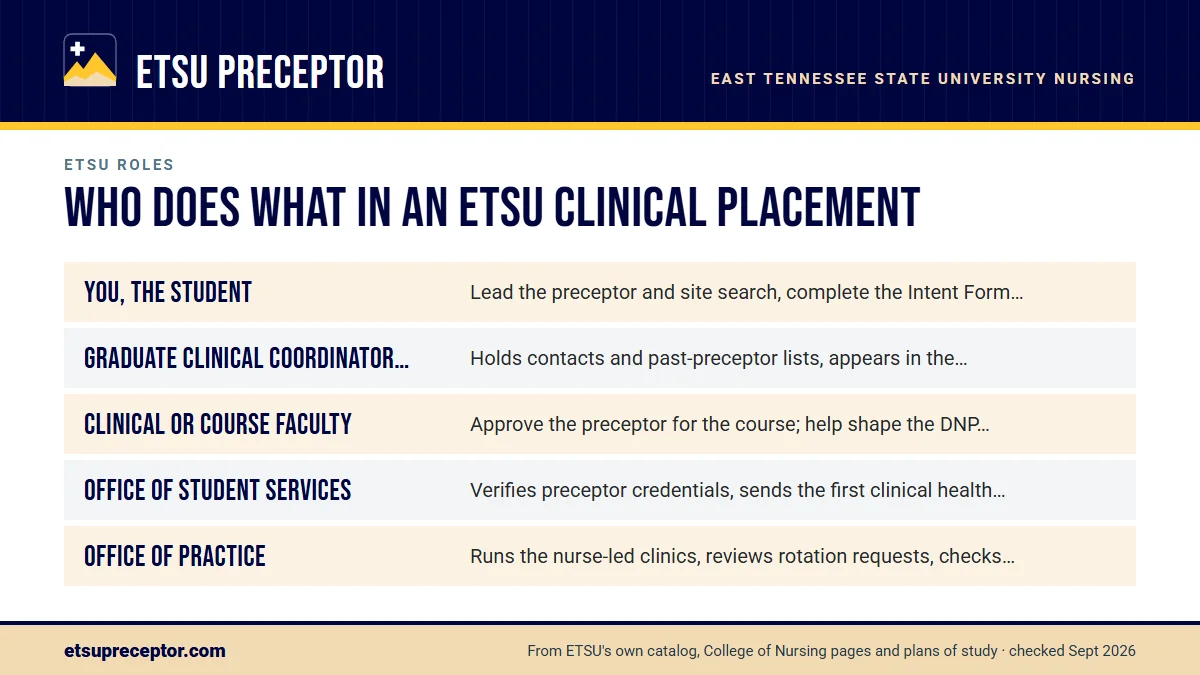
The map at a glance
Every role below comes from ETSU's own forms, catalog and College pages. Titles can change between catalog years, so check the current graduate catalog if a title looks unfamiliar.
| Role | What it does in your clinical | When you deal with it |
|---|---|---|
| You, the student | Lead the preceptor and site search, complete the Intent Form, submit in ProjectConcert, keep compliance current, log hours | From your first term |
| Graduate clinical coordinator (Graduate Clinical Placement Coordinator) | Holds contacts and past-preceptor lists, appears in the ProjectConcert dropdown, sends the approved preceptor's welcome email | During the search and at submission |
| Clinical or course faculty | Approve the preceptor for the course; help shape the DNP interprofessional experience | After submission and through the term |
| Office of Student Services | Verifies preceptor credentials, sends the first clinical health requirements email, handles pace changes | At admission, at approval, if your pace changes |
| Office of Practice | Runs the nurse-led clinics, reviews rotation requests, checks accepted students' ProjectConcert files | Only if you apply to a College clinic |
| Associate Dean of Graduate Programs | Receives reports of any license encumbrance | If your license status changes |
| DNP project chair | Doctorally prepared ETSU faculty member who verifies residency hours each semester | During DNP residencies |
| Preceptor | Supervises you on site, reviews your logs, completes mid-term and final evaluations | Every clinical day |
You and the graduate clinical coordinator
ETSU puts the first move on the student. ETSU Online's MSN FAQ describes a coordinator with many contacts and lists of past preceptors, then makes clear that the search itself is the student's to drive. The DNP and certificate FAQs match it, while the joint DNP FAQ describes a shared effort with existing ETSU and Tennessee Tech agreements. The finding your own preceptor page compares the wording program by program.
The coordinator appears at two fixed points. Filing the onboarding entry (ProjectConcert calls the format Preceptor & Clinical Agency Onboarding) means choosing a coordinator's name from a list, so the title may cover several people. After approval, the same role, styled Graduate Clinical Placement Coordinator at this step, emails your preceptor the Preceptor Welcome Email that carries their ProjectConcert credentials. Our coordinator page covers how to work with the role well.
Clinical faculty and the Office of Student Services
Two roles share the approval. Clinical faculty judge fit, reading the credentials and the patient grid on the Intent Form against what the course is meant to teach and to whom. Student Services, from room 2-230 of Nicks Hall, confirms that the preceptor's licenses and certifications check out. Beyond both sign-offs, an agreement with the site has to exist and your own requirements must be cleared before the first shift.
Which office drafts agreements with outside sites is not stated anywhere ETSU publishes. A Credentialing and Contract Specialist appears among the Office of Practice's staff titles, yet nothing says that post covers outside agencies, so ask the coordinator who starts the paperwork for your site.
Student Services does more than verify preceptors. Its first email about clinical health requirements is what opens ProjectConcert to a new student, and it rules on written requests to change between part-time and full-time study, weighing grades and whether a clinical slot exists at the new pace. The approval page follows the sign-offs in order.
The Office of Practice
Based in room 310 of Nicks Hall, the Office of Practice manages the College's Faculty Practice Network of nurse-managed clinics. It weighs requests for rotations, projects and grants at those clinics and looks through accepted students' ProjectConcert files for gaps. Nothing on its pages describes placing students with outside agencies.
Its staff titles sketch how the clinics run. At the top is an Associate Dean for Practice and Community Partnerships, who also serves as Chief Nursing Officer of ETSU Health, followed by an Executive Director, a Clinical Director, a Quality/Compliance Director and a Practice Administrator, with a coordinator and a credentialing and contract specialist supporting them. Request windows and documents are on the nurse-led clinics page.
Program leaders, advisors and the Graduate Dean
Behind the placement roles sit the people who own your program and your progress. ETSU's catalog and advising pages name an Associate Dean of Graduate Programs, a Graduate Coordinator, an MSN Program Director, a DNP Program Director, an ETSU-TTU DNP Program Director, academic advisors, a Graduate Progression Advisor and an Assistant Dean of Student Services.
One of these carries a hard rule. News of an encumbrance on any nursing license you hold must go straight to the Associate Dean of Graduate Programs; a suspension, a revocation or a change you fail to report ends in administrative withdrawal. See the RN license rule.
Outside the College, the Graduate Dean decides leave-of-absence requests, extensions on Incompletes and probation outcomes. Joint DNP students enter through either ETSU or Tennessee Tech, and the catalog frames its policies around a 'home school', so find out which university's offices keep your records.
DNP project roles
DNP residencies add a project team. ETSU's DNP project guide from 2020 lists a project chair, drawn from ETSU faculty holding a doctorate, who signs off residency hours as each semester closes; a Concentration Coordinator, who approves the project alongside course faculty and the DNP Program Director; and team members, one of whom may come from the practice site. During residencies, preceptors evaluate you in ProjectConcert while faculty file separate evaluations.
The 40-hour interprofessional requirement applies in every ETSU DNP concentration. According to the College's DNP page, you either join a formal interprofessional clinic or design the experience yourself with your advisor, course faculty and people at the partner organization. The DNP residencies page covers the four residency courses.
At the site, and where we fit
The clinical agency has decisions of its own. It is the agency, not ETSU, that reads your background check and decides whether you may train on its premises; ETSU holds on to nothing but evidence the check took place. A university-wide ETSU instruction sheet, not specific to nursing, mentions a facility's clinical education director reviewing flagged checks. Health systems add their own steps too; Ballad Health, for example, routes APP students through the program's clinical coordinator and requires its student orientation before a placement begins.
We take on the part ETSU hands to the student. We locate a preceptor and site near you, compile what the coordinator, faculty and Student Services will look for, and raise the agreement question at the very start, while the College still has room to arrange it. Approval stays with ETSU's own people, and each of them receives a file that is whole on arrival. Start with the short form at the bottom of this page.
Questions ETSU students ask
Who approves my preceptor at ETSU?
Two ETSU roles decide. Clinical faculty judge whether the preceptor suits the course, and the Office of Student Services confirms the preceptor's credentials are genuine and current. A signed agreement with the site and your own completed requirements are also needed before day one. Progress is tracked in ProjectConcert, where a rejected entry shows its reason in the Comment column.
Who sends my preceptor their ProjectConcert access?
Approved preceptors hear from the Graduate Clinical Placement Coordinator, whose Preceptor Welcome Email contains their ProjectConcert username and sign-in details. If yours has received nothing a few days after approval, write to the coordinator you picked from the list when you filed the onboarding entry.
Who do I tell if my nursing license gets an encumbrance?
The Associate Dean of Graduate Programs, straight away. ETSU's catalog requires graduate students to keep an unencumbered license in every state where they hold one and every state where they do clinicals. A suspended or revoked license, or failing to report a change, leads to administrative withdrawal.
Who handles a switch from full-time to part-time study?
Put the request in writing to Student Services at the College. ETSU says it considers how you are doing academically and whether a clinical slot exists at the new pace, and any switch shifts your practicums into different terms. Ask how the new plan of study shifts each practicum before you commit, so your preceptor search follows the new dates.
Does the Office of Practice find preceptors at outside sites?
Its page describes running the College's nurse-led clinics and reviewing rotation, project and grant requests there, not placing students elsewhere. For outside preceptors, the graduate clinical coordinator helps with contacts and past-preceptor lists while you lead the search. The office's request windows and document list apply to its own clinics.
Related pages
Last checked 2026-09-25
We check these pages against ETSU's own catalog, College of Nursing pages, plans of study and ProjectConcert guides. Your plan of study, your syllabus, your course faculty and the graduate clinical coordinator have the final word.
ETSU asks you to lead the preceptor search. We make it the fastest part of your program.
Tell us your ETSU concentration, where you live and which semester your next practicum starts. We find preceptors who fit the course's patient population and prepare everything your Preceptor Intent Form and ProjectConcert entry need.
- Preceptors matched to the course: young and middle adults for
NRSE 5012, older adults forNRSE 5014, women forNRSE 5022, children forNRSE 5024, psychiatric care forNRSE 5405 - Credentials, license numbers, certification dates and the site's patient mix ready for faculty approval
- In your own community, in Northeast Tennessee or wherever ETSU approves your clinicals
Start your placement plan
Program, city and semester is all we need to begin.