Pediatric NP-Primary Care practicums in the ETSU-TTU joint DNP
The Pediatric Nurse Practitioner-Primary Care concentration of the joint DNP run by East Tennessee State University (ETSU) and Tennessee Tech University prepares you to care for children of all ages. ETSU's 2026-27 catalog presents two of its courses, NRSE 5312 and NRSE 5317, as pediatric primary care practicums done under a preceptor, and a third, NRSE 5314, as a preceptorship paired with certification prep. Hours and a full course list are not published on the web, so this page sets out what is known and what to ask.
Need a pediatric preceptor?
Tell us your joint DNP term and city. We search for pediatric primary care preceptors near you.
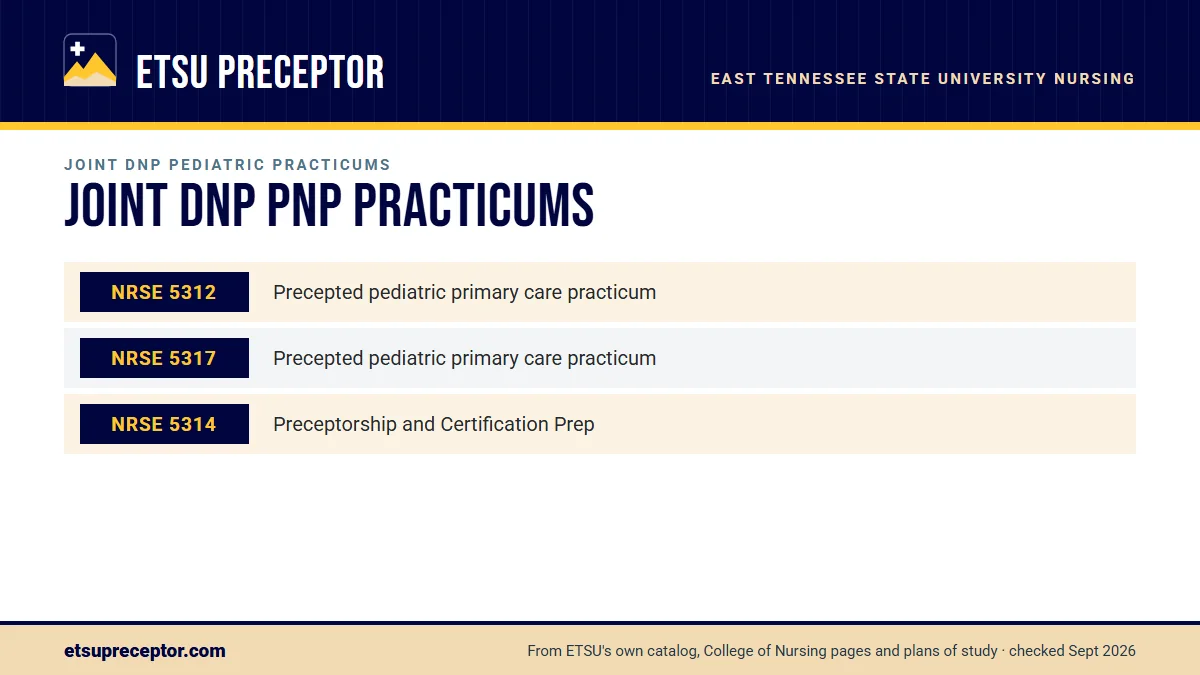
The three pediatric courses
These are the pediatric courses ETSU's catalog pages name for the concentration. Their order, credits and clock hours belong to the joint DNP PNP-Primary Care program page in the catalog (catalog 66, program 19218), which was unreachable during research for this site, so the plan of study the program issues you is the document to trust.
| Course | How the catalog describes it | Clock hours |
|---|---|---|
NRSE 5312 | Precepted pediatric primary care practicum | Not published on the web |
NRSE 5317 | Precepted pediatric primary care practicum | Not published on the web |
NRSE 5314 | Preceptorship and Certification Prep | Not published on the web |
The 2026-27 graduate catalog also lists NURS-prefixed courses beside ETSU's NRSE courses, and ETSU's web pages do not say which of them belong to the joint DNP. If your plan shows NURS courses with a clinical piece, ask how their hours and preceptors are arranged.
Why the pediatric track runs longer
ETSU Online lists 9 semesters for the full-time BSN-DNP in every joint DNP concentration except PNP-Primary Care, which takes 12. Part-time study takes 15 semesters in any concentration. BSN-DNP students start in fall, and the program runs 77 to 92 credits for BSN-DNP and 32 to 35 for MSN-DNP. The rest of the program is covered on the joint DNP page.
A longer plan means your pediatric placements are spread across a longer stretch of time than a classmate's in another concentration. Map every clinical term on your plan of study at the outset, and treat summer as a working term: ETSU's graduate plans schedule clinical courses in summer as a full semester.
The program is blended: mostly asynchronous, with some synchronous meetings and required intensives twice a year, in May and August, currently held on Zoom for 2 to 4 days. ETSU Online adds that some NP concentrations have skills-lab requirements met through in-person clinical hours in your own area. Ask whether that applies to PNP-Primary Care and which course carries it.
How the joint DNP describes placement help
The joint DNP's wording on placements differs from the rest of ETSU's graduate programs. Asked whether students get placement help, its FAQ says yes. It points out that students know their home region and may already have sites and preceptors in mind, adds that ETSU and TTU already have many agreements in place with clinical sites and preceptors, and promises close work with each student toward the best fit.
The MSN, ETSU DNP and certificate FAQs instead say the student is responsible for being proactive in the preceptor and site search. The joint DNP FAQ does not use that line, so the effort is described as shared, and the part that sits with you is bringing strong local leads. Finding your own preceptor compares the wording program by program.
Applicants apply through either university's graduate college, and catalog policies refer to your "home school." Ask the ETSU-TTU DNP Program Director which school's clinical coordinator handles your placement entries and contracts, since that decides where your paperwork goes.
Choosing a pediatric primary care preceptor
ETSU publishes no written minimums for NP preceptors. Its Preceptor Intent Form gives FNP, ANP and MD as credential examples, which shows nurse practitioners and physicians precepting NP students, and faculty read it to decide whether a preceptor suits the course's population focus, which for NRSE 5312 and NRSE 5317 is pediatric primary care.
Under Tennessee's board rule for programs it approves, a pediatric preceptor needs a clean license that is good in their own state and sits no lower than the credential you are working toward, along with pediatric competencies to match. In practice the patient panel is the test. The Intent Form asks how many children and adolescents a site sees, both as a share of its patients and per day, alongside other groups, and a pediatric primary care site should show children across the age range. Patient population mix explains how faculty read those numbers.
The posted form's concentration choices are AGPCNP, FNP and PMHNP, with no PNP option, so ask the coordinator which version joint DNP pediatric students use.
PNP practicums compared with the FNP pediatric course
ETSU's MSN and BSN-DNP FNP students also have a pediatric course: NRSE 5024 Children and Adolescents Practicum, 120 hours in their plans, which the catalog places across rural, urban and underserved sites. It gives family practice students one pediatric block inside a lifespan program. See NRSE 5024 for that course.
The PNP-Primary Care practicums differ in kind. The whole concentration centers on children of all ages, and the catalog builds a dedicated preceptorship, NRSE 5314, around preparing for the PNP-Primary Care certification exam. Ask faculty what depth of pediatric practice they expect from your preceptor and site for each of the three courses.
If you are still choosing between routes, ETSU describes FNP care as spanning the lifespan and PNP-Primary Care as serving children of all ages. The certification you sit for follows the concentration.
What to ask before your first pediatric practicum
- The clock hours for
NRSE 5312,NRSE 5317andNRSE 5314, and the semester each falls in. - Whether one preceptor can cover more than one course, or each course needs its own approval.
- Which school's coordinator receives your placement entries and sets up contracts.
- Which Intent Form version to use, since the posted one has no PNP option.
- Which system logs your clinical hours and evaluations for your home school.
- Whether any skills-lab requirement is met through in-person hours near you.
Put the questions to the ETSU-TTU DNP Program Director or the graduate clinical coordinator in one email, and keep your plan of study beside the answers. Ask a term ahead of each practicum, since a new site needs a contract in place before your first clinical day and ETSU publishes no lead time for setting one up.
Why joint DNP pediatric students choose us
Pediatric primary care placements reward a focused search. We look in your own community for pediatric nurse practitioners, pediatricians and family practice clinicians with busy pediatric panels whose work fits NRSE 5312 and NRSE 5317, gather the credential, license, certification and patient-mix details faculty need, and flag contract needs early for whichever school handles your placement. Where one preceptor can carry more than one course, we line that up too, so you build a relationship rather than starting over each term.
If a preceptor leaves mid-course, we find a replacement fast. Approval belongs to your faculty and credential checks to the College; we deliver them a complete, accurate package so the decision can come quickly. Tell us your city and first pediatric term with the contact form.
Questions ETSU students ask
Are clinical hours for the joint DNP pediatric track published?
ETSU does not publish clinical-hour totals for any joint DNP concentration on its web pages. The figures live on the 2026-27 catalog program page for PNP-Primary Care and in your plan of study. Ask the ETSU-TTU DNP Program Director for the hours in NRSE 5312, NRSE 5317 and NRSE 5314.
Does ETSU help joint DNP students find preceptors?
Yes. The joint program frames placement as teamwork: students bring knowledge of their own region and any sites or preceptors they already know, while the two universities contribute their existing site and preceptor agreements and help each student find a good fit. Good local leads are your share of the work.
How long does the ETSU-TTU PNP-Primary Care DNP take?
ETSU Online lists 12 semesters for the full-time BSN-DNP in PNP-Primary Care, three more than the other joint DNP concentrations, and 15 semesters for part-time study. BSN-DNP students start in fall, and the program totals 77 to 92 credits depending on concentration.
Can a family nurse practitioner precept a PNP student?
ETSU publishes no rule that settles it. Tennessee's rule sets a license floor, no lower than the credential you are pursuing, and asks for matching competencies, and ETSU faculty judge fit from the Intent Form, including how many children and adolescents the site sees. An FNP with a strong pediatric panel may fit; ask course faculty first.
Where are the ETSU-TTU joint DNP intensives held?
ETSU Online says joint DNP students attend program intensives twice a year, in May and August, currently held on Zoom and lasting 2 to 4 days. Plan clinical days around those dates, since summer and fall practicum schedules can overlap with them.
Related pages
Last checked 2026-09-25
We check these pages against ETSU's own catalog, College of Nursing pages, plans of study and ProjectConcert guides. Your plan of study, your syllabus, your course faculty and the graduate clinical coordinator have the final word.
ETSU asks you to lead the preceptor search. We make it the fastest part of your program.
Tell us your ETSU concentration, where you live and which semester your next practicum starts. We find preceptors who fit the course's patient population and prepare everything your Preceptor Intent Form and ProjectConcert entry need.
- Preceptors matched to the course: young and middle adults for
NRSE 5012, older adults forNRSE 5014, women forNRSE 5022, children forNRSE 5024, psychiatric care forNRSE 5405 - Credentials, license numbers, certification dates and the site's patient mix ready for faculty approval
- In your own community, in Northeast Tennessee or wherever ETSU approves your clinicals
Start your placement plan
Program, city and semester is all we need to begin.