ETSU nursing accreditation: CCNE by program level and Tennessee approval
East Tennessee State University (ETSU) College of Nursing lists four program levels as holding accreditation from the Commission on Collegiate Nursing Education (CCNE): baccalaureate, master's, DNP and post-graduate APRN certificates. It also states that the Tennessee Board of Nursing approves its programs. No accreditation or next-review dates appear on ETSU's pages, so ask the College whenever a form wants one.
Get your placement plan
Tell us your ETSU program and where you live. A placement advisor replies with the preceptor and site options that fit your ETSU course.
What ETSU states, level by level
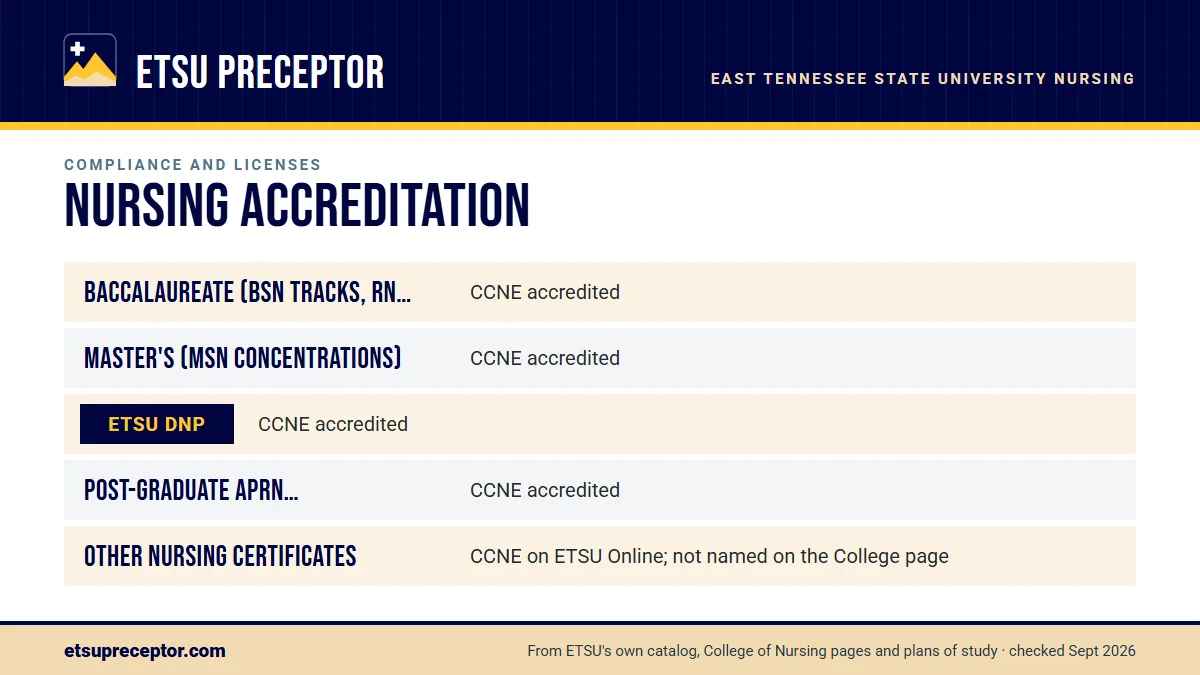
The College's home page carries the accreditation statement, and ETSU Online's program pages repeat it for the online programs. Set side by side, the statements line up like this.
| Program level | What ETSU's pages say | Where |
|---|---|---|
| Baccalaureate (BSN tracks, RN to BSN) | CCNE accredited | College home page |
| Master's (MSN concentrations) | CCNE accredited | College home page; ETSU Online MSN page |
| ETSU DNP | CCNE accredited | College home page; ETSU Online DNP page |
| Post-graduate APRN certificates | CCNE accredited | College home page; ETSU Online certificates page |
| Other nursing certificates | CCNE on ETSU Online; not named on the College page | See the conflict below |
| ETSU-TTU joint DNP | Not addressed separately on the pages reviewed | Ask the College |
State approval is a separate statement: the College reports Tennessee Board of Nursing approval for its programs. Neither statement is the same thing as a state licensure determination, which ETSU publishes separately.
The certificate conflict
ETSU's two sources disagree about certificates. The ETSU Online certificates page says all nursing certificates are CCNE accredited. The College home page names only the post-graduate APRN certificates in its CCNE statement and does not list the Health Care Genetics and Genomics certificate or the Post-Graduate Nursing Administration certificate.
For the APRN certificates (FNP, PMHNP and the post-DNP AGPCNP), both sources agree. If you are in one of the other two certificates and a form asks about accreditation, quote the College's own wording and ask the College of Nursing which statement applies to your program. Our post-graduate certificates page covers how those programs run their clinicals.
The joint DNP needs the same care. It is run with Tennessee Tech University's Whitson-Hester School of Nursing, and the catalog's policies speak of each student's "home school." Ask your home school's program office which accreditation statement covers your concentration before you write one down.
No dates on ETSU's pages
Neither the College nor ETSU Online publishes an accreditation date or a next-review date for any nursing program. A date you see on an unofficial page is not one ETSU has posted, so keep it off applications, scholarship forms and site paperwork.
When a form insists on a date, ask the College of Nursing for the current figures in writing, or check the accreditor's own listing yourself and note where the date came from. The same caution applies to program descriptions: quote ETSU's wording as written instead of paraphrasing it into a stronger claim. If a document asks only whether the program is accredited, without a date, the College's own sentence is the answer to give.
ETSU's pages publish no accreditation or review dates: get any date you need from the College in writing.
Tennessee Board of Nursing approval
The Tennessee Board of Nursing sits in the Department of Health's Division of Health Related Boards and approves nursing schools. It sets minimum curriculum for nursing programs in every delivery mode, online included. Its published approved-school lists cover LPN and RN programs only, and no APRN program list appears there.
For graduate programs, the Board's education rule sets the frame. Rule 1000-01-.11, effective October 8, 2024, requires APRN education to include the three graduate core courses (pathophysiology, health assessment and pharmacology), one of four roles and at least one of six population foci, with clinical supervision that matches national specialty and accreditor standards. The same rule says every clinical experience, including those with preceptors, is directed by nursing faculty.
That last line explains the shape of ETSU's process: faculty approve each preceptor, and preceptors add to faculty-directed learning without replacing it. Our page on Tennessee APRN practice and preceptors covers the rule in more depth.
Why it matters for certification and licensure
National certification and state licensure both rest on the program you finish. ETSU says its MSN FNP and PMHNP graduates are prepared for national certification in those roles, Nursing Administration graduates can take the ANCC Nurse Executive exam, and Nursing Education graduates are ready to sit for the NLN Certified Nurse Educator exam. Each joint DNP NP concentration leads to its own national exam.
In Tennessee, an APRN certificate under Rule 1000-04-.03 calls for at least a master's in a nursing specialty plus national certification, kept current, from a body the Board approves, and prescribing authority requires a degree in a board-recognized role and population focus.
Accreditation does not settle whether ETSU's curriculum meets another state's educational requirements. That question belongs to the College's licensure disclosures, which disagree with each other for some states, so check yours before you plan clinicals or a move.
What sites and preceptors may ask
A practice new to ETSU students may want to know what kind of program it is supporting. The accurate short answer: CCNE accreditation for the College's baccalaureate, master's, DNP and post-graduate APRN certificate programs, Tennessee Board of Nursing approval, no dates published on ETSU's pages, and a contract between the College and the site before any clinical day. Our clinical contracts page covers that last step.
Health systems also set rules for schools: Ballad Health, for instance, says on its own pages that it accepts APP students only when their program holds a current affiliation agreement with Ballad, with requests routed through that program's clinical coordinator. More on that in our guide to Tennessee NP preceptors.
Tennessee APRNs may also ask about the Tennessee Nurse Preceptor Incentive, which is aimed at APRNs licensed in Tennessee who teach APRN students from approved, accredited Tennessee public or private schools. Our incentive page explains how it works.
How we open the door with a new preceptor
We make the first conversation with a clinician easy. When we approach a preceptor for an ETSU student, we bring an accurate summary of the program, the course's patient population and hours from the plan of study, the College's approval steps and the contract requirement, so the preceptor can agree with confidence and the paperwork that follows goes smoothly. If a clinician asks about the incentive, the contract or the time involved, we answer from ETSU's published rules and point to the College for anything ETSU has not published.
The decision to approve stays with your clinical faculty, and credential verification stays with the College. We supply both with a complete, rule-fitting file on the first try. Start with the contact form.
Questions ETSU students ask
Is ETSU's online FNP program accredited?
Yes, according to ETSU. The MSN FNP falls under the master's level, which the College of Nursing lists as CCNE accredited, and ETSU Online's MSN page repeats that. The College also reports Tennessee Board of Nursing approval. No accreditation dates are posted on ETSU's pages, so ask the College if you need one.
When is ETSU nursing's next CCNE review?
ETSU's pages do not say. Neither the College of Nursing home page nor the ETSU Online program pages give an accreditation date or a next-review date for any program. If an application or a clinical site form needs one, ask the College in writing rather than copying a date from an unofficial source.
Is the ETSU-TTU joint DNP accredited?
The College's CCNE statement names DNP programs as a level, but the pages reviewed do not address the joint DNP separately. The program is run with Tennessee Tech University's Whitson-Hester School of Nursing, so ask your home school's program office or the ETSU-TTU DNP Program Director which statement covers your concentration.
Does accreditation mean my ETSU program meets my state's licensure rules?
No. Accreditation and state licensure determinations are separate. ETSU publishes state-by-state licensure disclosures, and its College pages and university consumer pages disagree for some states, including Hawaii and Maryland. Check the disclosure for your program and state, and confirm with your own board of nursing.
Does the Tennessee Board of Nursing approve ETSU's NP programs?
According to the College, yes: its programs carry approval from the Tennessee Board of Nursing, the body that approves nursing schools and sets minimum curriculum in every delivery mode. The Board's published approved-school lists cover LPN and RN programs only, so there is no separate APRN program list to check there.
Related pages
Last checked 2026-09-25
We check these pages against ETSU's own catalog, College of Nursing pages, plans of study and ProjectConcert guides. Your plan of study, your syllabus, your course faculty and the graduate clinical coordinator have the final word.
ETSU asks you to lead the preceptor search. We make it the fastest part of your program.
Tell us your ETSU concentration, where you live and which semester your next practicum starts. We find preceptors who fit the course's patient population and prepare everything your Preceptor Intent Form and ProjectConcert entry need.
- Preceptors matched to the course: young and middle adults for
NRSE 5012, older adults forNRSE 5014, women forNRSE 5022, children forNRSE 5024, psychiatric care forNRSE 5405 - Credentials, license numbers, certification dates and the site's patient mix ready for faculty approval
- In your own community, in Northeast Tennessee or wherever ETSU approves your clinicals
Start your placement plan
Program, city and semester is all we need to begin.