Connecticut and ETSU nursing clinicals
East Tennessee State University (ETSU) marks Connecticut as meeting requirements on all of its licensure pages. Connecticut's own rules for visiting programs were drafted with prelicensure education in mind, and the biggest recent change for graduate students there concerns licensing: since October 1, 2025, Connecticut honors multistate RN licenses.
Training in Connecticut?
Tell us your town, program and next practicum. We search close to home and flag the contract early.
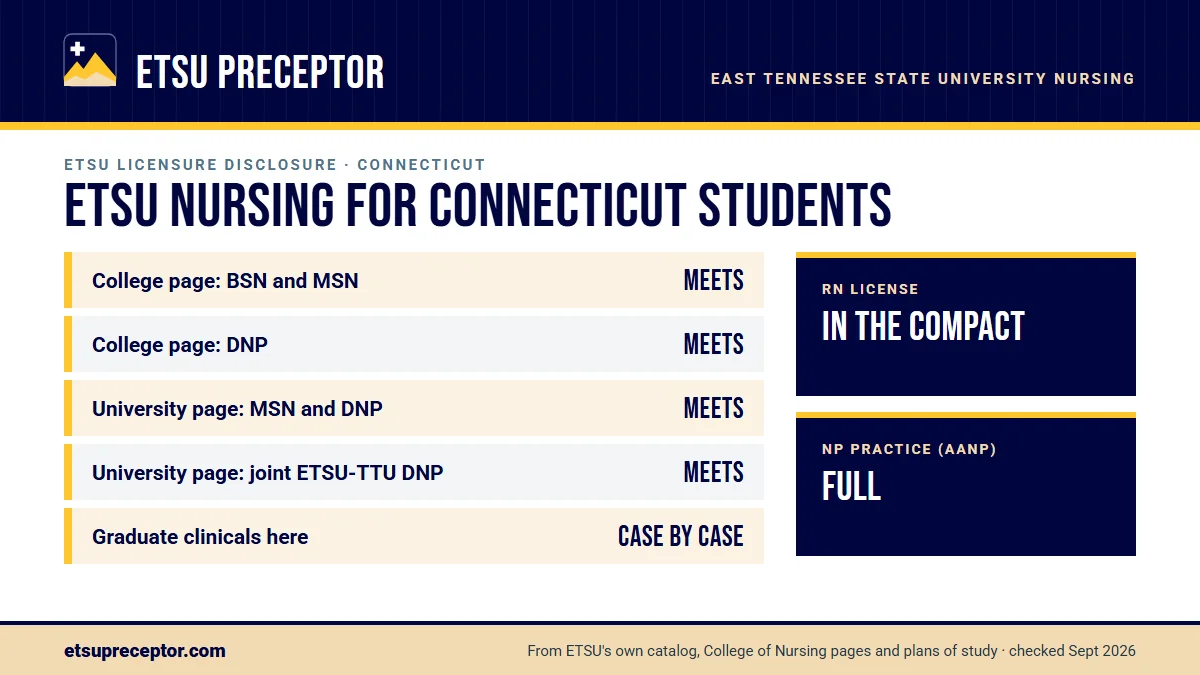
What ETSU says about Connecticut
| ETSU page | Program | Result for Connecticut |
|---|---|---|
| College of Nursing MSN page (updated September 2025) | BSN and MSN | Meets |
| College of Nursing DNP page (updated April 2026) | ETSU DNP and ETSU-TTU joint DNP | Meets |
| University consumer information pages (tables updated June 2025) | MSN and DNP | Meets |
| University consumer information page (updated July 2024) | ETSU-TTU joint DNP | Meets |
| University consumer information page | BSN | Meets |
Every ETSU table lands on "meets" for Connecticut, BSN through joint DNP, so the disclosure needs no second opinion. Before you apply from Connecticut, ETSU still wants you to check with the state's board, which here is the Board of Examiners for Nursing inside the Department of Public Health. Any other state can be checked on ETSU's licensure disclosures.
How Connecticut treats nursing programs from other states
Connecticut's regulations give a program from elsewhere "deemed approved" status on three conditions: approval from its home board, a curriculum that meets Connecticut's RN standard, and home-state licensure requirements at Connecticut's level or above. No separate filing or notice to Connecticut is described.
Visiting programs that use Connecticut agencies do inherit two duties: a written contract with each agency, and the state's staffing ratios. Those ratios cap direct-care groups at 10 students for each clinical instructor, preceptors at two students apiece, and faculty oversight at 16 precepted students per faculty member, and evaluation stays with faculty.
The catch for ETSU graduate students is scope. The chapter is aimed at schools preparing people for their first nursing license and never mentions graduate APRN tracks or post-licensure study, so it cannot tell you whether an MSN or DNP rotation needs anything extra. Put the question to the board, and count on ETSU reviewing the placement on its own merits, pending whatever approval regulators require. See clinicals outside Tennessee.
Connecticut's program rules were written for prelicensure education, so confirm how they touch an MSN or DNP rotation with the board and with ETSU.
Practice rules, preceptors and places to look
AANP counts Connecticut as a full practice state, with a condition: an NP first logs 2,000 hours over at least three years of physician collaboration. For precepting, the regulations sketch a profile for nurses precepting advanced students in RN programs (an active RN license from Connecticut or the state where they precept, a nursing bachelor's, two years or more in the specialty), but ETSU's clinical faculty decide whether your preceptor fits, using an Intent Form whose credential examples include FNP, ANP and MD.
The Hartford area is the largest metro at about 1.17 million people, followed by Bridgeport-Stamford-Danbury near 978,000, New Haven near 579,000 and Waterbury-Shelton near 463,000. Systems on NP students' lists include UConn Health; Trinity Health Of New England; the Hartford HealthCare and Yale New Haven Health networks; and New York-based Northwell Health, whose western Connecticut hospitals, Danbury Hospital among them, were formerly part of Nuvance Health. These illustrate the search, not sites set up for ETSU, and ETSU would need a contract in place with whichever one you use.
Licensing: Connecticut's first year in the compact
October 1, 2025 is the date to remember. From then on, the Department of Public Health says, RN students training in Connecticut may use either a Connecticut license or a multistate one issued by their home compact state, so a Tennessee resident's multistate license now reaches Connecticut clinics.
ETSU's MSN license rule (Tennessee or the clinical state, unencumbered) is simple to meet here, and its DNP rule, Tennessee or a compact state, is one Connecticut now passes. Connecticut has no APRN Compact law. Keep every license unencumbered and report any change at once, as the license page explains.
Why ETSU students in Connecticut choose us
With four sizable metros, Connecticut offers choices; the work is picking one that fits your ETSU course and ETSU's rules. Around your home we look for an NP or physician with the right patient population for the course, prepare the credential, certification and site information for the Preceptor Intent Form and ProjectConcert, and raise the contract early so the College has room to put it in place.
Two ETSU checks follow, faculty approval of the preceptor and a credential review by the Office of Student Services, and the packet we prepare lets both happen without anyone chasing missing details. Connecticut students can start on the contact form.
Questions ETSU students ask
Is ETSU's online NP program open to Connecticut residents?
ETSU's disclosures say its MSN and DNP meet Connecticut's educational requirements, on the College of Nursing pages and the university consumer information pages alike. Applicants living outside Tennessee should also clear the program with their own board first, which in Connecticut means the Board of Examiners for Nursing, part of the state's Department of Public Health.
Does a Connecticut RN license meet ETSU's DNP license rule?
Since October 1, 2025 it can. ETSU's DNP wants licensure from Tennessee or a compact state, and Connecticut became a compact participant on that date. Confirm your license type with the College before your first clinical course.
Do Connecticut's clinical ratios apply to my ETSU rotation?
Connecticut's two-students-per-preceptor cap and its other ratios come from a chapter aimed at schools that prepare new nurses for a first license, and that chapter never mentions APRN or post-licensure study. Ask the Board of Examiners for Nursing and ETSU how, or whether, the ratios reach a graduate rotation before you plan around them.
What if I move to Connecticut in the middle of my ETSU program?
ETSU's rule is that a mid-program move works only if the destination state's board permits you to continue; tell both the College and the records office when it happens. Connecticut's compact status helps on the license side, but clinical plans still go through ETSU's review. Read moving mid-program.
Related pages
Last checked 2026-09-25
We check these pages against ETSU's own catalog, College of Nursing pages, plans of study and ProjectConcert guides. Your plan of study, your syllabus, your course faculty and the graduate clinical coordinator have the final word.
ETSU asks you to lead the preceptor search. We make it the fastest part of your program.
Tell us your ETSU concentration, where you live and which semester your next practicum starts. We find preceptors who fit the course's patient population and prepare everything your Preceptor Intent Form and ProjectConcert entry need.
- Preceptors matched to the course: young and middle adults for
NRSE 5012, older adults forNRSE 5014, women forNRSE 5022, children forNRSE 5024, psychiatric care forNRSE 5405 - Credentials, license numbers, certification dates and the site's patient mix ready for faculty approval
- In your own community, in Northeast Tennessee or wherever ETSU approves your clinicals
Start your placement plan
Program, city and semester is all we need to begin.